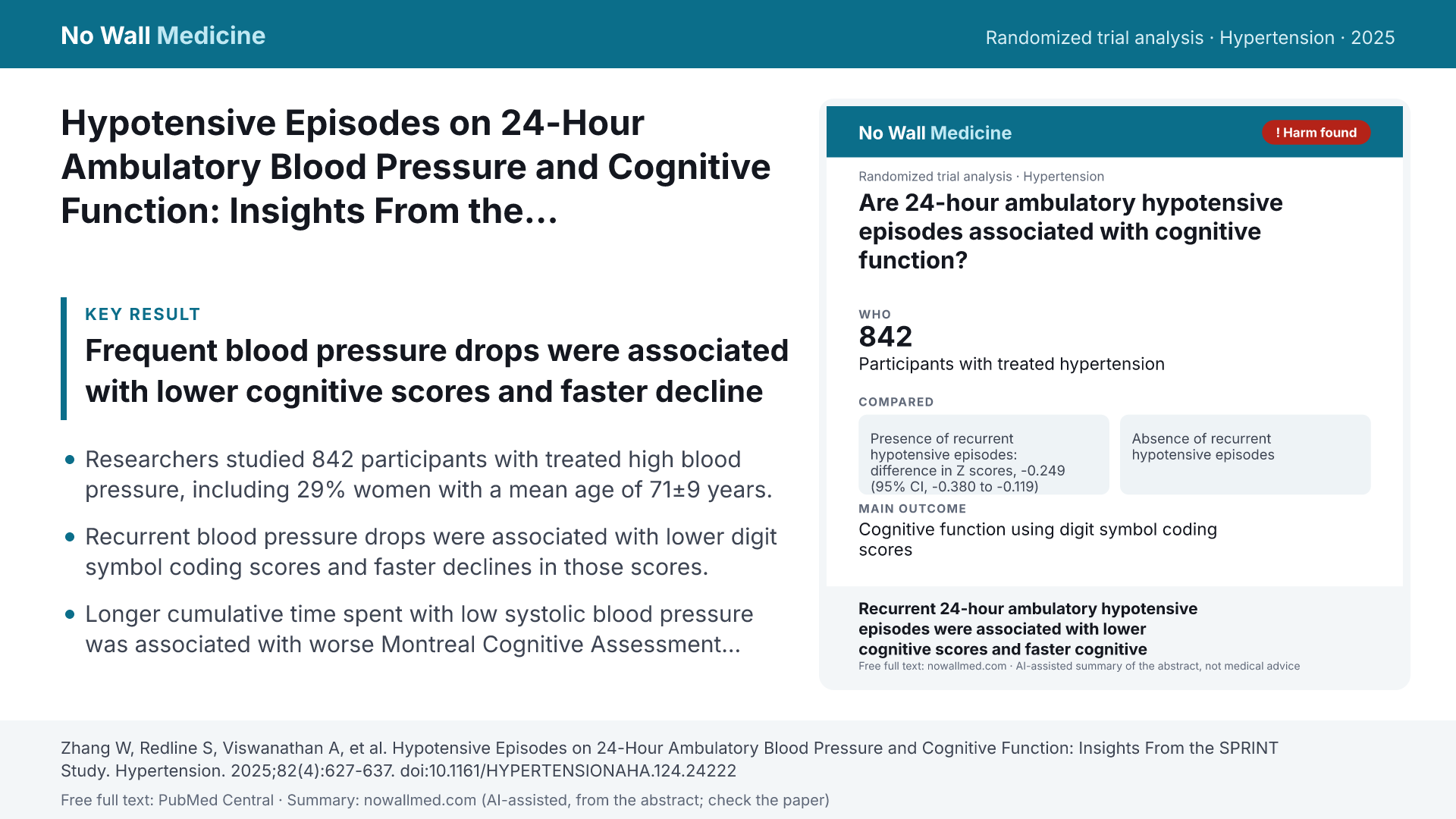
Frequent blood pressure drops were associated with lower cognitive scores and faster decline
Hypotensive Episodes on 24-Hour Ambulatory Blood Pressure and Cognitive Function: Insights From the SPRINT Study
Randomized trial analysisHarm found
Are 24-hour ambulatory hypotensive episodes associated with cognitive function?
Who
842
Participants with treated hypertension
Compared
Presence of recurrent hypotensive episodes: difference in Z scores, -0.249 (95% CI, -0.380 to -0.119)
Absence of recurrent hypotensive episodes
Main outcome
Cognitive function using digit symbol coding scores
Result: difference in Z scores, -0.249 (95% CI, -0.380 to -0.119)
Bottom line: Recurrent 24-hour ambulatory hypotensive episodes were associated with lower cognitive scores and faster cognitive decline.
Hypertension · 2025-01-22 · Save PNG
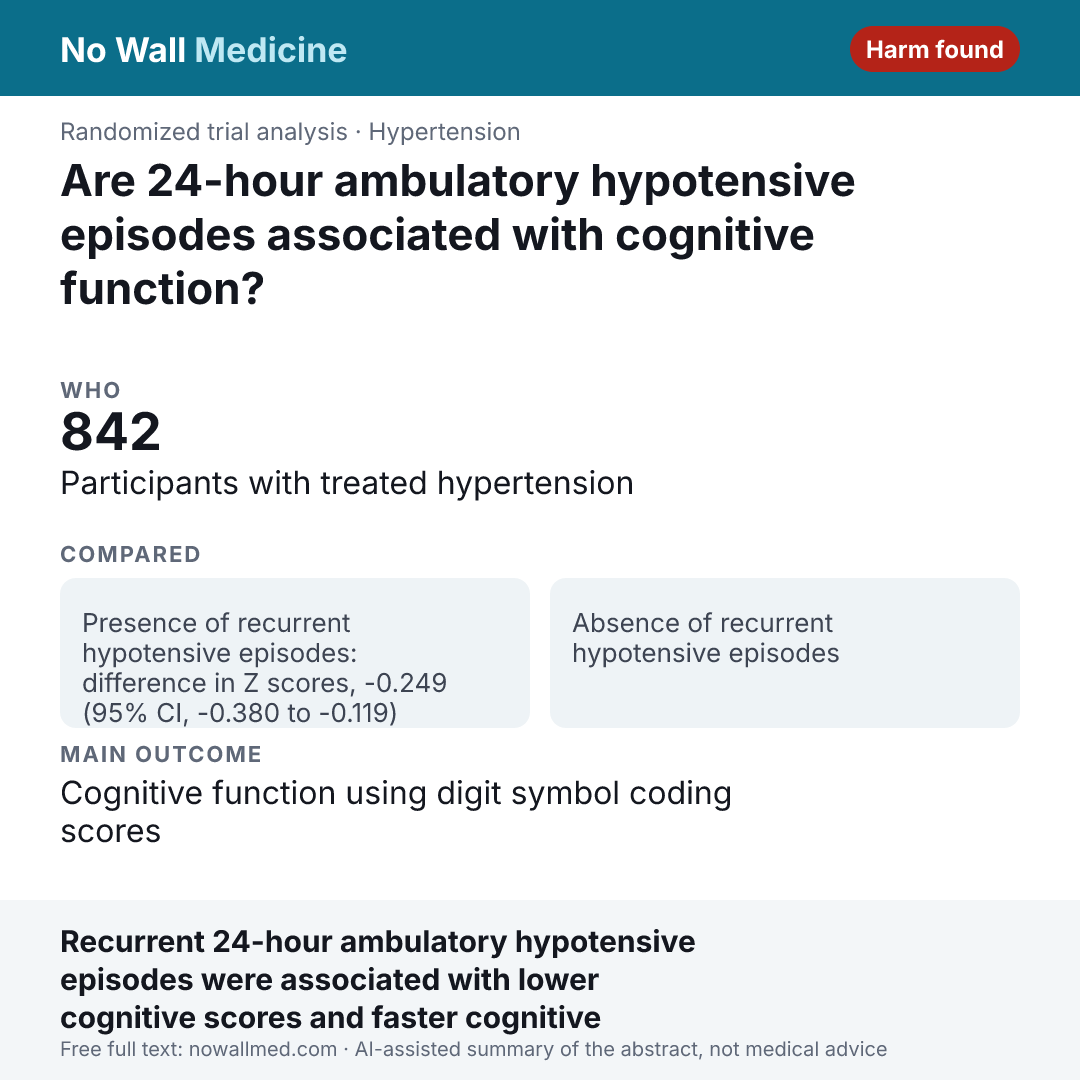
Clinical question: Are 24-hour ambulatory hypotensive episodes associated with cognitive function?
Key points
- Researchers studied 842 participants with treated high blood pressure, including 29% women with a mean age of 71±9 years.
- Recurrent blood pressure drops were associated with lower digit symbol coding scores and faster declines in those scores.
- Longer cumulative time spent with low systolic blood pressure was associated with worse Montreal Cognitive Assessment and digit symbol coding scores.
Headline and key points written with AI from the paper’s abstract, with every number checked against it. Read the paper before relying on them.
Was this summary helpful?
Subject terms
Headline, design, result, key points, caveat and citation as plain text.
Cite this article
Zhang W, Redline S, Viswanathan A, et al. Hypotensive Episodes on 24-Hour Ambulatory Blood Pressure and Cognitive Function: Insights From the SPRINT Study. Hypertension. 2025;82(4):627-637. doi:10.1161/HYPERTENSIONAHA.124.24222
Spotted a mistake? Suggest a correction