Hypothermia for moderate or severe neonatal encephalopathy in low-income and middle-income countries (HELIX): a randomised controlled trial in India, Sri Lanka, and Bangladesh
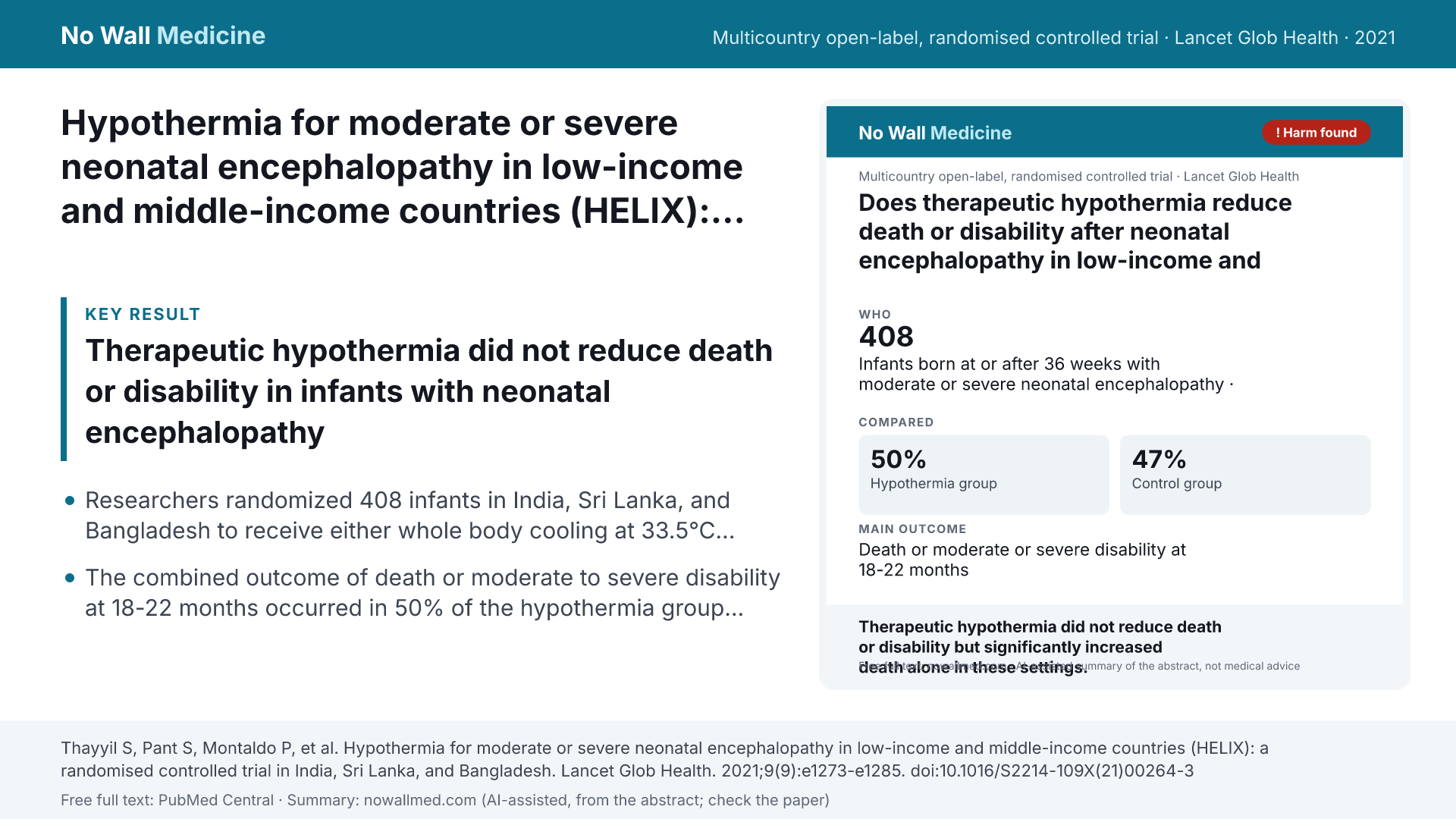
Key result: Therapeutic hypothermia did not reduce death or disability in infants with neonatal encephalopathy
Multicountry open-label, randomised controlled trialHarm found
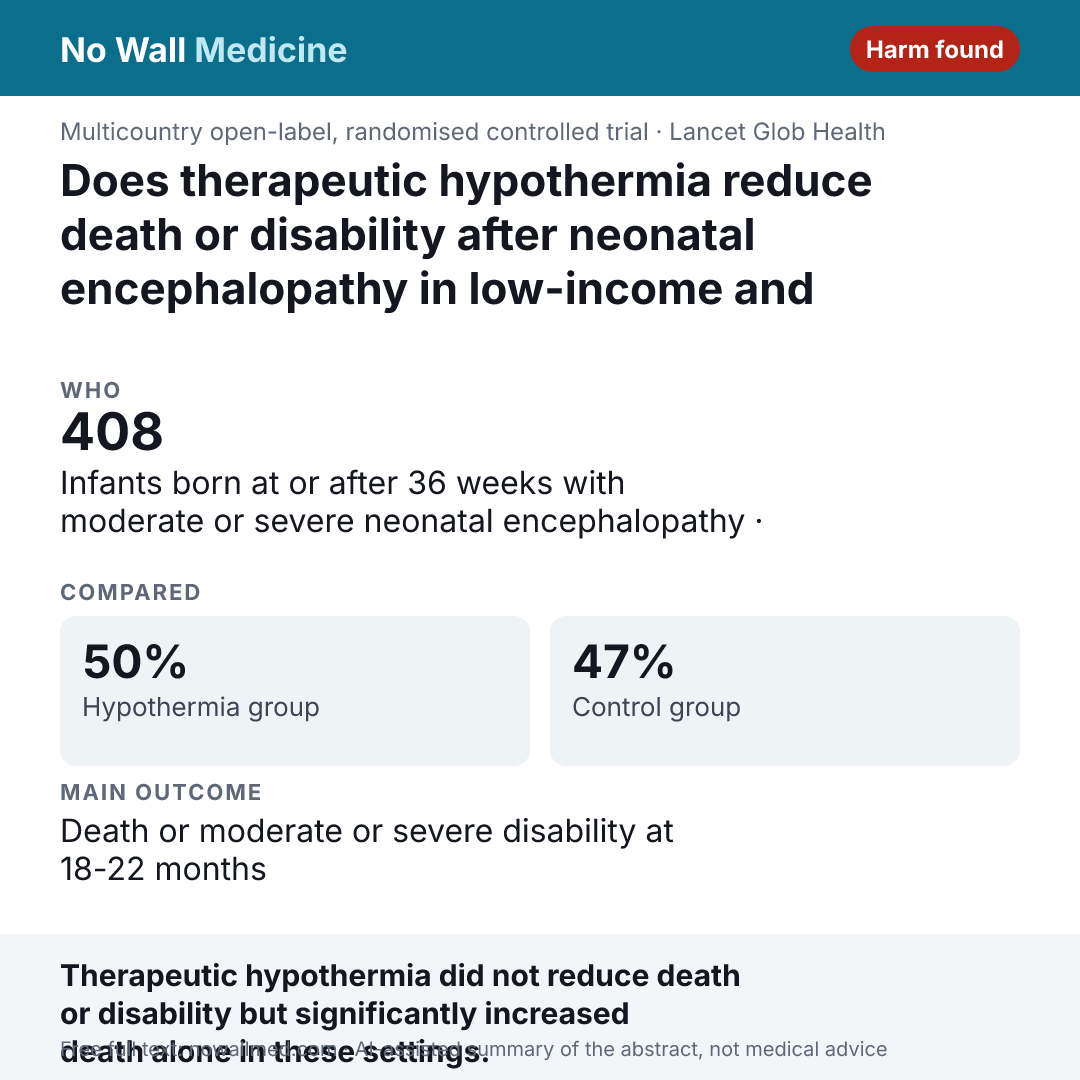
Does therapeutic hypothermia reduce death or disability after neonatal encephalopathy in low-income and middle-income countries?
Who
408
Infants born at or after 36 weeks with moderate or severe neonatal encephalopathy · Seven tertiary neonatal intensive care units in India, Sri Lanka, and Bangladesh
Compared
50%Hypothermia group
47%Control group
Main outcome
Death or moderate or severe disability at 18-22 months
Result: risk ratio 1·06 (95% CI 0·87-1·30)
Bottom line: Therapeutic hypothermia did not reduce death or disability but significantly increased death alone in these settings.
Funded by: National Institute for Health Research, Garfield Weston Foundation, and Bill & Melinda Gates Foundation
Lancet Glob Health · 2021-08-03 · Save PNG
Key points
- Researchers randomized 408 infants in India, Sri Lanka, and Bangladesh to receive either whole body cooling at 33.5°C for 72 hours or usual care.
- The combined outcome of death or moderate to severe disability at 18-22 months occurred in 50% of the hypothermia group and 47% of the control group.
- Death alone occurred in 42% of the hypothermia group compared to 31% in the control group.
Discussion prompts
- Would these patients look like yours? Who was left out?
- Is the main outcome one that matters to patients?
- Is the difference large enough to change what you do?
Cite: Thayyil S, Pant S, Montaldo P, et al. Hypothermia for moderate or severe neonatal encephalopathy in low-income and middle-income countries (HELIX): a randomised controlled trial in India, Sri Lanka, and Bangladesh. Lancet Glob Health. 2021;9(9):e1273-e1285. doi:10.1016/S2214-109X(21)00264-3
Free full text: PubMed Central · Summary and visual abstract: nowallmed.com/a/hypothermia-for-moderate-or-severe-neonatal-encephalopathy-in-low-1gbf732/ (AI-assisted from the abstract; check the paper before relying on it).