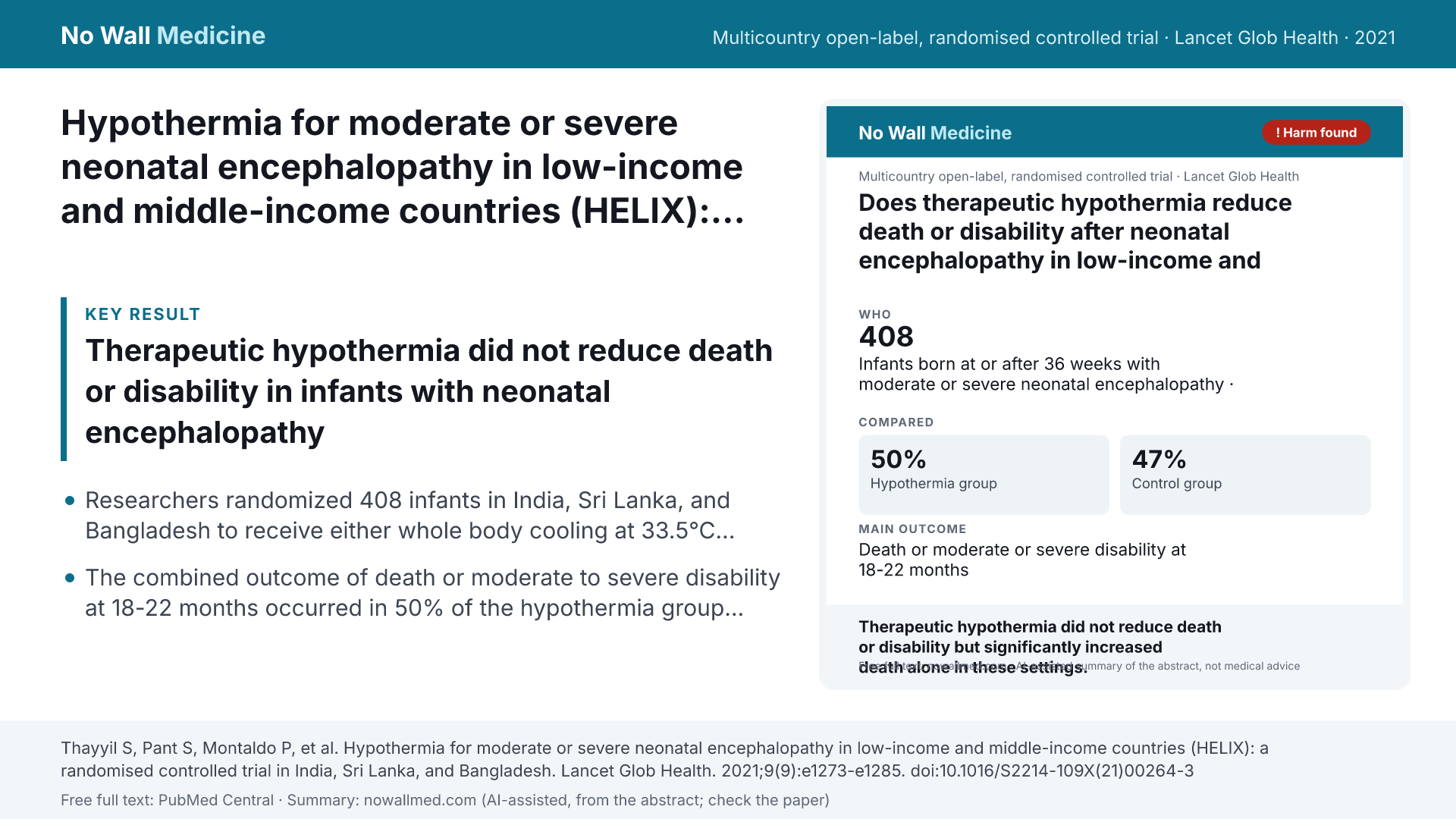
Therapeutic hypothermia did not reduce death or disability in infants with neonatal encephalopathy
Hypothermia for moderate or severe neonatal encephalopathy in low-income and middle-income countries (HELIX): a randomised controlled trial in India, Sri Lanka, and Bangladesh
Multicountry open-label, randomised controlled trialHarm found
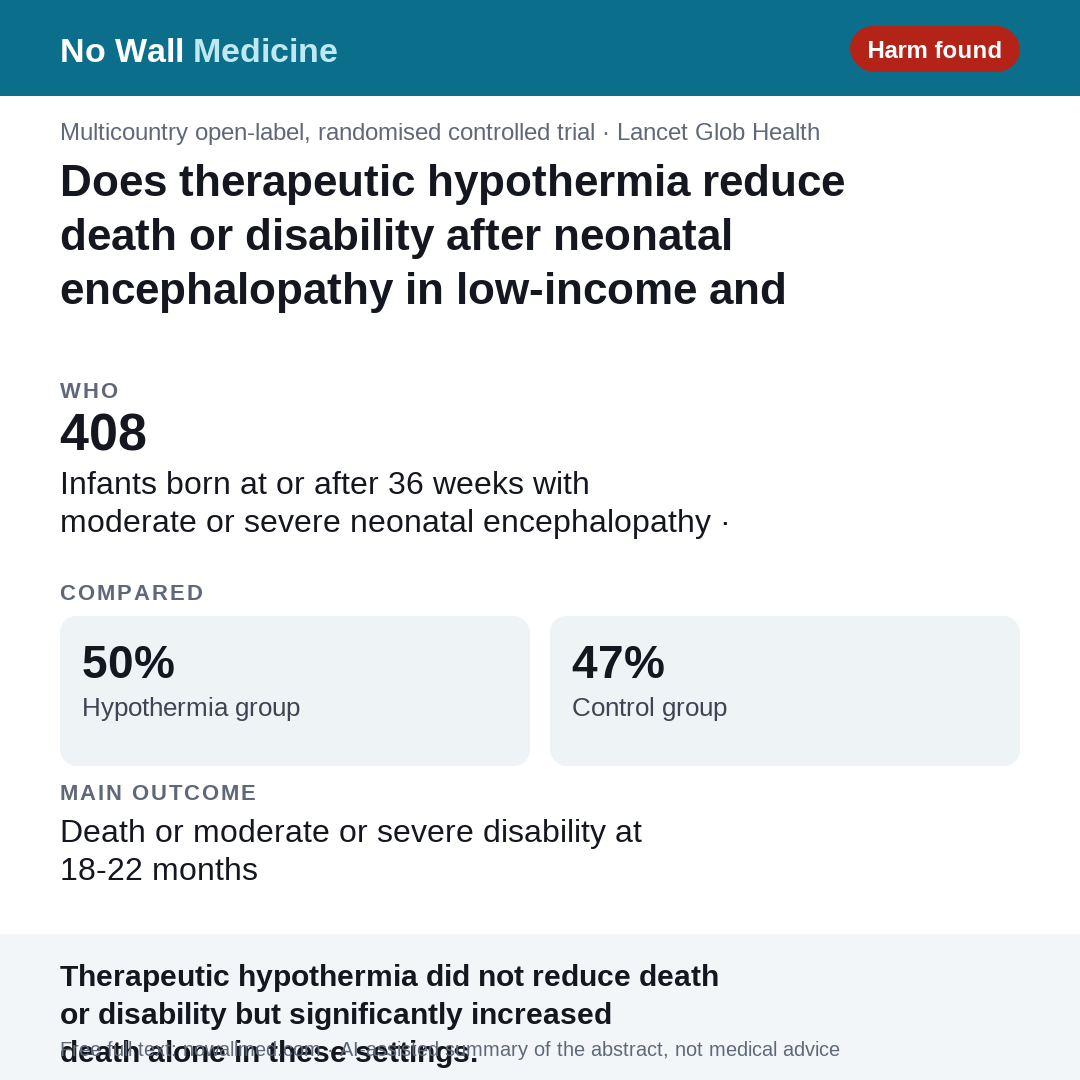
Does therapeutic hypothermia reduce death or disability after neonatal encephalopathy in low-income and middle-income countries?
Who
408
Infants born at or after 36 weeks with moderate or severe neonatal encephalopathy · Seven tertiary neonatal intensive care units in India, Sri Lanka, and Bangladesh
Compared
50%Hypothermia group
47%Control group
Main outcome
Death or moderate or severe disability at 18-22 months
Result: risk ratio 1·06 (95% CI 0·87-1·30)
Bottom line: Therapeutic hypothermia did not reduce death or disability but significantly increased death alone in these settings.
Funded by: National Institute for Health Research, Garfield Weston Foundation, and Bill & Melinda Gates Foundation
Lancet Glob Health · 2021-08-03Download image
Clinical question: Does therapeutic hypothermia reduce death or disability after neonatal encephalopathy in low-income and middle-income countries?
Why it matters: It is unknown if therapeutic hypothermia is safe and effective for treating neonatal encephalopathy, a type of brain dysfunction in newborns, in low-income and middle-income countries.
Key points
- Researchers randomized 408 infants in India, Sri Lanka, and Bangladesh to receive either whole body cooling at 33.5°C for 72 hours or usual care.
- The combined outcome of death or moderate to severe disability at 18-22 months occurred in 50% of the hypothermia group and 47% of the control group.
- Death alone occurred in 42% of the hypothermia group compared to 31% in the control group.
Headline and key points written with AI from the paper’s abstract, with every number checked against it. Read the paper before relying on them.
Was this summary helpful?
Abstract
Background
Although therapeutic hypothermia reduces death or disability after neonatal encephalopathy in high-income countries, its safety and efficacy in low-income and middle-income countries is unclear. We aimed to examine whether therapeutic hypothermia alongside optimal supportive intensive care reduces death or moderate or severe disability after neonatal encephalopathy in south Asia. Methods
We did a multicountry open-label, randomised controlled trial in seven tertiary neonatal intensive care units in India, Sri Lanka, and Bangladesh. We enrolled infants born at or after 36 weeks of gestation with moderate or severe neonatal encephalopathy and a need for continued resuscitation at 5 min of age or an Apgar score of less than 6 at 5 min of age (for babies born in a hospital), or both, or an absence of crying by 5 min of age (for babies born at home). Using a web-based randomisation system, we allocated infants into a group receiving whole body hypothermia (33·5°C) for 72 h using a servo-controlled cooling device, or to usual care (control group), within 6 h of birth. All recruiting sites had facilities for invasive ventilation, cardiovascular support, and access to 3 Tesla MRI scanners and spectroscopy. Masking of the intervention was not possible, but those involved in the magnetic resonance biomarker analysis and neurodevelopmental outcome assessments were masked to the allocation. The primary outcome was a combined endpoint of death or moderate or severe disability at 18-22 months, assessed by the Bayley Scales of Infant and Toddler Development (third edition) and a detailed neurological examination. Analysis was by intention to treat. This trial is registered with ClinicalTrials.gov, NCT02387385. Findings
We screened 2296 infants between Aug 15, 2015, and Feb 15, 2019, of whom 576 infants were eligible for inclusion. After exclusions, we recruited 408 eligible infants and we assigned 202 to the hypothermia group and 206 to the control group. Primary outcome data were available for 195 (97%) of the 202 infants in the hypothermia group and 199 (97%) of the 206 control group infants. 98 (50%) infants in the hypothermia group and 94 (47%) infants in the control group died or had a moderate or severe disability (risk ratio 1·06; 95% CI 0·87-1·30; p=0·55). 84 infants (42%) in the hypothermia group and 63 (31%; p=0·022) infants in the control group died, of whom 72 (36%) and 49 (24%; p=0·0087) died during neonatal hospitalisation. Five serious adverse events were reported: three in the hypothermia group (one hospital readmission relating to pneumonia, one septic arthritis, and one suspected venous thrombosis), and two in the control group (one related to desaturations during MRI and other because of endotracheal tube displacement during transport for MRI). No adverse events were considered causally related to the study intervention. Interpretation
Therapeutic hypothermia did not reduce the combined outcome of death or disability at 18 months after neonatal encephalopathy in low-income and middle-income countries, but significantly increased death alone. Therapeutic hypothermia should not be offered as treatment for neonatal encephalopathy in low-income and middle-income countries, even when tertiary neonatal intensive care facilities are available. Funding
National Institute for Health Research, Garfield Weston Foundation, and Bill & Melinda Gates Foundation. Translations
For the Hindi, Malayalam, Telugu, Kannada, Singhalese, Tamil, Marathi and Bangla translations of the abstract see Supplementary Materials section.
Abstract reproduced under the article’s CC BY licence.
Subject terms
Cite this article
Thayyil S, Pant S, Montaldo P, et al. Hypothermia for moderate or severe neonatal encephalopathy in low-income and middle-income countries (HELIX): a randomised controlled trial in India, Sri Lanka, and Bangladesh. Lancet Glob Health. 2021. doi:10.1016/S2214-109X(21)00264-3
Spotted a mistake? Suggest a correction