Identification of phenotypes in paediatric patients with acute respiratory distress syndrome: a latent class analysis
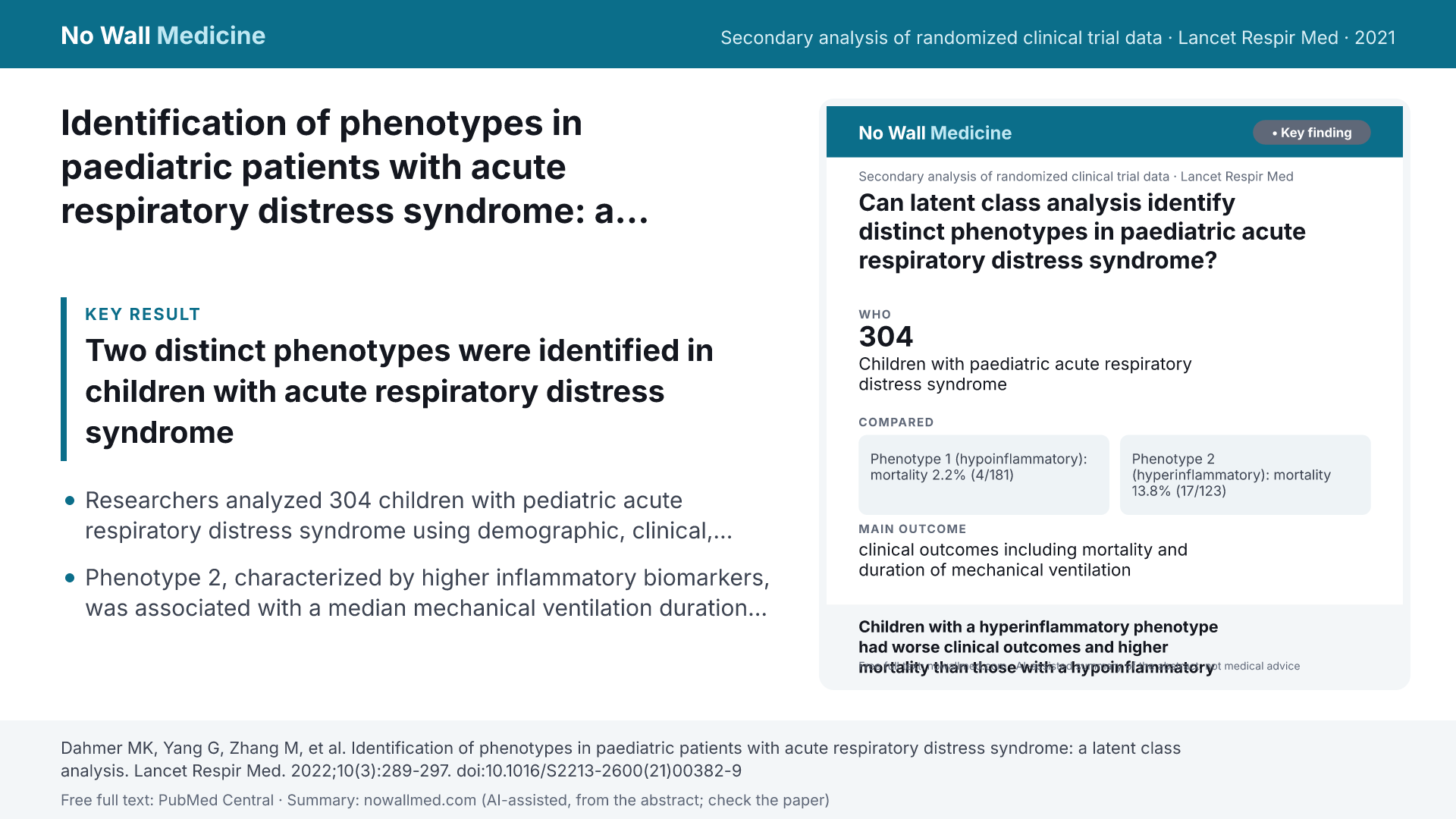
Key result: Two distinct phenotypes were identified in children with acute respiratory distress syndrome
Secondary analysis of randomized clinical trial dataKey finding
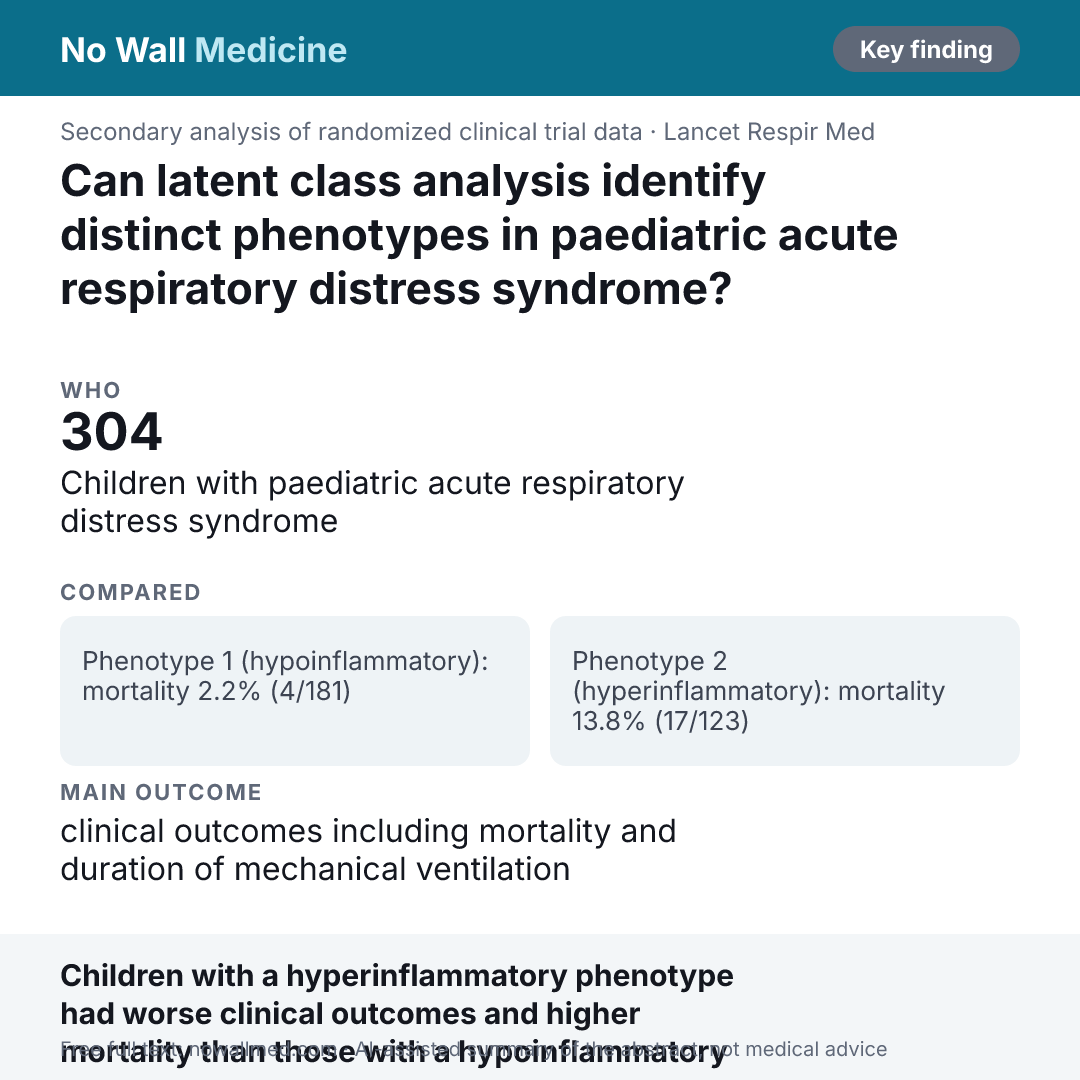
Can latent class analysis identify distinct phenotypes in paediatric acute respiratory distress syndrome?
Who
304
Children with paediatric acute respiratory distress syndrome
Compared
Phenotype 1 (hypoinflammatory): mortality 2.2% (4/181)
Phenotype 2 (hyperinflammatory): mortality 13.8% (17/123)
Main outcome
clinical outcomes including mortality and duration of mechanical ventilation
Result: median 10.0 days [IQR 6.3-21.0] vs 6.6 days [4.1-10.8]
Bottom line: Children with a hyperinflammatory phenotype had worse clinical outcomes and higher mortality than those with a hypoinflammatory phenotype.
Funded by: US National Institutes of Health
Lancet Respir Med · 2021-12-06 · Save PNG
Key points
- Researchers analyzed 304 children with pediatric acute respiratory distress syndrome using demographic, clinical, and plasma biomarker data.
- Phenotype 2, characterized by higher inflammatory biomarkers, was associated with a median mechanical ventilation duration of 10.0 days compared to 6.6 days for phenotype 1.
- The hyperinflammatory phenotype 2 was associated with a 13.8% mortality rate compared to 2.2% in the hypoinflammatory phenotype 1.
Discussion prompts
- Would these patients look like yours? Who was left out?
- Is the main outcome one that matters to patients?
- Is the difference large enough to change what you do?
Cite: Dahmer MK, Yang G, Zhang M, et al. Identification of phenotypes in paediatric patients with acute respiratory distress syndrome: a latent class analysis. Lancet Respir Med. 2022;10(3):289-297. doi:10.1016/S2213-2600(21)00382-9
Free full text: PubMed Central · Summary and visual abstract: nowallmed.com/a/identification-of-phenotypes-in-paediatric-patients-with-acute-13s1ru/ (AI-assisted from the abstract; check the paper before relying on it).