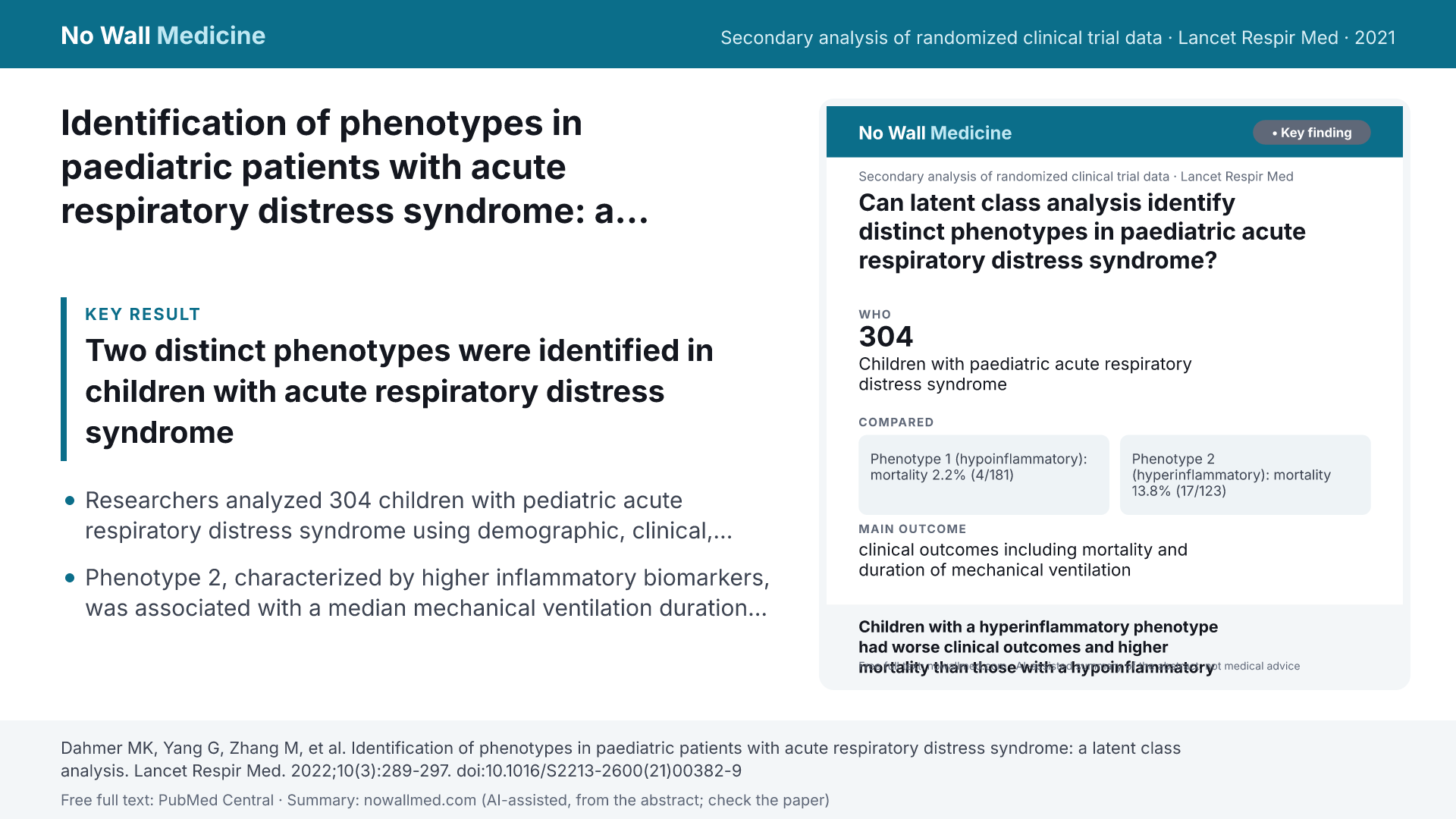
Two distinct phenotypes were identified in children with acute respiratory distress syndrome
Identification of phenotypes in paediatric patients with acute respiratory distress syndrome: a latent class analysis
Secondary analysis of randomized clinical trial dataHarm found
Can latent class analysis identify distinct phenotypes in paediatric acute respiratory distress syndrome?
Who
304
Children with paediatric acute respiratory distress syndrome
Compared
Phenotype 1 (hypoinflammatory): mortality 2.2% (4/181)
Phenotype 2 (hyperinflammatory): mortality 13.8% (17/123)
Main outcome
clinical outcomes including mortality and duration of mechanical ventilation
Result: median 10.0 days [IQR 6.3-21.0] vs 6.6 days [4.1-10.8]
Bottom line: Children with a hyperinflammatory phenotype had worse clinical outcomes and higher mortality than those with a hypoinflammatory phenotype.
Funded by: US National Institutes of Health
Lancet Respir Med · 2021-12-06Download image
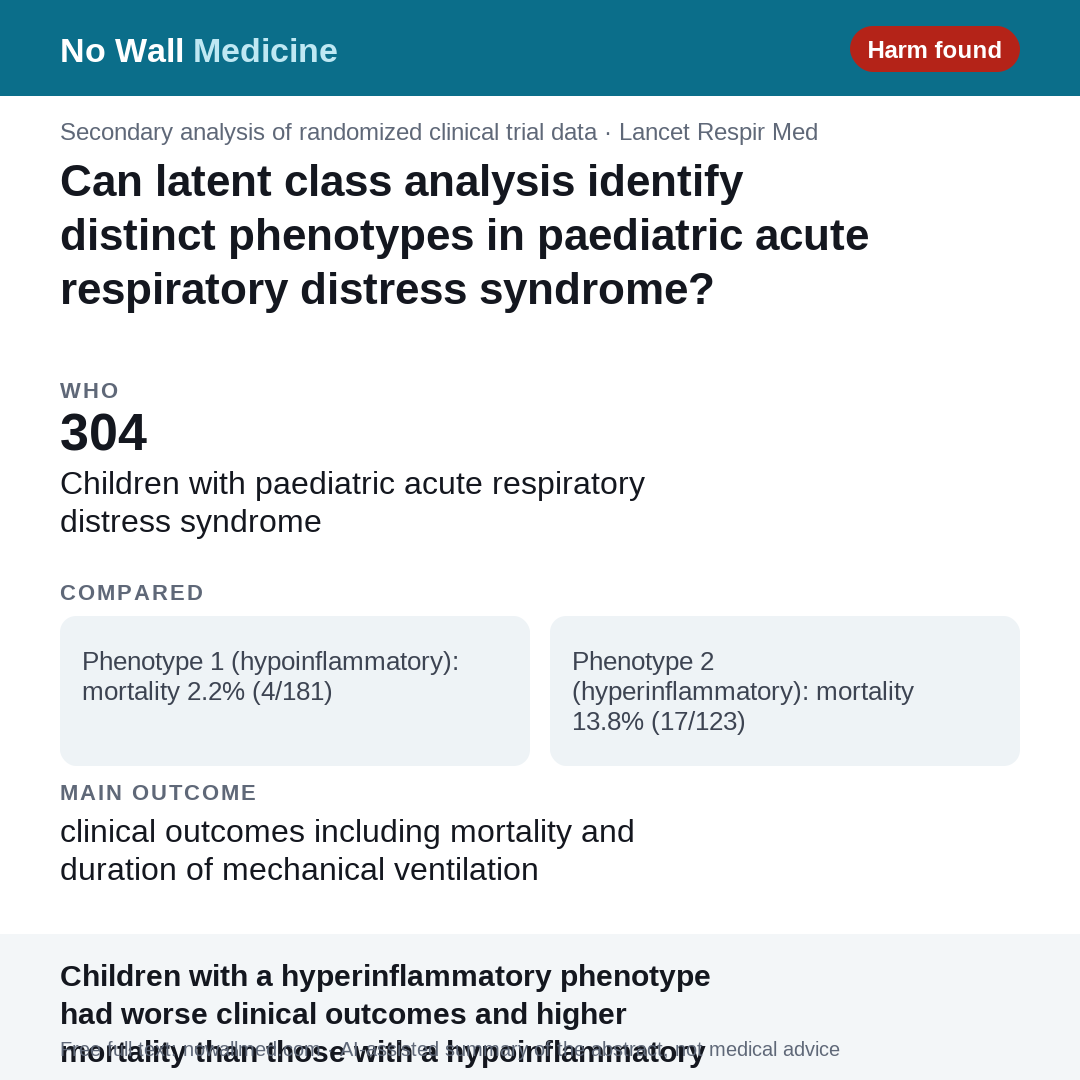
Clinical question: Can latent class analysis identify distinct phenotypes in paediatric acute respiratory distress syndrome?
Why it matters: It was unknown if children with acute respiratory distress syndrome exhibit similar inflammatory phenotypes to adults and how these phenotypes relate to clinical outcomes.
Key points
- Researchers analyzed 304 children with pediatric acute respiratory distress syndrome using demographic, clinical, and plasma biomarker data.
- Phenotype 2, characterized by higher inflammatory biomarkers, was associated with a median mechanical ventilation duration of 10.0 days compared to 6.6 days for phenotype 1.
- The hyperinflammatory phenotype 2 was associated with a 13.8% mortality rate compared to 2.2% in the hypoinflammatory phenotype 1.
Headline and key points written with AI from the paper’s abstract, with every number checked against it. Read the paper before relying on them.
Was this summary helpful?
Subject terms
Cite this article
Dahmer MK, Yang G, Zhang M, et al. Identification of phenotypes in paediatric patients with acute respiratory distress syndrome: a latent class analysis. Lancet Respir Med. 2021. doi:10.1016/S2213-2600(21)00382-9
Spotted a mistake? Suggest a correction