Airway occlusion pressure may underestimate respiratory effort in children with high airway resistance
Phenotypes based on respiratory drive and effort to identify the risk factors when P0.1 fails to estimate ∆PES in ventilated children
Secondary analysis of a randomized controlled trialMixed results
What factors are associated with P0.1 failing to estimate esophageal pressure changes?
Who
222
Children and young adults with pediatric acute respiratory distress syndrome
Compared
536Aligned phenotypes (77%)
119High underestimated effort (12%)
37Overestimated effort (4%)
Main outcome
Mismatch between airway occlusion pressure and esophageal pressure changes
Bottom line: In pediatric acute respiratory distress syndrome, airway occlusion pressure commonly underestimates high respiratory effort.
Crit Care · 2024-10-04Download image
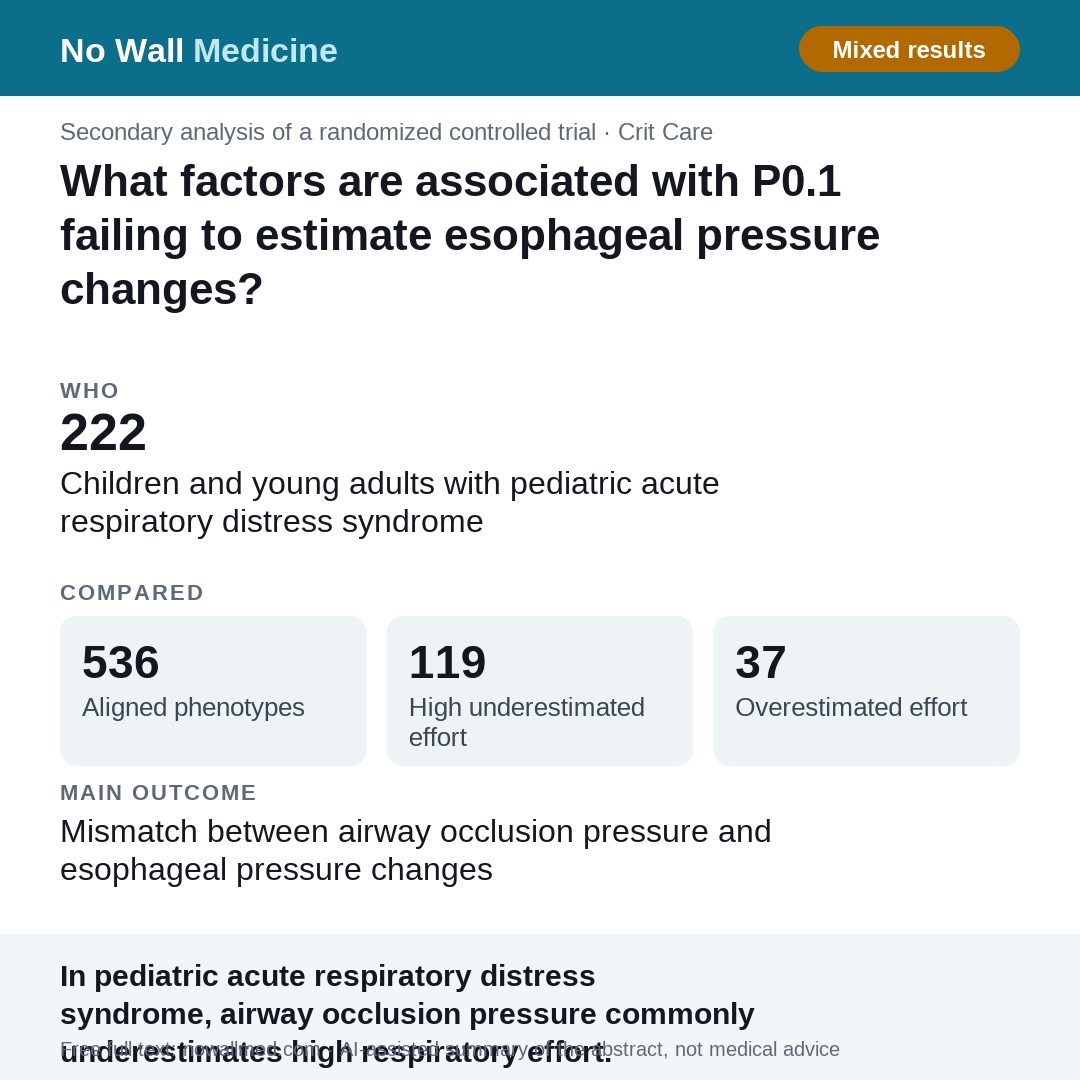
Clinical question: What factors are associated with P0.1 failing to estimate esophageal pressure changes?
Why it matters: It is unknown which clinical factors cause airway occlusion pressure to inaccurately estimate esophageal pressure, the gold standard for measuring respiratory effort.
Key points
- Researchers analyzed 953 patient days from 222 children and young adults with pediatric acute respiratory distress syndrome to compare airway occlusion pressure with esophageal pressure.
- High underestimated effort was associated with higher airway resistance, higher tidal volume, higher opioid use, and lower set ventilator rate in 12% of patient days.
- Overestimated effort occurred in 4% of patient days and was associated with higher alveolar dead space and lower respiratory resistance.
Headline and key points written with AI from the paper’s abstract, with every number checked against it. Read the paper before relying on them.
Was this summary helpful?
Subject terms
Cite this article
Vedrenne-Cloquet M, Ito Y, Hotz J, Klein MJ, Herrera M, Chang D. Phenotypes based on respiratory drive and effort to identify the risk factors when P0.1 fails to estimate ∆PES in ventilated children. Crit Care. 2024. doi:10.1186/s13054-024-05103-x
Spotted a mistake? Suggest a correction
Top studies every Monday
The week’s key trials and guidelines in your specialties, plus any topics you follow. By email, free.
Get the weekly digest