Three distinct recovery patterns identified in patients undergoing surgery for degenerative cervical myelopathy
Identification, validation, and prediction of longitudinal recovery phenotypes in degenerative cervical myelopathy: analysis of prospective cohorts and a randomised controlled trial
Analysis of prospective cohorts and a randomised controlled trialBenefit found
Do joint changes across neurological, functional, and quality-of-life domains define distinct recovery patterns in degenerative cervical myelopathy?
Who
1047
Symptomatic adult patients with degenerative cervical myelopathy undergoing surgical treatment · Clinic-based cohorts
Compared
Trajectory 1: minimal postoperative improvement
Trajectory 2: greatest reductions in neck pain disability
Trajectory 3: global recovery
Main outcome
Changes in neurological, functional, and health-related quality of life
Result: odds ratio 10.90 (95% CI 6.15-19.32) for neurological MCID
Bottom line: Degenerative cervical myelopathy patients follow three distinct multidimensional recovery trajectories not captured by neurological severity alone.
eClinicalMedicine · 2026-08-22Download image
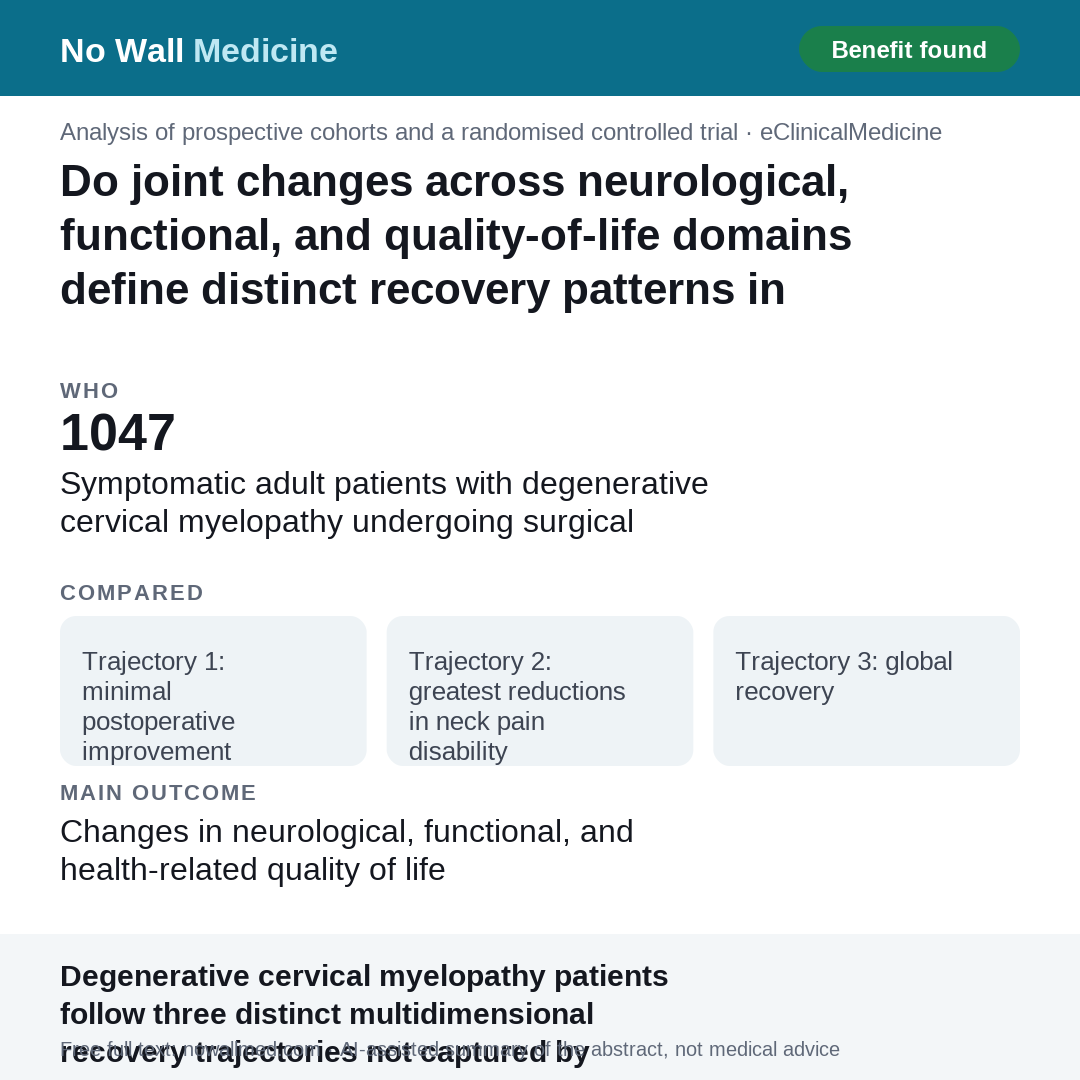
Clinical question: Do joint changes across neurological, functional, and quality-of-life domains define distinct recovery patterns in degenerative cervical myelopathy?
Why it matters: Traditional views characterize symptom evolution in degenerative cervical myelopathy by neurological deficit severity alone, rather than considering functional and quality-of-life changes.
Key points
- Researchers analyzed 1047 adult patients with degenerative cervical myelopathy who underwent surgical treatment and completed at least three assessments.
- The study identified three groups: 17% had minimal improvement, 50% showed the greatest reduction in neck pain disability, and 33% experienced global recovery.
- Patients in the global recovery group had much higher odds of achieving minimal clinically important differences in neurological function, physical quality of life, and disability.
Headline and key points written with AI from the paper’s abstract, with every number checked against it. Read the paper before relying on them.
Spotted a mistake? Suggest a correction