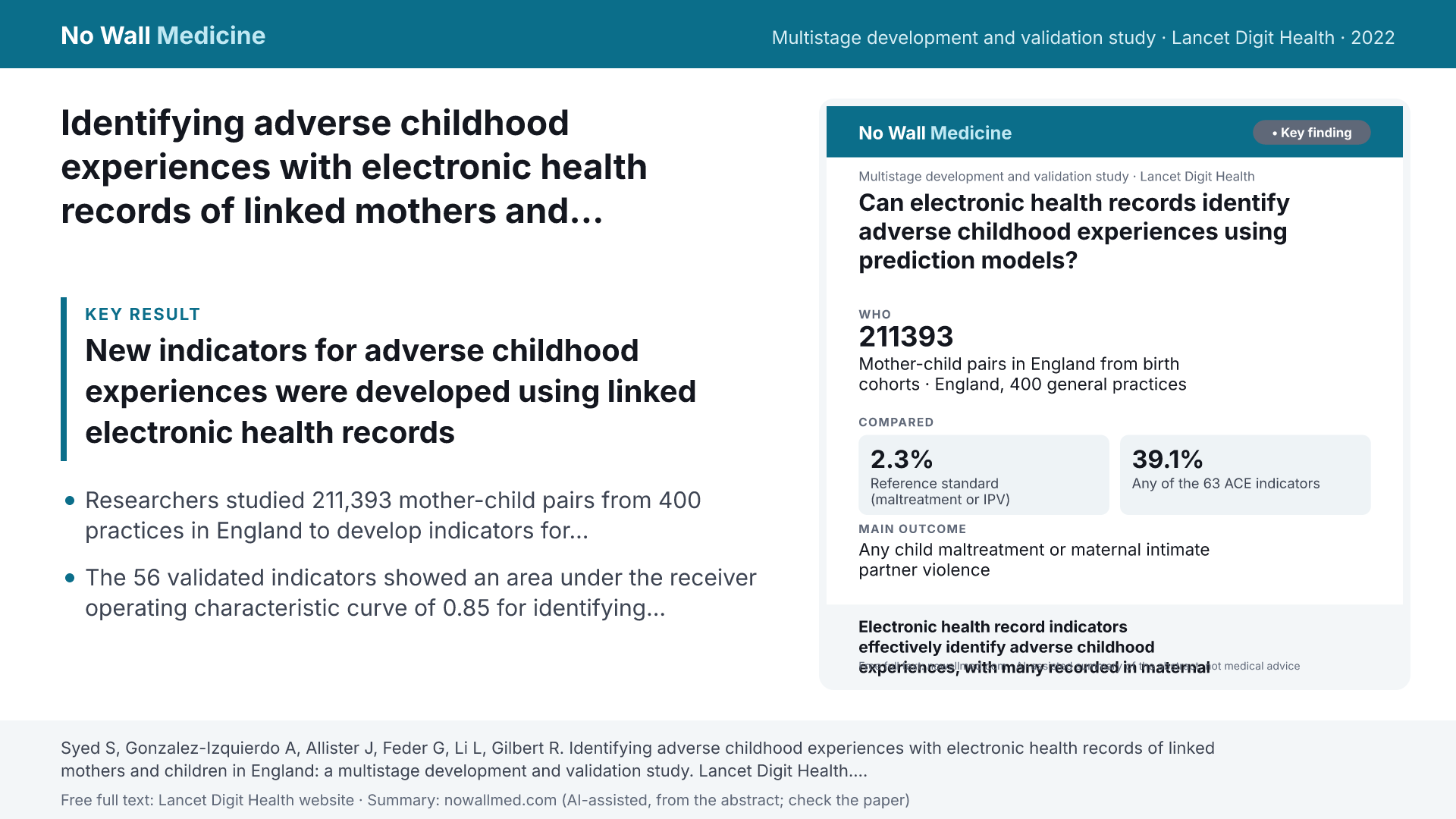
New indicators for adverse childhood experiences were developed using linked electronic health records
Identifying adverse childhood experiences with electronic health records of linked mothers and children in England: a multistage development and validation study
Multistage development and validation studyBenefit found
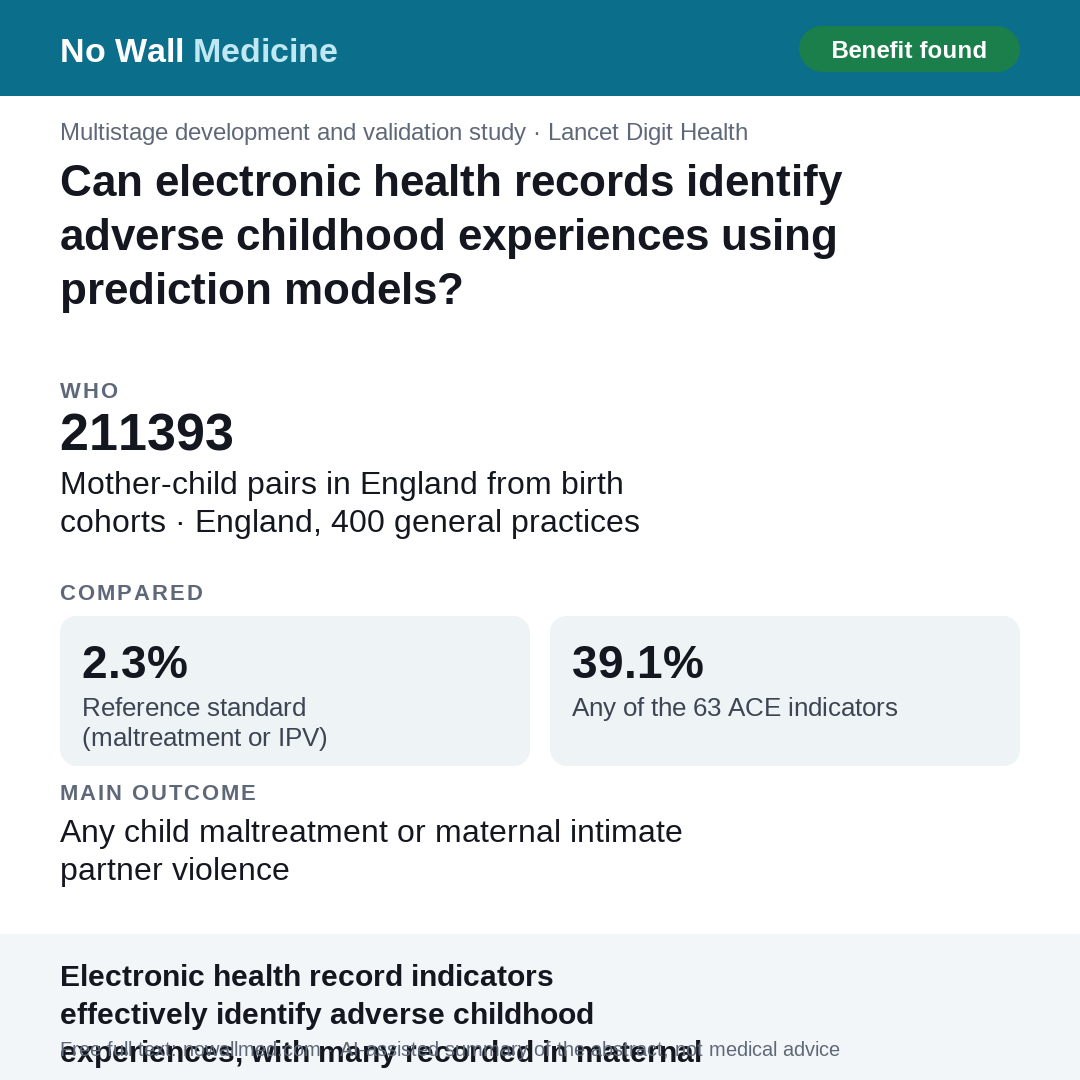
Can electronic health records identify adverse childhood experiences using prediction models?
Who
211393
Mother-child pairs in England from birth cohorts · England, 400 general practices
Compared
2.3%Reference standard (maltreatment or IPV)
39.1%Any of the 63 ACE indicators (95% CI 38.7-39.5)
Main outcome
Any child maltreatment or maternal intimate partner violence
Result: area under the receiver operating characteristic curve 0.85 (95% CI 0.84-0.86)
Bottom line: Electronic health record indicators effectively identify adverse childhood experiences, with many recorded in maternal primary care records.
Lancet Digit Health · 2022-05-17Download image
Clinical question: Can electronic health records identify adverse childhood experiences using prediction models?
Why it matters: Well developed indicators for identifying adverse childhood experiences within linked electronic health records of mothers and children remain scarce.
Key points
- Researchers studied 211,393 mother-child pairs from 400 practices in England to develop indicators for adverse childhood experiences.
- The 56 validated indicators showed an area under the receiver operating characteristic curve of 0.85 for identifying child maltreatment or maternal intimate partner violence.
- Among the 63 indicators, the period prevalence was 39.1% for any indicator and 2.3% for the reference standard of child maltreatment or maternal intimate partner violence.
Headline and key points written with AI from the paper’s abstract, with every number checked against it. Read the paper before relying on them.
Was this summary helpful?
Abstract
Background
Electronic health records (EHRs) of mothers and children provide an opportunity to identify adverse childhood experiences (ACEs) during crucial periods of childhood development, yet well developed indicators of ACEs remain scarce. We aimed to develop clinically relevant indicators of ACEs for linked EHRs of mothers and children using a multistage prediction model of child maltreatment and maternal intimate partner violence (IPV). Methods
In this multistage development and validation study, we developed a representative population-based birth cohort of mothers and children in England, followed from up to 2 years before birth to up to 5 years after birth across the Clinical Practice Research Datalink (CPRD) GOLD (primary care), Hospital Episode Statistics (secondary care), and the Office for National Statistics mortality register. We included livebirths in England between July 1, 2004, and June 30, 2016, to mothers aged 16-55 years, who had registered with a general practitioner (GP) that met CPRD quality standards before 21 weeks of gestation. The primary outcome (reference standard) was any child maltreatment or maternal IPV in either the mother's or child's record from 2 years before birth (maternal IPV only) to 5 years after birth. We used seven prediction models, combined with expert ratings, to systematically develop indicators. We validated the final indicators by integrating results from machine learning models, survival analyses, and clustering analyses in the validation cohort. Findings
We included data collected between July 1, 2002, and June 27, 2018. Of 376 006 eligible births, we included 211 393 mother-child pairs (422 786 patients) from 400 practices, of whom 126 837 mother-child pairs (60·0%; 240 practices) were randomly assigned to a derivation cohort and 84 556 pairs (40·0%; 160 practices) to a validation cohort. We included 63 indicators in six ACE domains: maternal mental health problems, maternal substance misuse, adverse family environments, child maltreatment, maternal IPV, and high-risk presentations of child maltreatment. Excluding the seven indicators in the reference standard, 56 indicators showed high discriminative validity for the reference standard of any child maltreatment or maternal IPV between 2 years before and 5 years after birth (validation cohort, area under the receiver operating characteristic curve 0·85 [95% CI 0·84-0·86]). During the 2 years before birth and 5 years after birth, the overall period prevalence of maternal IPV and child maltreatment (reference standard) was 2·3% (2876 of 126 837 pairs) in the derivation cohort and 2·3% (1916 of 84 556 pairs) in the validation cohort. During the 2 years before and after birth, the period prevalence was 39·1% (95% CI 38·7-39·5; 34 773 pairs) for any of the 63 ACE indicators, 22·2% (21·8-22·5%; 20 122 pairs) for maternal mental health problems, 15·7% (15·4-16·0%; 14 549 pairs) for adverse family environments, 8·1% (7·8-8·3%; 6808 pairs) for high-risk presentations of child maltreatment, 6·9% (6·7-7·2%; 7856 pairs) for maternal substance misuse, and 3·0% (2·9-3·2%; 2540 pairs) for any child maltreatment (2·4% [2·3-5·6%; 2051 pairs]) and maternal IPV (1·0% [0·8-1·0%; 875 pairs]). 62·6% (21 785 of 34 773 pairs) of ACEs were recorded in primary care only, and 72·3% (25 140 cases) were recorded in the maternal record only. Interpretation
We developed clinically relevant indicators for identifying ACEs using the EHRs of mothers and children presenting to general practices and hospital admissions. Over 70% of ACEs were identified via maternal records and were recorded in primary care by GPs within 2 years of birth, reinforcing the importance of reviewing parental and carer records to inform clinical responses to children. ACE indicators can contribute to longitudinal surveillance informing public health policy and resource allocation. Further evaluation is required to determine how ACE indicators can be used in clinical practice. Funding
None.
Abstract reproduced under the article’s CC BY licence.
Subject terms
Cite this article
Syed S, Gonzalez-Izquierdo A, Allister J, Feder G, Li L, Gilbert R. Identifying adverse childhood experiences with electronic health records of linked mothers and children in England: a multistage development and validation study. Lancet Digit Health. 2022. doi:10.1016/S2589-7500(22)00061-9
Spotted a mistake? Suggest a correction