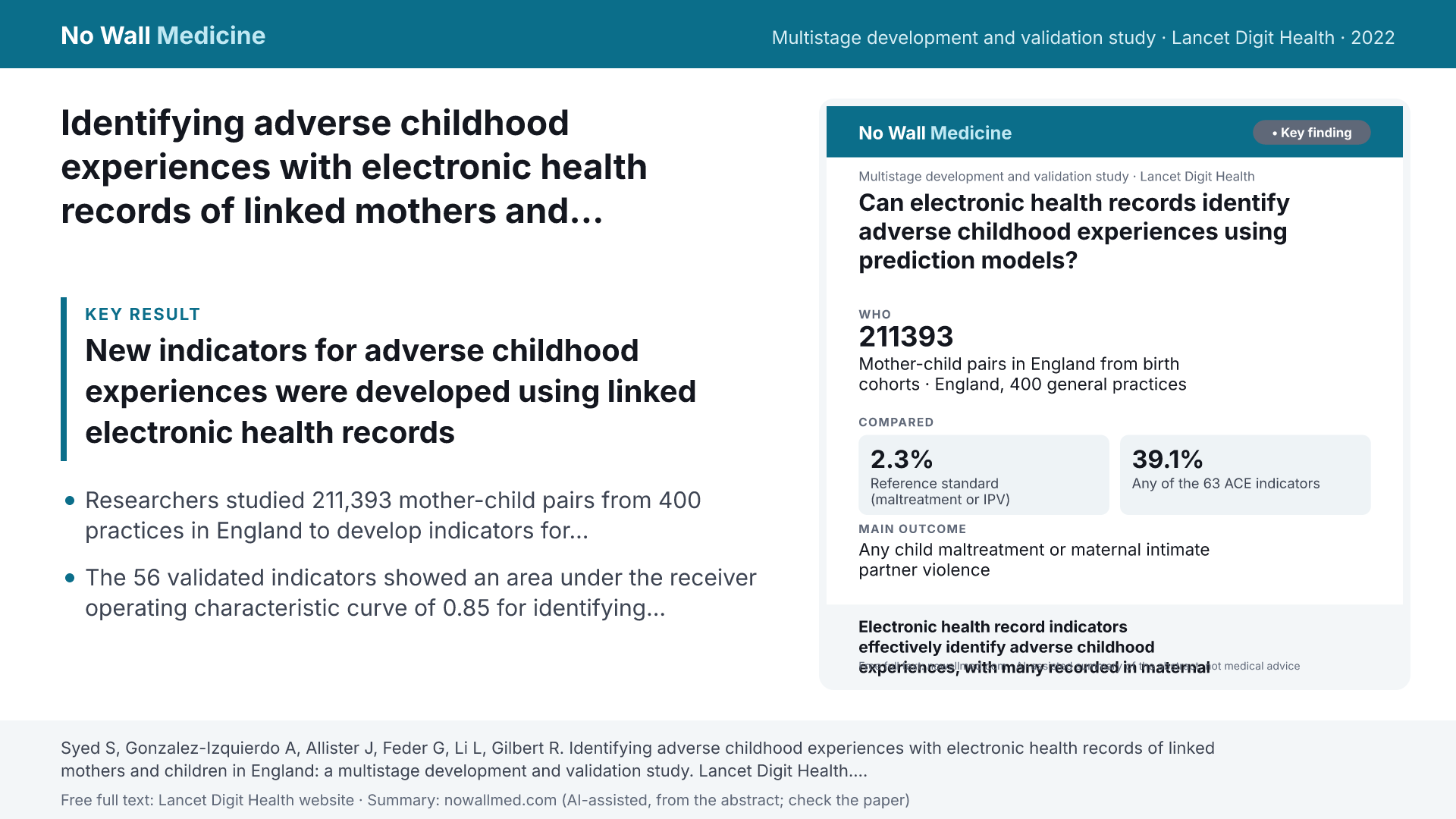
Identifying adverse childhood experiences with electronic health records of linked mothers and children in England: a multistage development and validation study
Key result: New indicators for adverse childhood experiences were developed using linked electronic health records
Key points
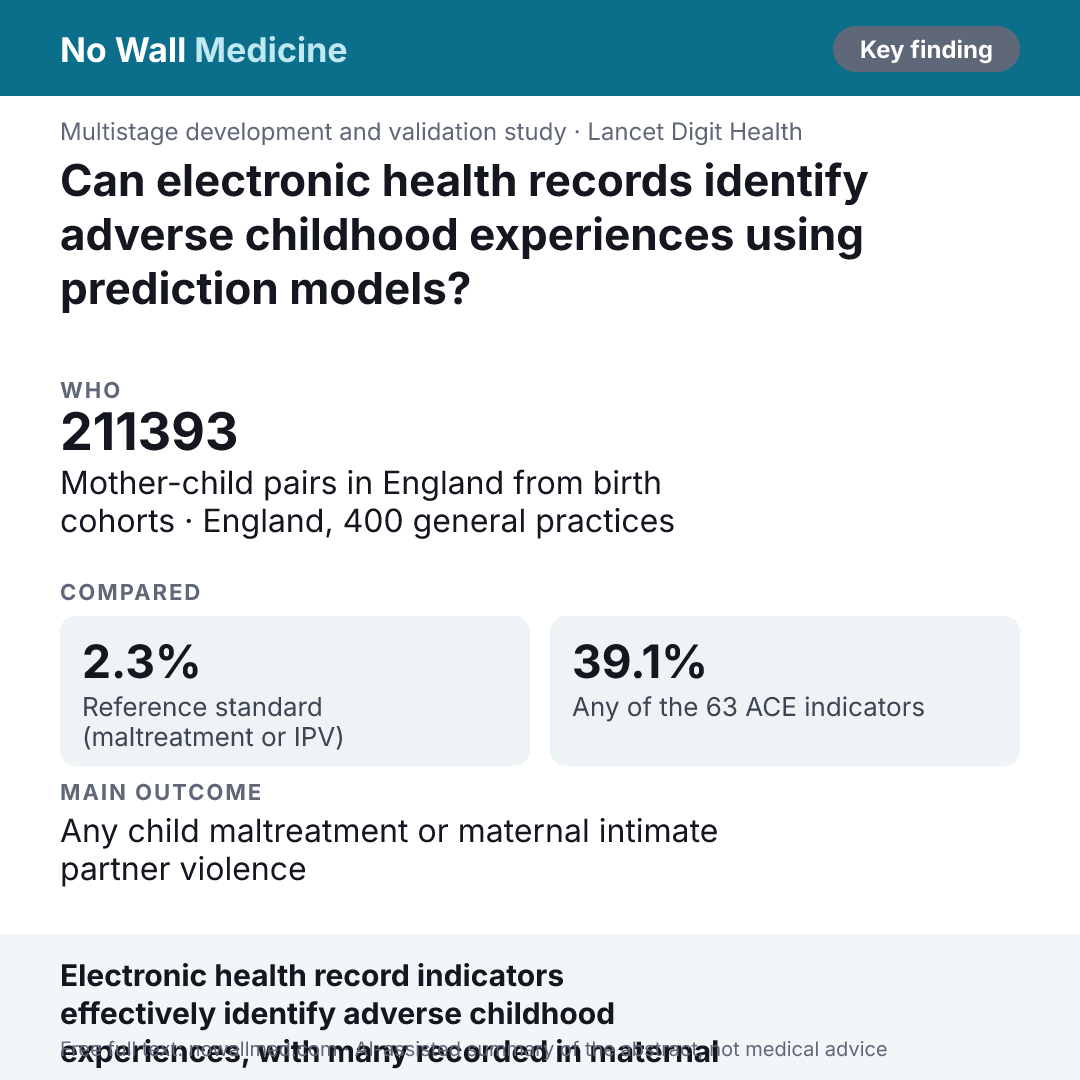
- Researchers studied 211,393 mother-child pairs from 400 practices in England to develop indicators for adverse childhood experiences.
- The 56 validated indicators showed an area under the receiver operating characteristic curve of 0.85 for identifying child maltreatment or maternal intimate partner violence.
- Among the 63 indicators, the period prevalence was 39.1% for any indicator and 2.3% for the reference standard of child maltreatment or maternal intimate partner violence.
Why it matters: Well developed indicators for identifying adverse childhood experiences within linked electronic health records of mothers and children remain scarce.
Discussion prompts
- Would these patients look like yours? Who was left out?
- Is the main outcome one that matters to patients?
- Is the difference large enough to change what you do?
Cite: Syed S, Gonzalez-Izquierdo A, Allister J, Feder G, Li L, Gilbert R. Identifying adverse childhood experiences with electronic health records of linked mothers and children in England: a multistage development and validation study. Lancet Digit Health. 2022;4(7):e482-e496. doi:10.1016/S2589-7500(22)00061-9
Free full text: Lancet Digit Health website · Summary and visual abstract: nowallmed.com/a/identifying-adverse-childhood-experiences-with-electronic-health-1fjy2h7/ (AI-assisted from the abstract; check the paper before relying on it).