Identifying and ranking causal biochemical biomarkers for breast cancer: a Mendelian randomisation study
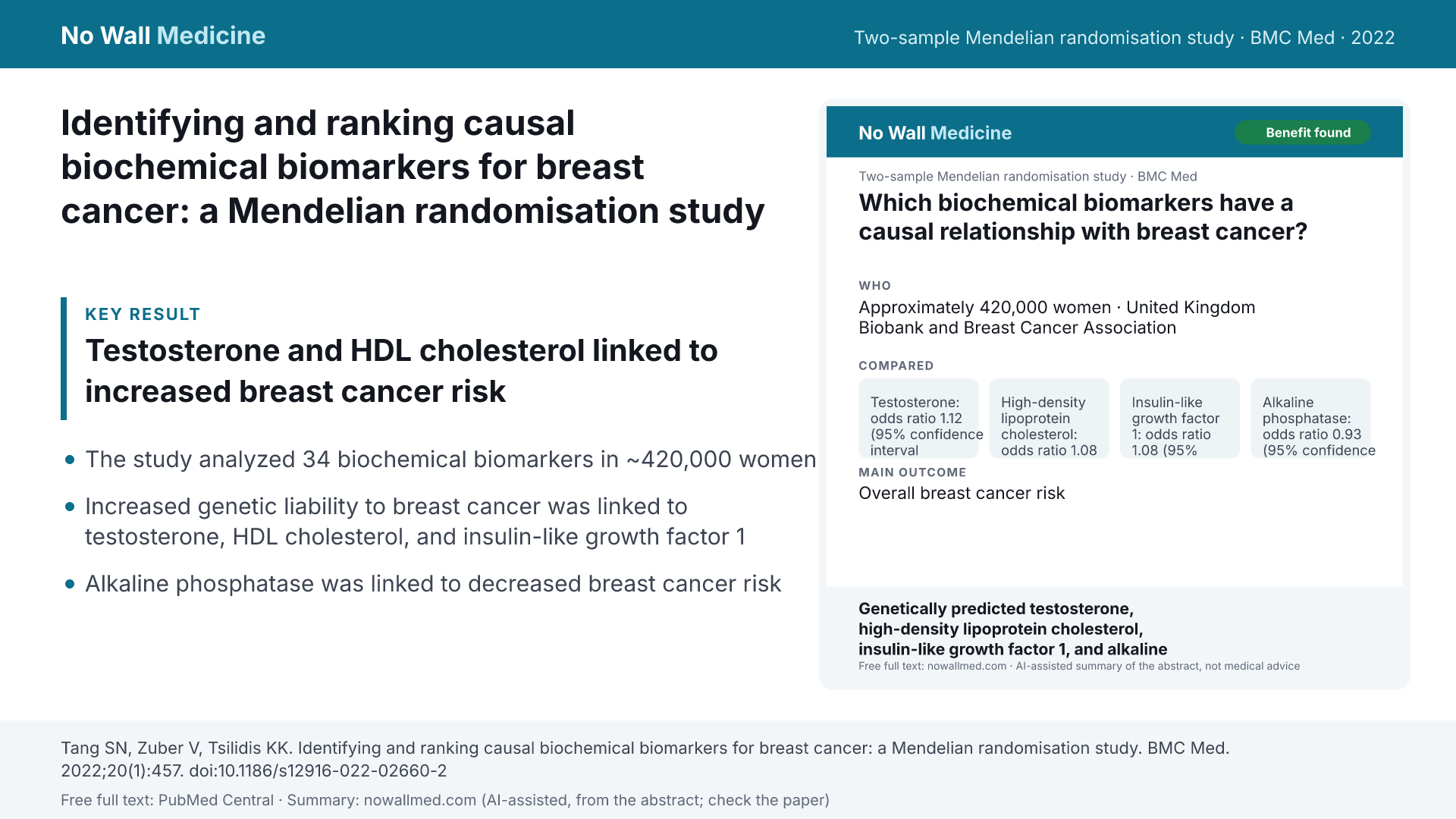
Key result: Testosterone and HDL cholesterol linked to increased breast cancer risk
Two-sample Mendelian randomisation studyBenefit found
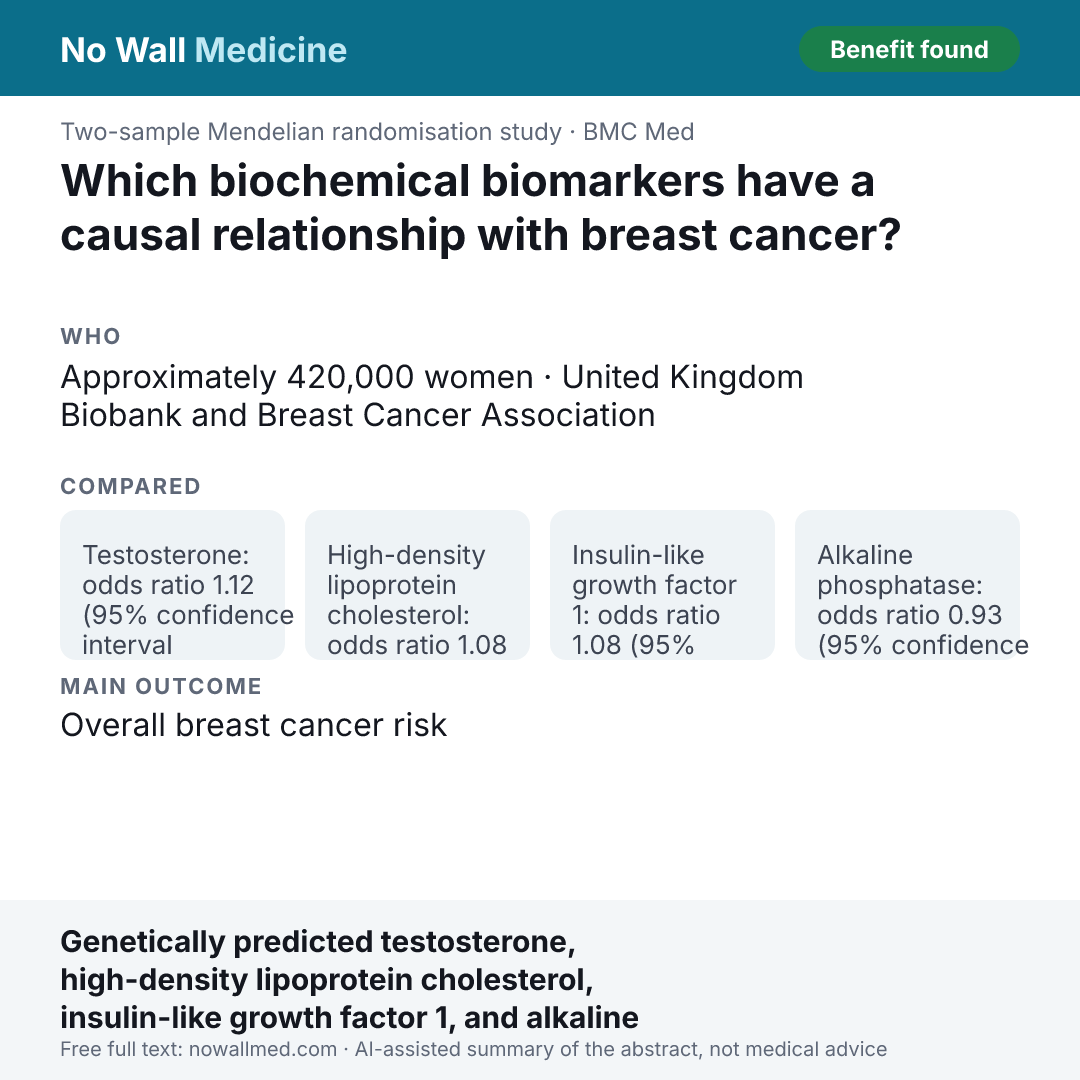
Which biochemical biomarkers have a causal relationship with breast cancer?
Who
Approximately 420,000 women · United Kingdom Biobank and Breast Cancer Association Consortium
Compared
Testosterone: odds ratio 1.12 (95% confidence interval 1.04-1.21)
High-density lipoprotein cholesterol: odds ratio 1.08 (95% confidence interval 1.04-1.13)
Insulin-like growth factor 1: odds ratio 1.08 (95% confidence interval 1.02-1.13)
Alkaline phosphatase: odds ratio 0.93 (95% confidence interval 0.89-0.98)
Main outcome
Overall breast cancer risk
Bottom line: Genetically predicted testosterone, high-density lipoprotein cholesterol, insulin-like growth factor 1, and alkaline phosphatase are causally linked to breast cancer.
Limitation: Further studies are needed to understand full disease pathways.
BMC Med · 2022-11-23 · Save PNG
Key points
- The study analyzed 34 biochemical biomarkers in ~420,000 women.
- Increased genetic liability to breast cancer was linked to testosterone, HDL cholesterol, and insulin-like growth factor 1.
- Alkaline phosphatase was linked to decreased breast cancer risk.
Limitation the authors note: Further studies are needed to understand full disease pathways
Discussion prompts
- Would these patients look like yours? Who was left out?
- Is the main outcome one that matters to patients?
- Is the difference large enough to change what you do?
Cite: Tang SN, Zuber V, Tsilidis KK. Identifying and ranking causal biochemical biomarkers for breast cancer: a Mendelian randomisation study. BMC Med. 2022;20(1):457. doi:10.1186/s12916-022-02660-2
Free full text: PubMed Central · Summary and visual abstract: nowallmed.com/a/identifying-and-ranking-causal-biochemical-biomarkers-for-breast-1855oyc/ (AI-assisted from the abstract; check the paper before relying on it).