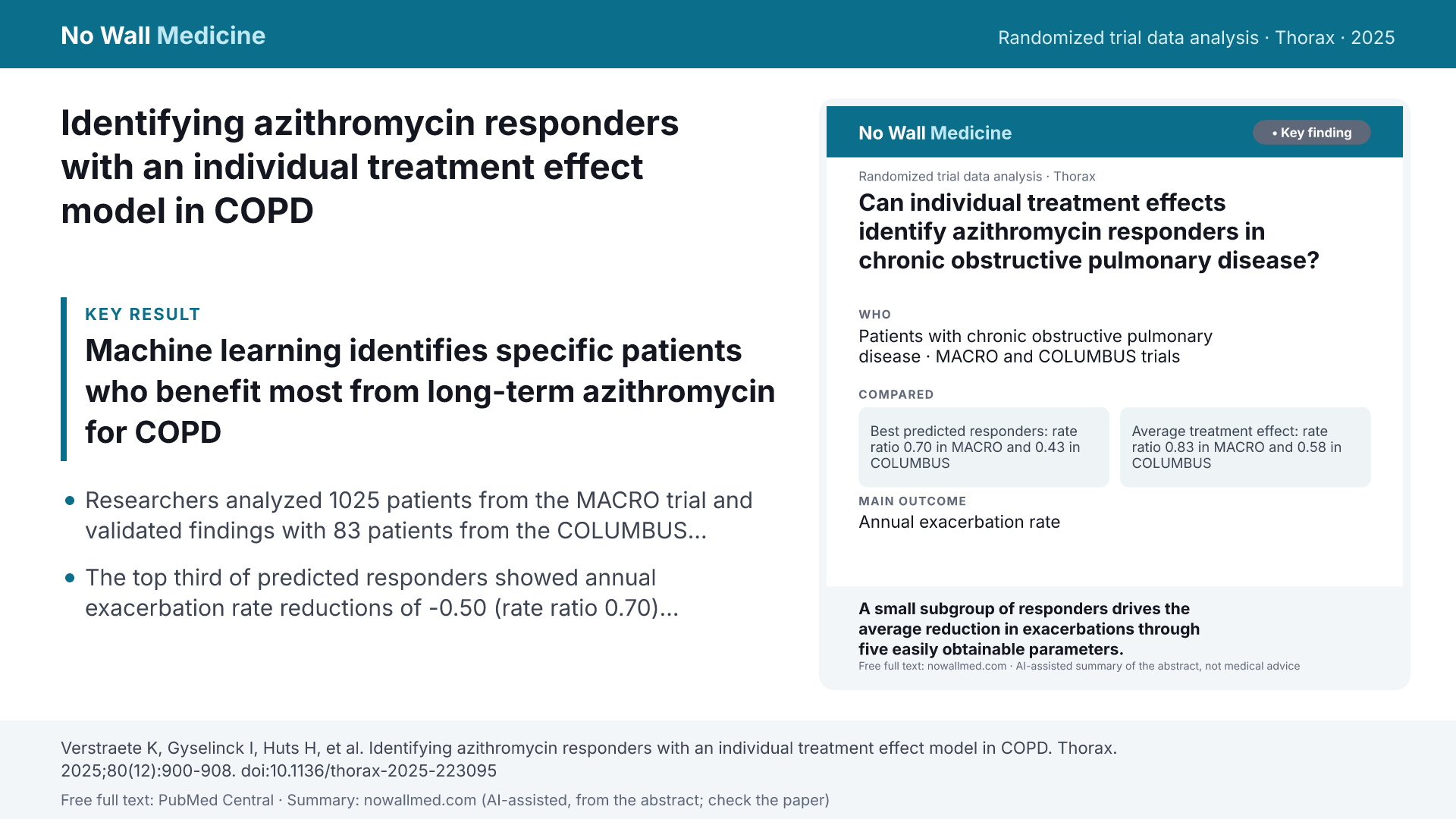
Identifying azithromycin responders with an individual treatment effect model in COPD
Key result: Machine learning identifies specific patients who benefit most from long-term azithromycin for COPD
Randomized trial data analysisKey finding
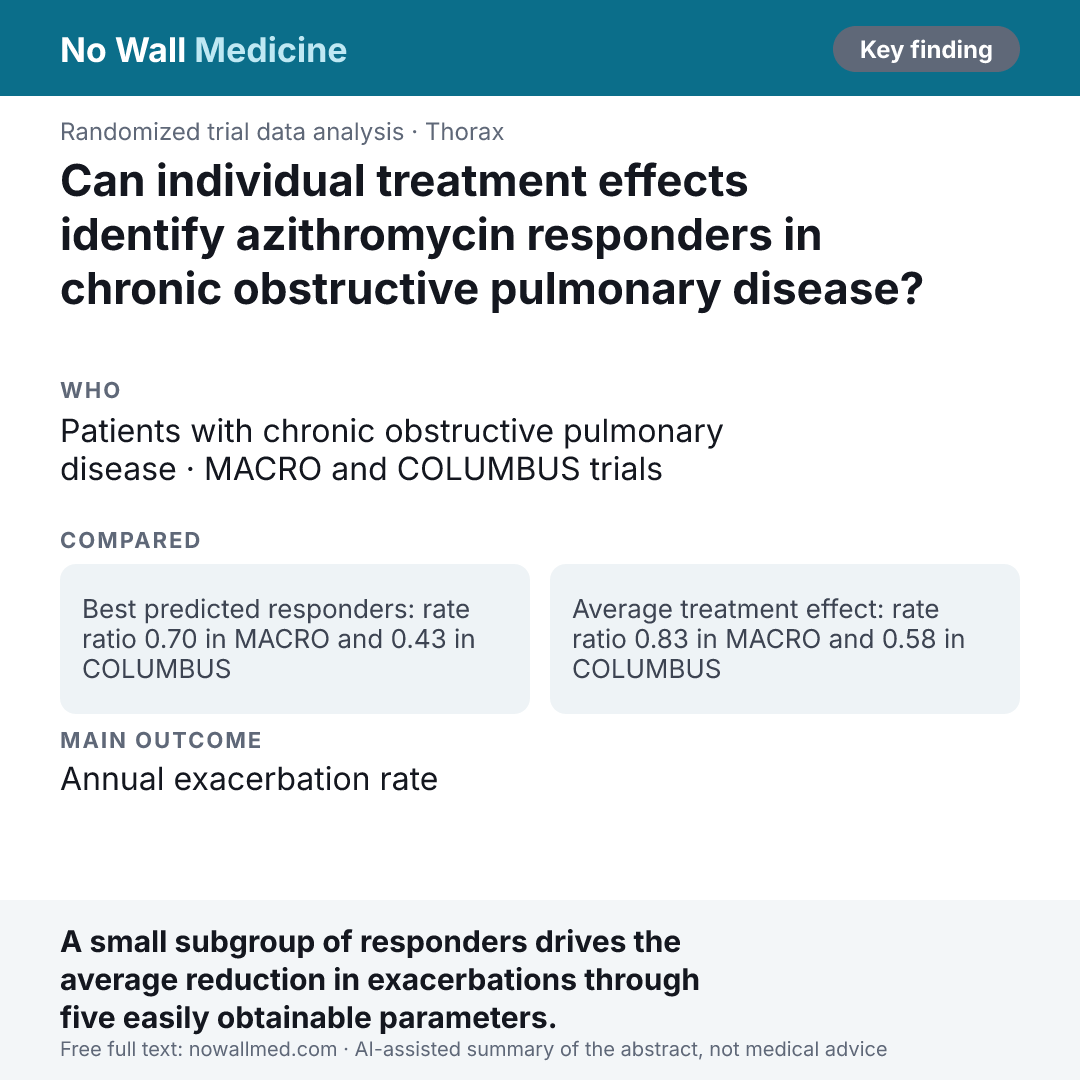
Can individual treatment effects identify azithromycin responders in chronic obstructive pulmonary disease?
Who
Patients with chronic obstructive pulmonary disease · MACRO and COLUMBUS trials
Compared
Best predicted responders: rate ratio 0.70 in MACRO and 0.43 in COLUMBUS
Average treatment effect: rate ratio 0.83 in MACRO and 0.58 in COLUMBUS
Main outcome
Annual exacerbation rate
Bottom line: A small subgroup of responders drives the average reduction in exacerbations through five easily obtainable parameters.
Thorax · 2025-11-14 · Save PNG
Key points
- Researchers analyzed 1025 patients from the MACRO trial and validated findings with 83 patients from the COLUMBUS trial using a causal machine learning model.
- The top third of predicted responders showed annual exacerbation rate reductions of -0.50 (rate ratio 0.70) in MACRO and -2.28 (rate ratio 0.43) in COLUMBUS.
- No significant treatment effect was observed in the remaining two-thirds of patients in either study group.
Why it matters: Clinicians need better ways to identify which patients with chronic obstructive pulmonary disease will respond to azithromycin to avoid unnecessary drug exposure.
Discussion prompts
- Would these patients look like yours? Who was left out?
- Is the main outcome one that matters to patients?
- Is the difference large enough to change what you do?
Cite: Verstraete K, Gyselinck I, Huts H, et al. Identifying azithromycin responders with an individual treatment effect model in COPD. Thorax. 2025;80(12):900-908. doi:10.1136/thorax-2025-223095
Free full text: PubMed Central · Summary and visual abstract: nowallmed.com/a/identifying-azithromycin-responders-with-an-individual-treatment-14v1n3g/ (AI-assisted from the abstract; check the paper before relying on it).