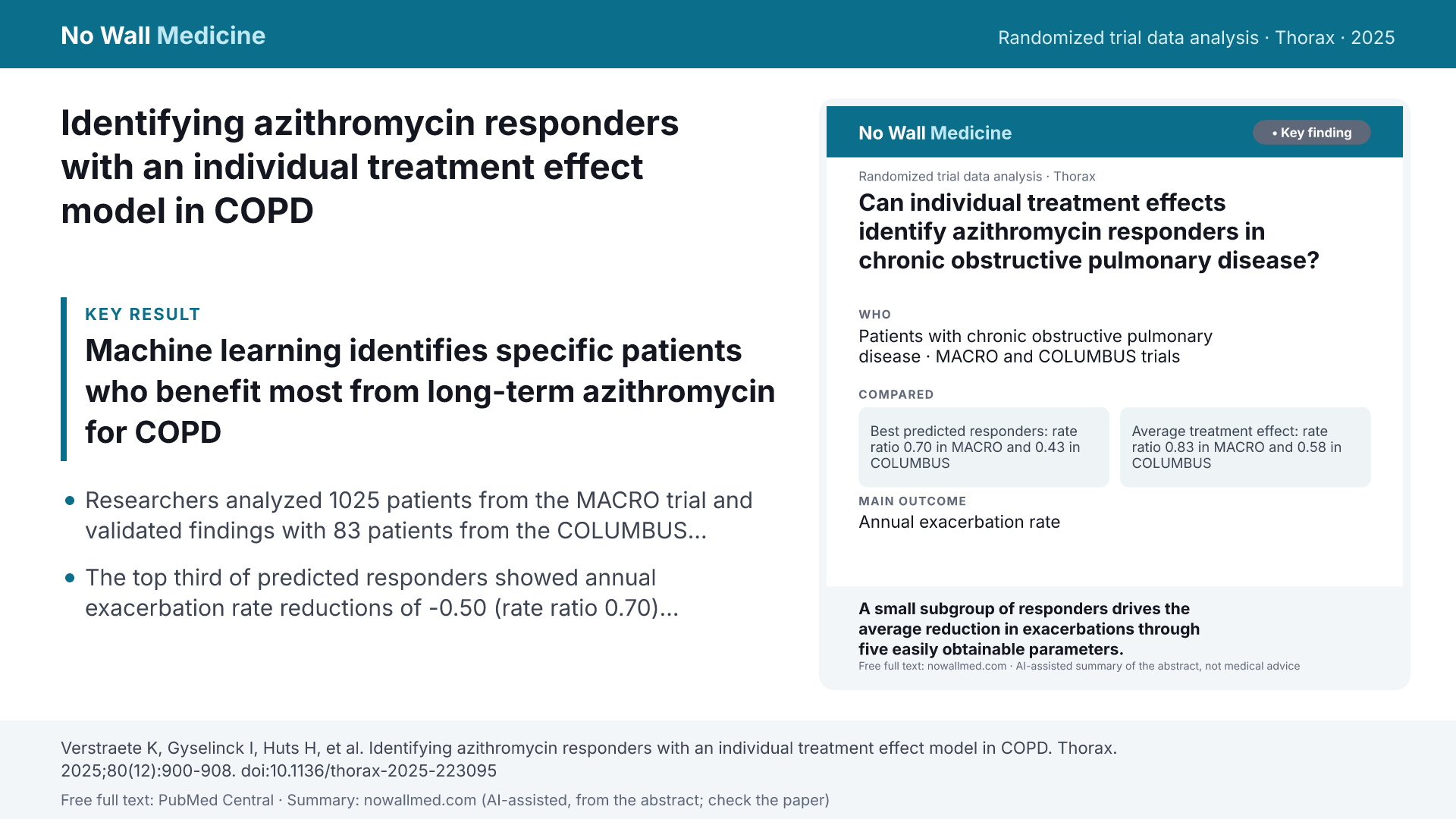
Machine learning identifies specific patients who benefit most from long-term azithromycin for COPD
Identifying azithromycin responders with an individual treatment effect model in COPD
Randomized trial data analysisBenefit found
Can individual treatment effects identify azithromycin responders in chronic obstructive pulmonary disease?
Who
Patients with chronic obstructive pulmonary disease · MACRO and COLUMBUS trials
Compared
Best predicted responders: rate ratio 0.70 in MACRO and 0.43 in COLUMBUS
Average treatment effect: rate ratio 0.83 in MACRO and 0.58 in COLUMBUS
Main outcome
Annual exacerbation rate
Bottom line: A small subgroup of responders drives the average reduction in exacerbations through five easily obtainable parameters.
Thorax · 2025-11-14Download image
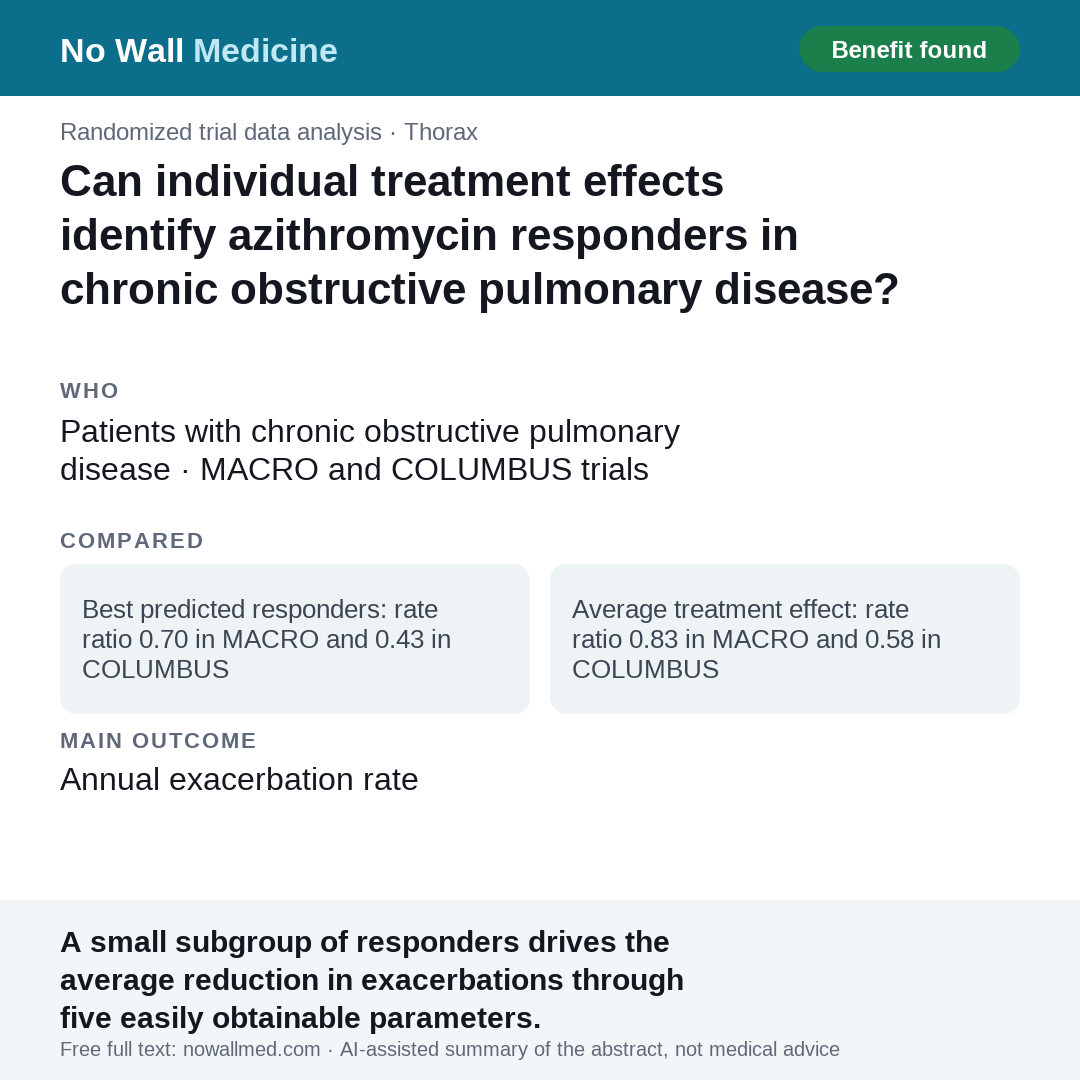
Clinical question: Can individual treatment effects identify azithromycin responders in chronic obstructive pulmonary disease?
Why it matters: Clinicians need better ways to identify which patients with chronic obstructive pulmonary disease will respond to azithromycin to avoid unnecessary drug exposure.
Key points
- Researchers analyzed 1025 patients from the MACRO trial and validated findings with 83 patients from the COLUMBUS trial using a causal machine learning model.
- The top third of predicted responders showed annual exacerbation rate reductions of -0.50 (rate ratio 0.70) in MACRO and -2.28 (rate ratio 0.43) in COLUMBUS.
- No significant treatment effect was observed in the remaining two-thirds of patients in either study group.
Headline and key points written with AI from the paper’s abstract, with every number checked against it. Read the paper before relying on them.
Was this summary helpful?
Abstract
Objective
Long-term azithromycin treatment effectively prevents acute exacerbations of chronic obstructive pulmonary disease (COPD). However, patients would benefit from better identification of responders and non-responders to minimise unnecessary exposure. We aimed to assess treatment effect heterogeneity and estimate individual treatment effects (ITEs) to distinguish patients most likely to benefit from prophylactic treatment. Methods
We used data from 1025 patients of the MACRO trial to assess the ITE of azithromycin on annual exacerbation rate. A Causal Forest was used as a causal machine learning model. We independently validated our findings using data from 83 patients of the COLUMBUS trial. Results
The tertile of patients with the best predicted ITE within MACRO and within the COLUMBUS independent validation cohort showed significant and substantially greater reductions in annual exacerbation rates (in MACRO -0.50, rate ratio 0.70, p=0.01, in COLUMBUS: -2.28, rate ratio 0.43, p<0.001) compared with the average treatment effect across the entire cohort (MACRO -0.35, rate ratio 0.83, p=0.01 and COLUMBUS -1.28, rate ratio 0.58, p=0.001). Conversely, no significant treatment effect was observed in the remaining two-thirds of patients. Primary determinants of ITE included respiratory symptoms, white blood cell count, haemoglobin, C-reactive protein and forced vital capacity. Smoking status did not emerge as a significant predictor. Conclusion
Based on five easily obtainable parameters to predict ITE, we identified treatment effect heterogeneity in COPD subjects treated with azithromycin maintenance therapy and found a small subgroup of responders driving the average reduction in exacerbations reported in previous trials.
Abstract reproduced under the article’s CC BY NC licence.
Subject terms
Cite this article
Verstraete K, Gyselinck I, Huts H, Djamin RS, Staes M, Talman S. Identifying azithromycin responders with an individual treatment effect model in COPD. Thorax. 2025. doi:10.1136/thorax-2025-223095
Spotted a mistake? Suggest a correction
Top studies every Monday
The week’s key trials and guidelines in your specialties, plus any topics you follow. By email, free.
Get the weekly digest