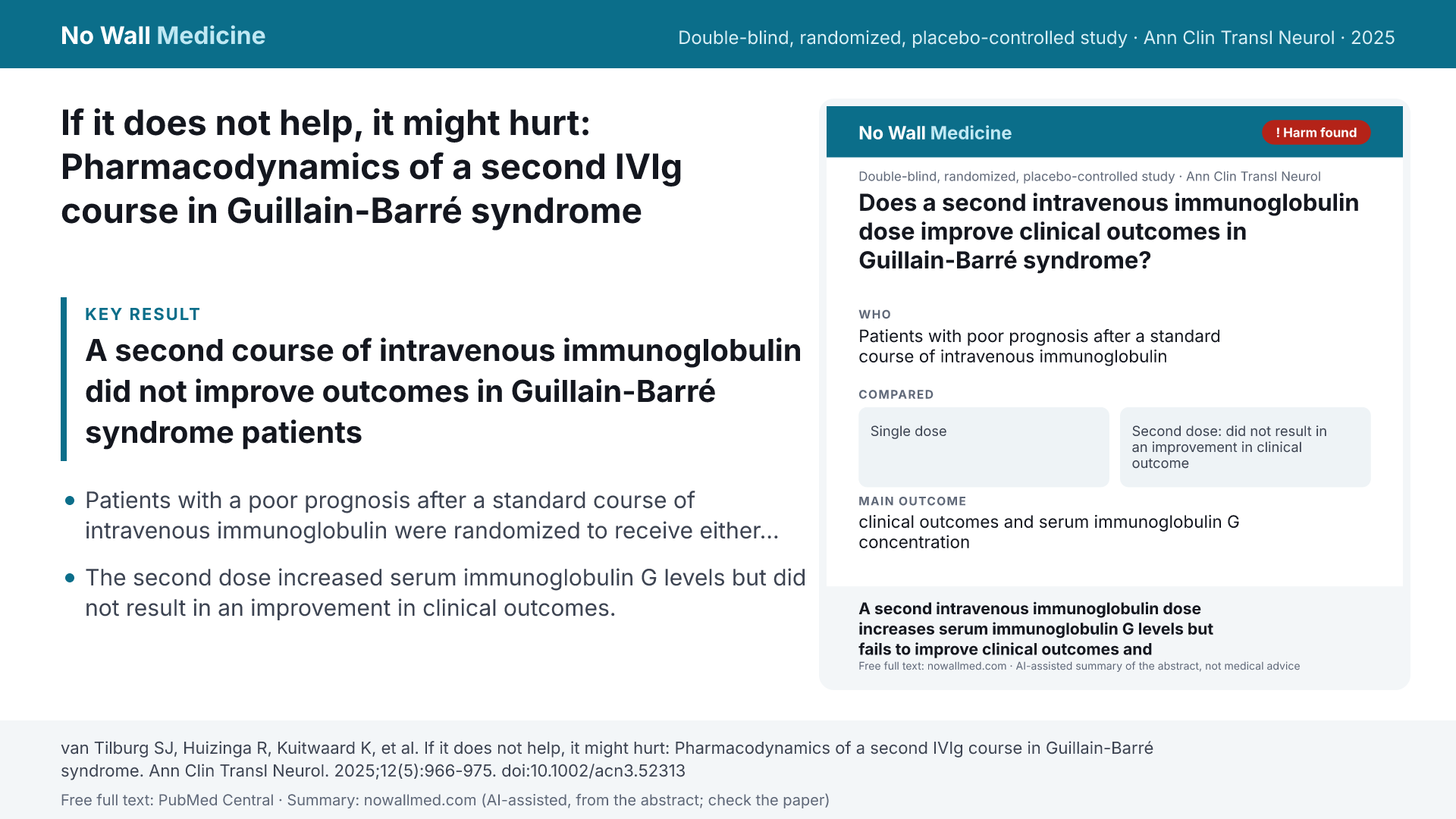
If it does not help, it might hurt: Pharmacodynamics of a second IVIg course in Guillain-Barré syndrome
Key result: A second course of intravenous immunoglobulin did not improve outcomes in Guillain-Barré syndrome patients
Double-blind, randomized, placebo-controlled studyHarm found
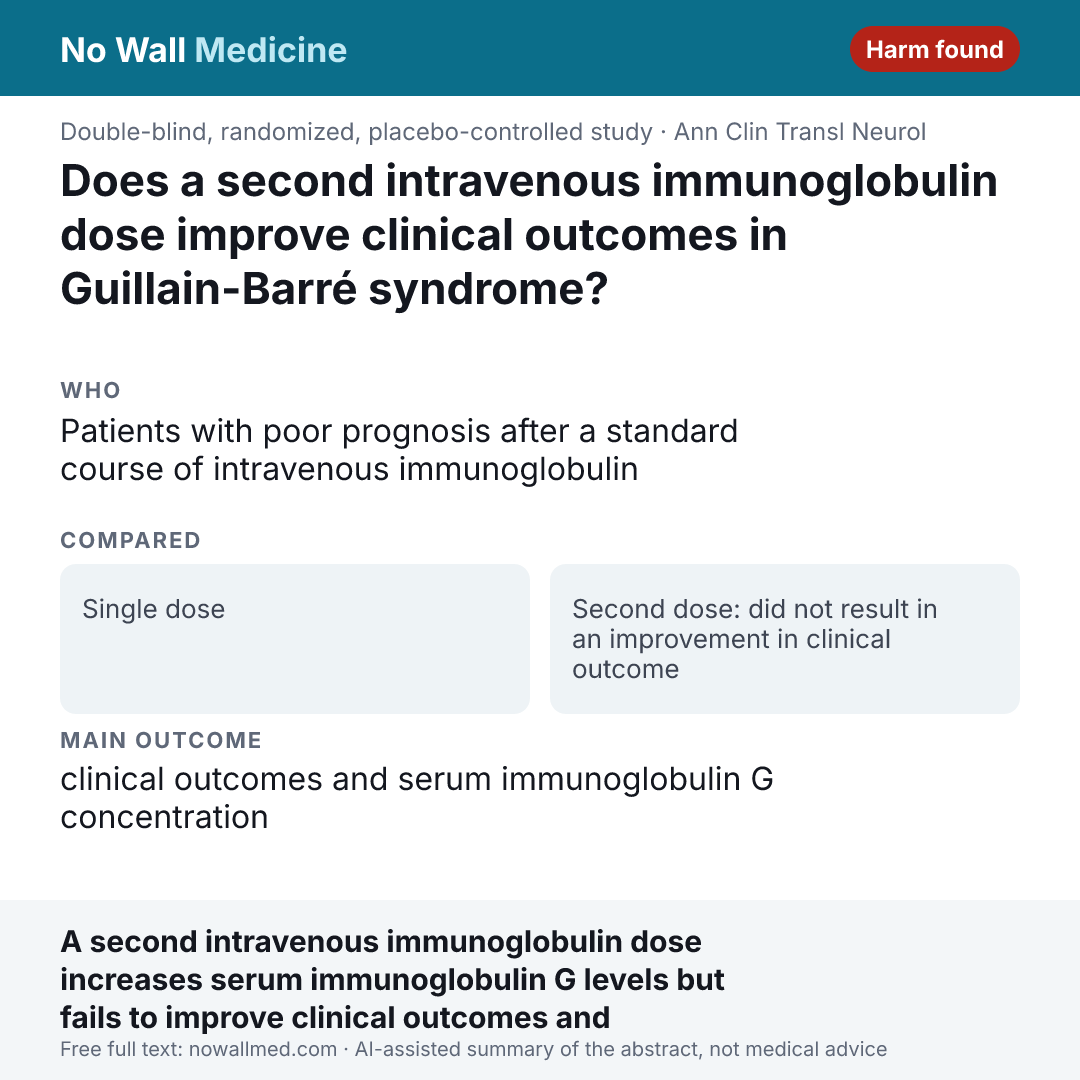
Does a second intravenous immunoglobulin dose improve clinical outcomes in Guillain-Barré syndrome?
Who
Patients with poor prognosis after a standard course of intravenous immunoglobulin
Compared
Single dose
Second dose: did not result in an improvement in clinical outcome
Main outcome
clinical outcomes and serum immunoglobulin G concentration
Bottom line: A second intravenous immunoglobulin dose increases serum immunoglobulin G levels but fails to improve clinical outcomes and increases serious adverse events.
Ann Clin Transl Neurol · 2025-03-14 · Save PNG
Key points
- Patients with a poor prognosis after a standard course of intravenous immunoglobulin were randomized to receive either a single additional dose or a placebo.
- The second dose increased serum immunoglobulin G levels but did not result in an improvement in clinical outcomes.
- Serious adverse events, including blood clot-related events, occurred more frequently in the group receiving the second dose.
Discussion prompts
- Would these patients look like yours? Who was left out?
- Is the main outcome one that matters to patients?
- Is the difference large enough to change what you do?
Cite: van Tilburg SJ, Huizinga R, Kuitwaard K, et al. If it does not help, it might hurt: Pharmacodynamics of a second IVIg course in Guillain-Barré syndrome. Ann Clin Transl Neurol. 2025;12(5):966-975. doi:10.1002/acn3.52313
Free full text: PubMed Central · Summary and visual abstract: nowallmed.com/a/if-it-does-not-help-it-might-hurt-pharmacodynamics-of-a-second-ivig-jbj8j3/ (AI-assisted from the abstract; check the paper before relying on it).