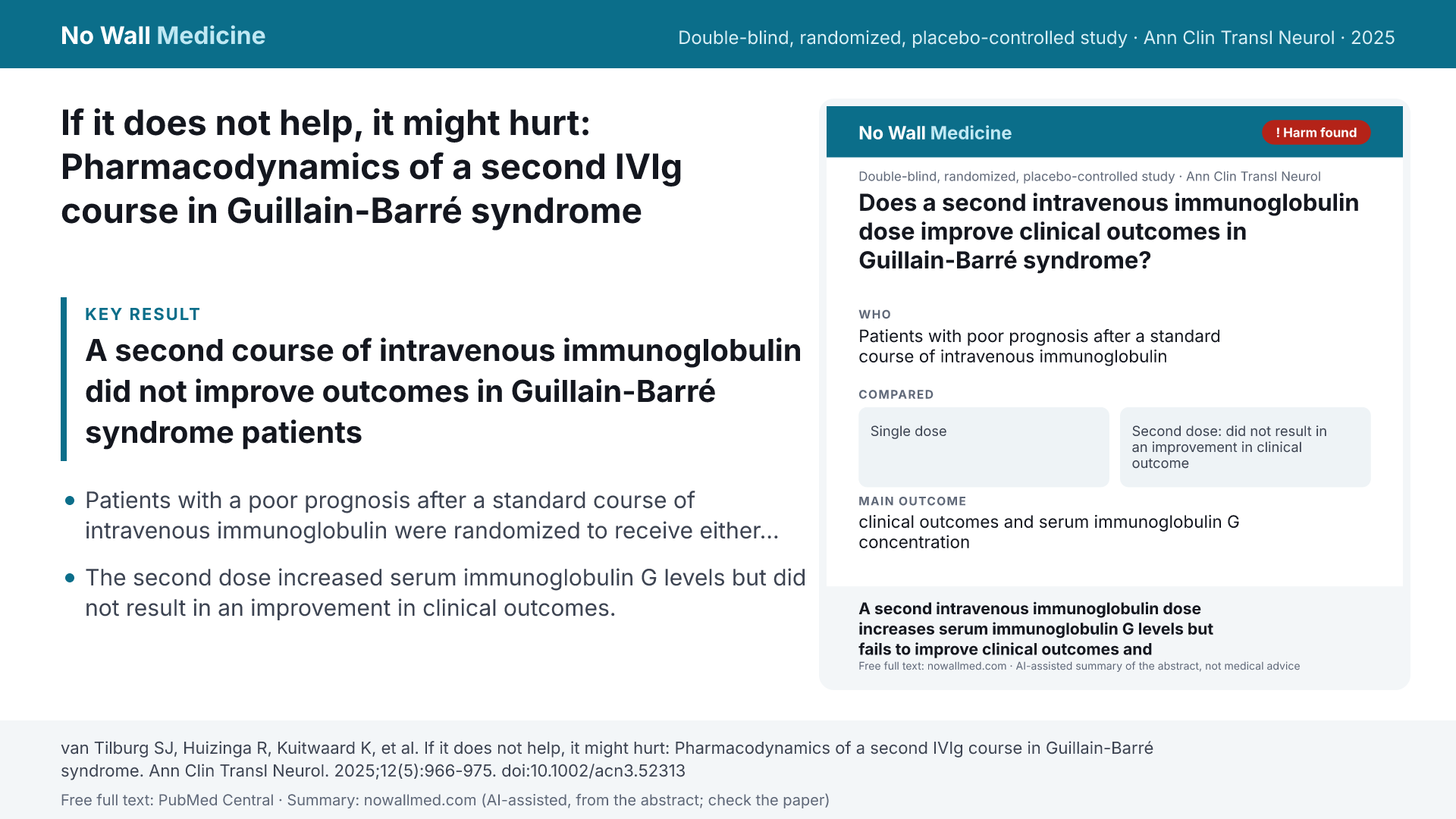
A second course of intravenous immunoglobulin did not improve outcomes in Guillain-Barré syndrome patients
If it does not help, it might hurt: Pharmacodynamics of a second IVIg course in Guillain-Barré syndrome
Double-blind, randomized, placebo-controlled studyHarm found
Does a second intravenous immunoglobulin dose improve clinical outcomes in Guillain-Barré syndrome?
Who
Patients with poor prognosis after a standard course of intravenous immunoglobulin
Compared
Single dose
Second dose: did not result in an improvement in clinical outcome
Main outcome
clinical outcomes and serum immunoglobulin G concentration
Bottom line: A second intravenous immunoglobulin dose increases serum immunoglobulin G levels but fails to improve clinical outcomes and increases serious adverse events.
Ann Clin Transl Neurol · 2025-03-14Download image
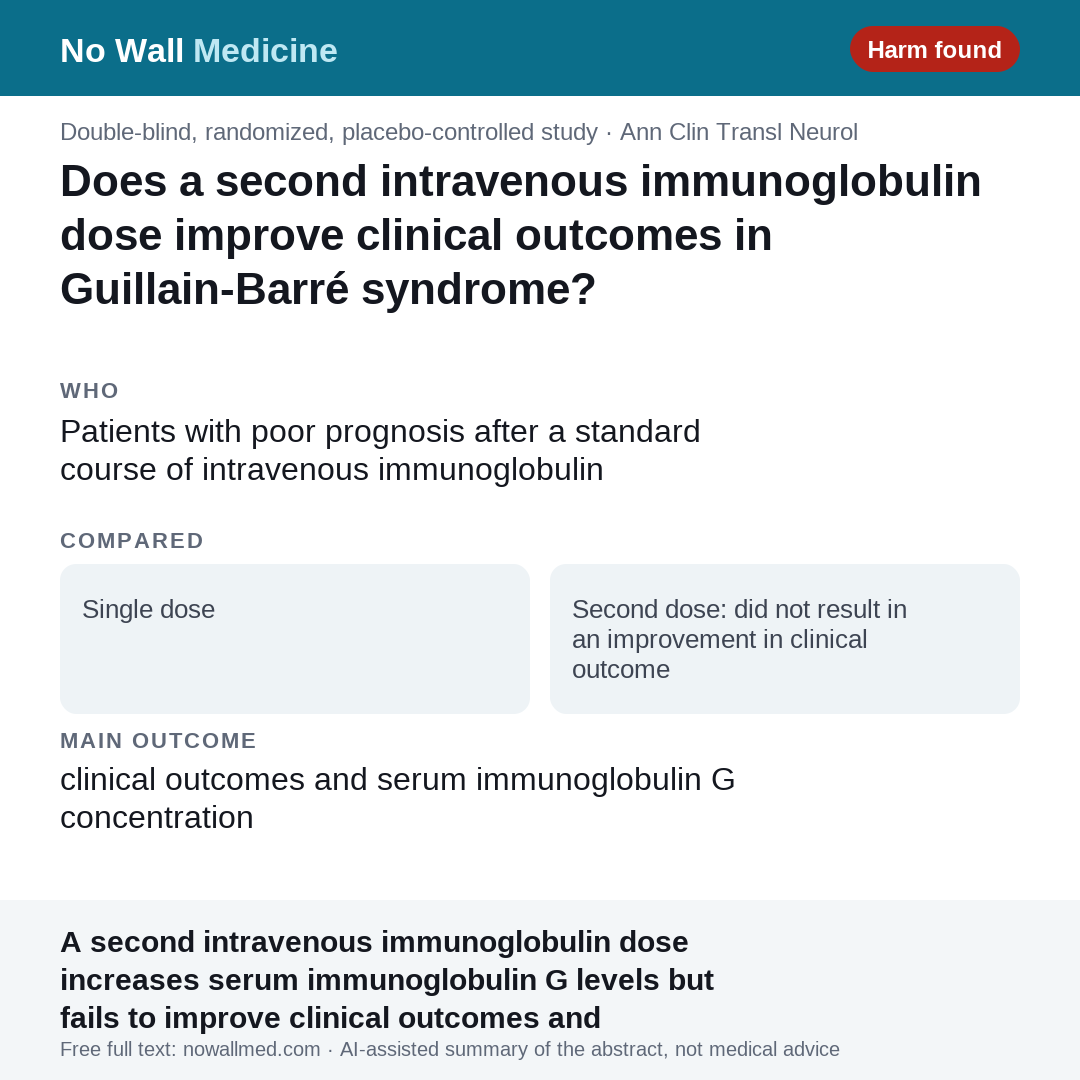
Clinical question: Does a second intravenous immunoglobulin dose improve clinical outcomes in Guillain-Barré syndrome?
Why it matters: It is unknown whether providing a second course of intravenous immunoglobulin to patients with a poor prognosis after initial treatment improves clinical recovery.
Key points
- Patients with a poor prognosis after a standard course of intravenous immunoglobulin were randomized to receive either a single additional dose or a placebo.
- The second dose increased serum immunoglobulin G levels but did not result in an improvement in clinical outcomes.
- Serious adverse events, including blood clot-related events, occurred more frequently in the group receiving the second dose.
Headline and key points written with AI from the paper’s abstract, with every number checked against it. Read the paper before relying on them.
Was this summary helpful?
Subject terms
Cite this article
van Tilburg SJ, Huizinga R, Kuitwaard K, et al. If it does not help, it might hurt: Pharmacodynamics of a second IVIg course in Guillain-Barré syndrome. Ann Clin Transl Neurol. 2025. doi:10.1002/acn3.52313
Spotted a mistake? Suggest a correction