Rituximab was not more effective than placebo for preventing worsening in chronic inflammatory demyelinating polyradiculoneuropathy
Rituximab versus placebo for chronic inflammatory demyelinating polyradiculoneuropathy: a randomized trial
Randomized, double-blind, placebo-controlled trialNo clear difference
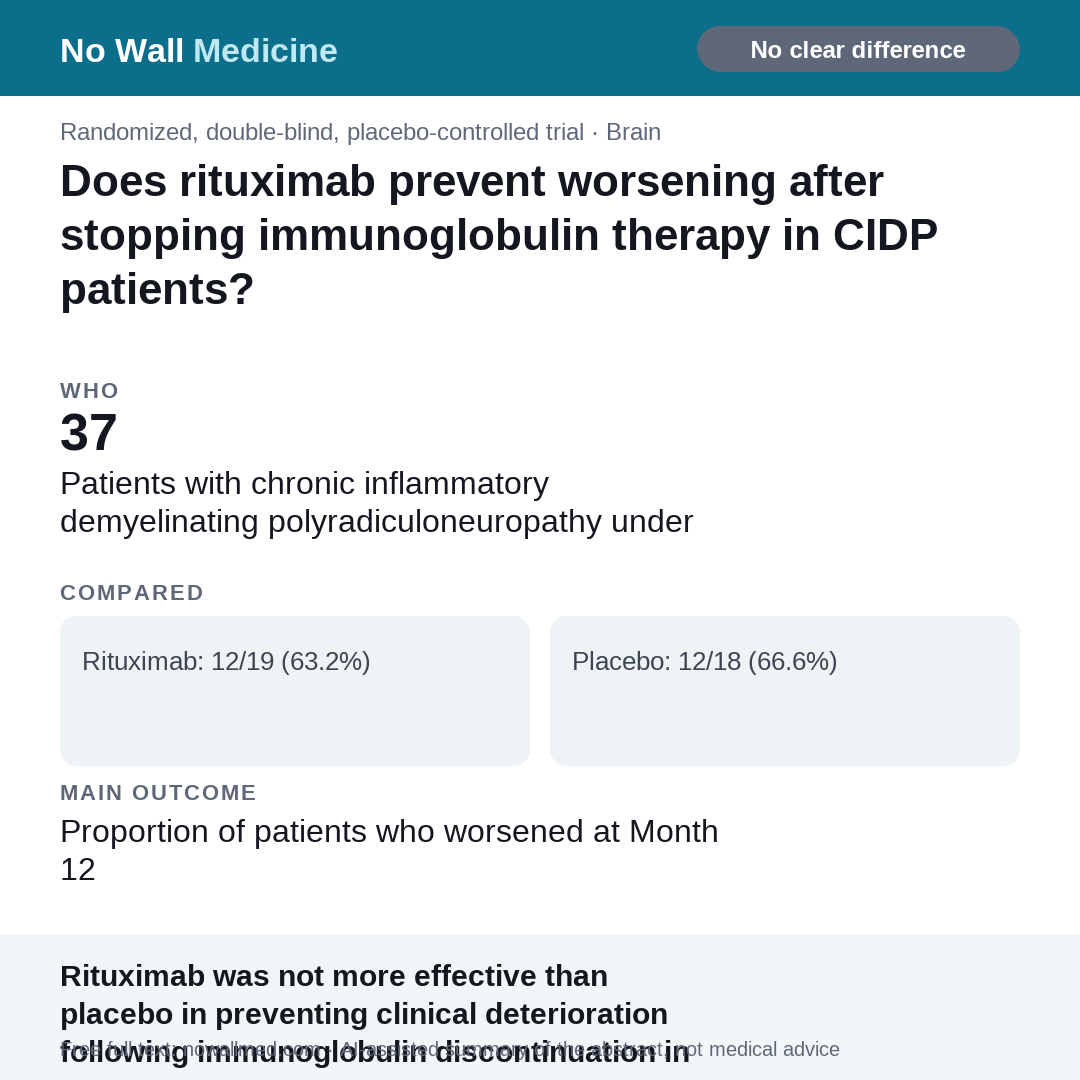
Does rituximab prevent worsening after stopping immunoglobulin therapy in CIDP patients?
Who
37
Patients with chronic inflammatory demyelinating polyradiculoneuropathy under immunoglobulin therapy · Seven Italian hospitals
Compared
Rituximab: 12/19 (63.2%)
Placebo: 12/18 (66.6%)
Main outcome
Proportion of patients who worsened at Month 12
Result: odds ratio 0.86 (95% CI 0.22-3.32)
Bottom line: Rituximab was not more effective than placebo in preventing clinical deterioration following immunoglobulin discontinuation in CIDP.
Brain · 2024-12-11Download image
Clinical question: Does rituximab prevent worsening after stopping immunoglobulin therapy in CIDP patients?
Why it matters: It is unknown if rituximab can prevent clinical deterioration in patients with chronic inflammatory demyelinating polyradiculoneuropathy after they stop immunoglobulin therapy.
Key points
- Researchers conducted a randomized trial with 37 patients with chronic inflammatory demyelinating polyradiculoneuropathy who were assigned to receive either rituximab or a placebo.
- At Month 12, 63.2% of the rituximab group and 66.6% of the placebo group experienced clinical worsening.
- No significant differences were found between the groups at Month 18 or in the mean scores of the clinical scales used.
Headline and key points written with AI from the paper’s abstract, with every number checked against it. Read the paper before relying on them.
Was this summary helpful?
Subject terms
Cite this article
Nobile-Orazio E, Cocito D, Manganelli F, Fazio R, Lauria Pinter G, Benedetti L. Rituximab versus placebo for chronic inflammatory demyelinating polyradiculoneuropathy: a randomized trial. Brain. 2024. doi:10.1093/brain/awae400
Spotted a mistake? Suggest a correction
Top studies every Monday
The week’s key trials and guidelines in your specialties, plus any topics you follow. By email, free.
Get the weekly digest