Neurofilament light chain levels were associated with improved prediction of walking ability in Guillain-Barré syndrome
Neurofilament light chain improves clinical prognostic models for Guillain-Barré syndrome
Randomized placebo-controlled trialMixed results
Does neurofilament light chain improve prognostic models for Guillain-Barré syndrome?
Who
293
Patients with Guillain-Barré syndrome
Compared
Clinical models without neurofilament light chain
Clinical models with neurofilament light chain: C-statistic 0.88 (95% CI 0.83 to 0.94)
Main outcome
Inability to walk and respiratory failure
Result: delta C-statistic range 0.01-0.11
Bottom line: Neurofilament light chain improves models predicting inability to walk, but not respiratory failure.
J Neurol Neurosurg Psychiatry · 2025-10-15Download image
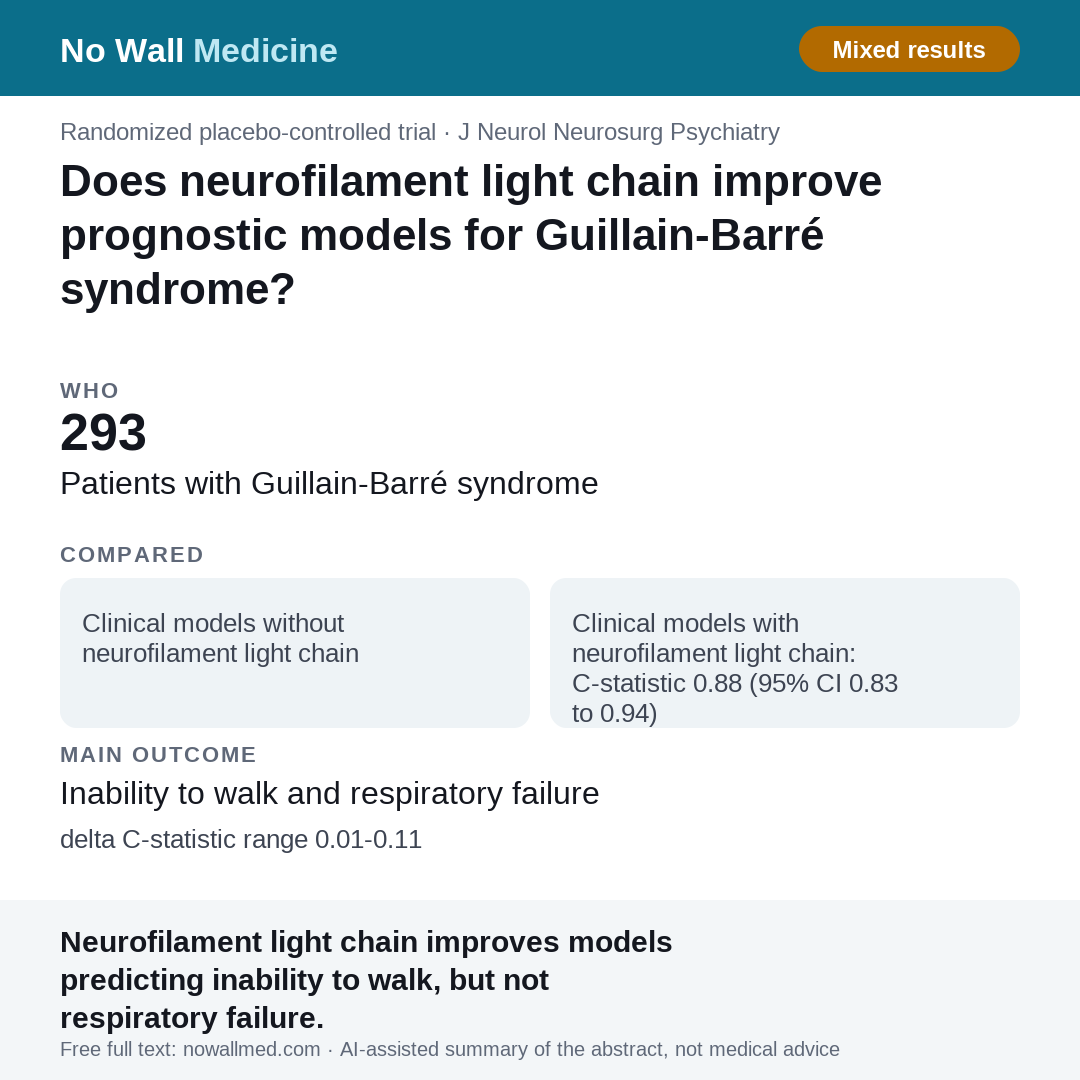
Clinical question: Does neurofilament light chain improve prognostic models for Guillain-Barré syndrome?
Why it matters: Existing clinical models for Guillain-Barré syndrome may not fully predict which patients will experience inability to walk or respiratory failure.
Key points
- Researchers studied 293 patients from a randomized trial to see if neurofilament light chain, a protein indicating nerve damage, improved clinical prediction models.
- Higher levels of neurofilament light chain in serum and cerebrospinal fluid were associated with inability to walk at 4 and 26 weeks.
- Adding neurofilament light chain to existing scores improved prediction of walking ability with a C-statistic range increase of 0.01-0.11, but not respiratory failure.
Headline and key points written with AI from the paper’s abstract, with every number checked against it. Read the paper before relying on them.
Abstract
Background
Several prognostic models predict clinical outcomes in Guillain-Barré syndrome (GBS). Recently, neurofilament light chain (NfL) has emerged as a prognostic biomarker. We investigated the added prognostic value of NfL in serum (sNfL) and cerebrospinal fluid (cNfL) to models based on clinical factors predicting respiratory failure and inability to walk in GBS. Methods
We included patients from a randomised placebo-controlled trial (second intravenous immunoglobulin dose in GBS). Serum was acquired at entry and week 1, 2, 4 and 12 and cerebrospinal fluid at entry. NfL levels were determined on a single molecule array. The additional prognostic value of NfL to the (modified) Erasmus GBS Outcome Score ((m)EGOS) and (modified) Erasmus GBS Respiratory Insufficiency Score was evaluated using logistic regression analyses. Results
In total, 293 patients were included (74 (25%) mechanically ventilated, 38/275 (13%) unable to walk at 26 weeks). Higher sNfL at entry, week 1 and week 2 and cNfL at entry were associated with inability to walk at 4 and 26 weeks. Neither sNfL nor cNfL levels at entry were associated with respiratory failure. The EGOS and mEGOS improved after adding NfL (∆C-statistic range: 0.01-0.11), especially the models predicting outcome at 26 weeks. A new model predicting inability to walk at 26 weeks consisting of sNfL at entry, GBS disability score at entry and Medical Research Council sum score at week 2 performed best (C-statistic: 0.88 (95% CI 0.83 to 0.94)). Conclusions
Addition of NfL may improve clinical prognostic models for the prediction of inability to walk, but not of respiratory failure. Trial registration number
NTR2224/NL2107.
Abstract reproduced under the article’s CC BY licence.
Topics
Cite this article
Thomma RCM, Luijten LWG, van Tilburg SJ, Wiegers EJA, Teunissen CE, Vermunt L. Neurofilament light chain improves clinical prognostic models for Guillain-Barré syndrome. J Neurol Neurosurg Psychiatry. 2025. doi:10.1136/jnnp-2025-336046
Spotted a mistake? Suggest a correction