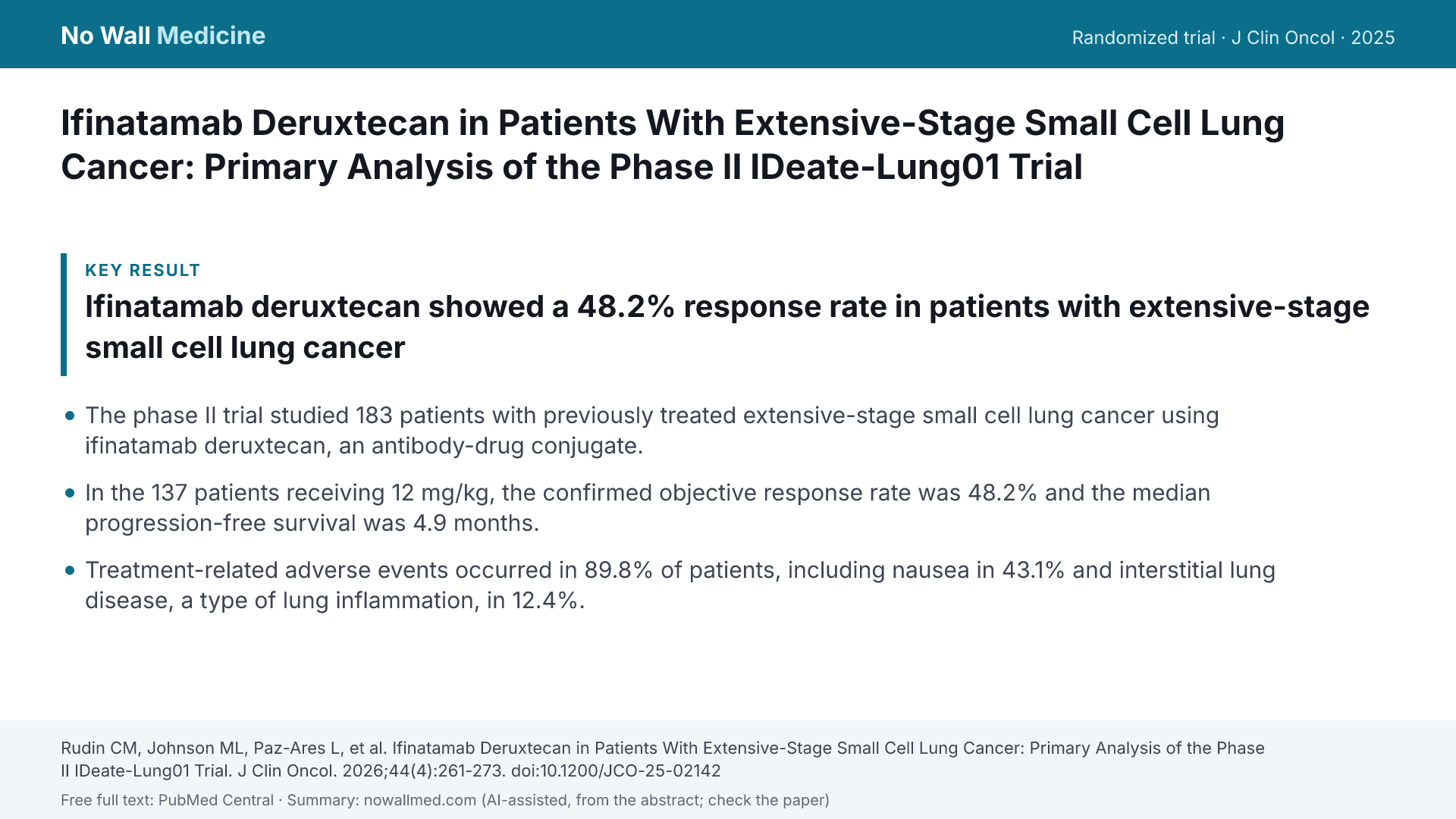
Ifinatamab deruxtecan showed a 48.2% response rate in patients with extensive-stage small cell lung cancer
Ifinatamab Deruxtecan in Patients With Extensive-Stage Small Cell Lung Cancer: Primary Analysis of the Phase II IDeate-Lung01 Trial
Phase II randomized trialEarly signal
What is the efficacy and safety of ifinatamab deruxtecan in previously treated extensive-stage small cell lung cancer?
Who
183
Patients with previously treated extensive-stage small cell lung cancer
Compared
8 mg/kg group
48.2%12 mg/kg group (95% CI, 39.6 to 56.9)
Main outcome
objective response rate
Bottom line: Ifinatamab deruxtecan 12 mg/kg showed promising efficacy in patients with previously treated extensive-stage small cell lung cancer.
J Clin Oncol · 2025-10-14Download image
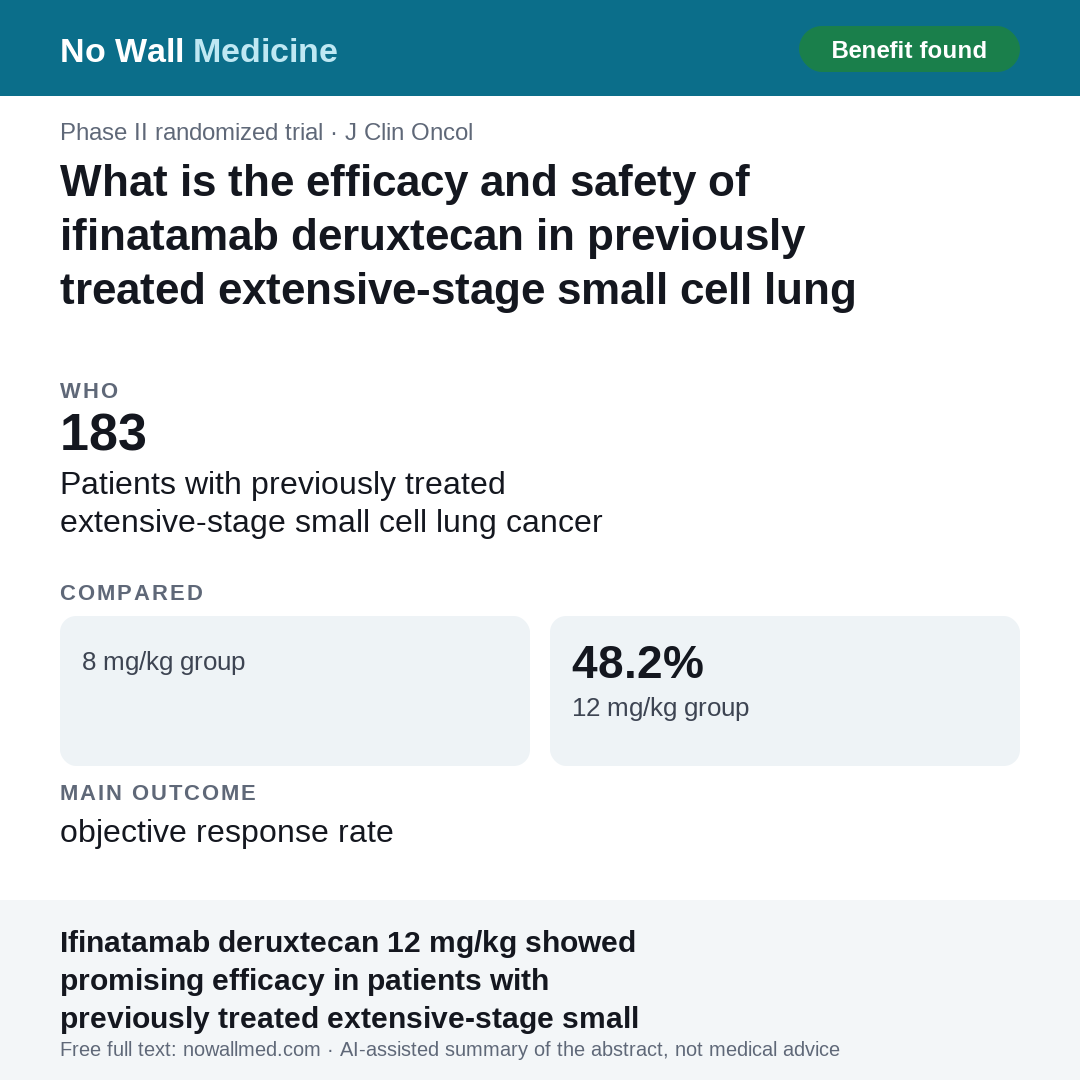
Clinical question: What is the efficacy and safety of ifinatamab deruxtecan in previously treated extensive-stage small cell lung cancer?
Why it matters: Treatment options are limited for patients whose extensive-stage small cell lung cancer has returned or progressed after previous therapies.
Key points
- The phase II trial studied 183 patients with previously treated extensive-stage small cell lung cancer using ifinatamab deruxtecan, an antibody-drug conjugate.
- In the 137 patients receiving 12 mg/kg, the confirmed objective response rate was 48.2% and the median progression-free survival was 4.9 months.
- Treatment-related adverse events occurred in 89.8% of patients, including nausea in 43.1% and interstitial lung disease, a type of lung inflammation, in 12.4%.
Headline and key points written with AI from the paper’s abstract, with every number checked against it. Read the paper before relying on them.
Was this summary helpful?
Subject terms
Cite this article
Rudin CM, Johnson ML, Paz-Ares L, et al. Ifinatamab Deruxtecan in Patients With Extensive-Stage Small Cell Lung Cancer: Primary Analysis of the Phase II IDeate-Lung01 Trial. J Clin Oncol. 2025. doi:10.1200/JCO-25-02142
Spotted a mistake? Suggest a correction