Dual-energy computed tomography provided higher image quality than single-energy computed tomography for head and neck imaging
Image quality comparison of single-energy and dual-energy computed tomography for head and neck patients: a prospective randomized study
Prospective randomized studyBenefit found
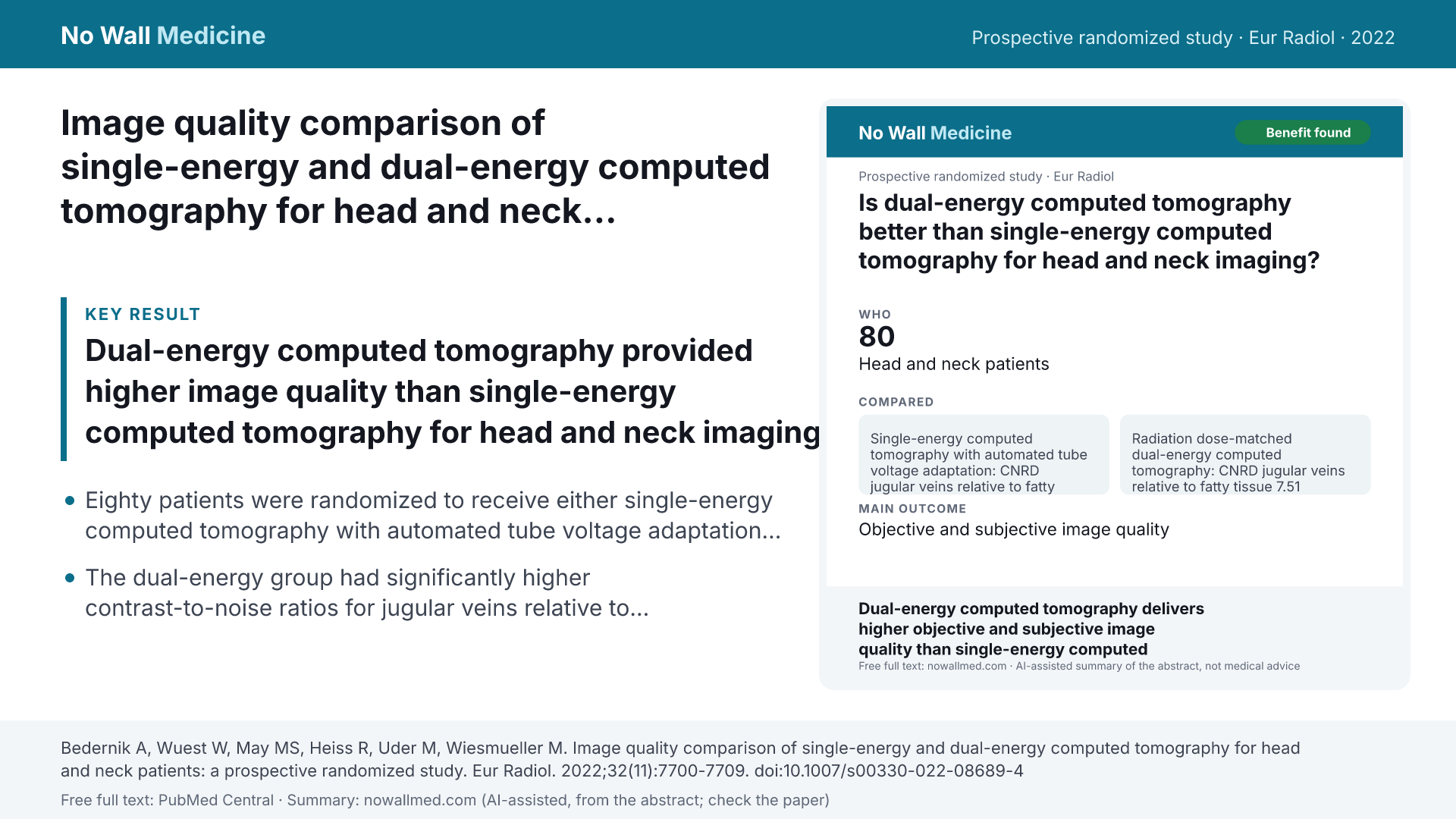
Is dual-energy computed tomography better than single-energy computed tomography for head and neck imaging?
Who
80
Head and neck patients
Compared
Single-energy computed tomography with automated tube voltage adaptation: CNRD jugular veins relative to fatty tissue 6.08
Radiation dose-matched dual-energy computed tomography: CNRD jugular veins relative to fatty tissue 7.51
Main outcome
Objective and subjective image quality
Bottom line: Dual-energy computed tomography delivers higher objective and subjective image quality than single-energy computed tomography in head and neck imaging.
Eur Radiol · 2022-04-20Download image

Clinical question: Is dual-energy computed tomography better than single-energy computed tomography for head and neck imaging?
Why it matters: It was unknown whether dual-energy computed tomography provides better image quality than single-energy computed tomography using automated tube voltage adaptation for head and neck patients.
Key points
- Eighty patients were randomized to receive either single-energy computed tomography with automated tube voltage adaptation or radiation dose-matched dual-energy computed tomography.
- The dual-energy group had significantly higher contrast-to-noise ratios for jugular veins relative to fatty tissue (7.51/6.08) and muscle relative to fatty tissue (4.18/2.90).
- Dual-energy images were associated with less pronounced artifacts and higher overall diagnostic acceptability compared to the single-energy group.
Headline and key points written with AI from the paper’s abstract, with every number checked against it. Read the paper before relying on them.
Was this summary helpful?
Subject terms
Cite this article
Bedernik A, Wuest W, May MS, Heiss R, Uder M, Wiesmueller M. Image quality comparison of single-energy and dual-energy computed tomography for head and neck patients: a prospective randomized study. Eur Radiol. 2022. doi:10.1007/s00330-022-08689-4
Spotted a mistake? Suggest a correction