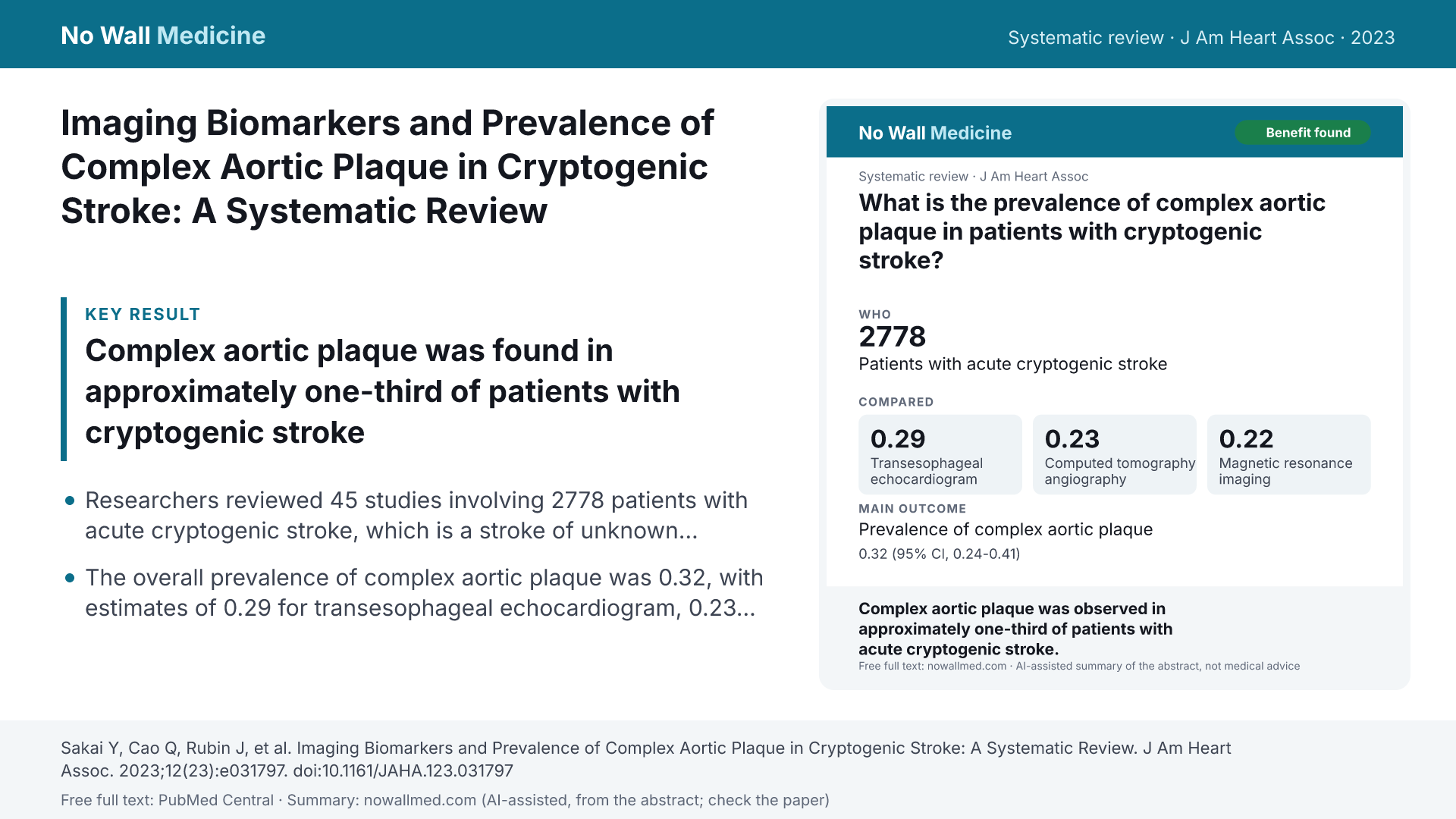
Complex aortic plaque was found in approximately one-third of patients with cryptogenic stroke
Imaging Biomarkers and Prevalence of Complex Aortic Plaque in Cryptogenic Stroke: A Systematic Review
Systematic reviewBenefit found
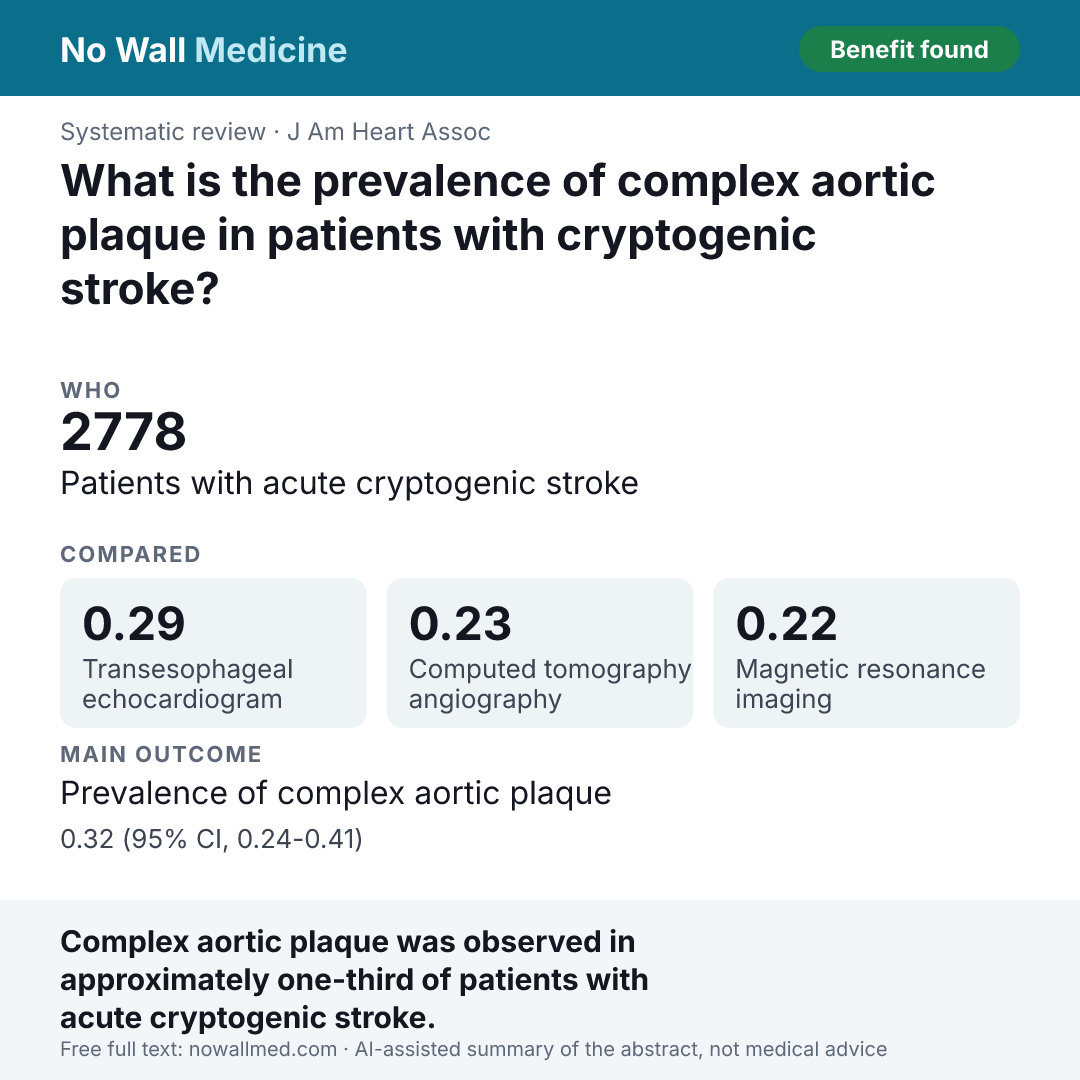
What is the prevalence of complex aortic plaque in patients with cryptogenic stroke?
Who
2778
Patients with acute cryptogenic stroke
Compared
0.29Transesophageal echocardiogram (95% CI, 0.20-0.40)
0.23Computed tomography angiography (95% CI, 0.15-0.34)
0.22Magnetic resonance imaging (95% CI, 0.06-0.54)
Main outcome
Prevalence of complex aortic plaque
Result: 0.32 (95% CI, 0.24-0.41)
Bottom line: Complex aortic plaque was observed in approximately one-third of patients with acute cryptogenic stroke.
Limitation: High study heterogeneity suggests a need for reproducible imaging methods.
J Am Heart Assoc · 2023-11-28 · Save PNG
Clinical question: What is the prevalence of complex aortic plaque in patients with cryptogenic stroke?
Why it matters: The specific criteria used to identify complex aortic plaque through different imaging methods are inconsistent across medical literature.
Key points
- Researchers reviewed 45 studies involving 2778 patients with acute cryptogenic stroke, which is a stroke of unknown cause, to assess complex aortic plaque prevalence.
- The overall prevalence of complex aortic plaque was 0.32, with estimates of 0.29 for transesophageal echocardiogram, 0.23 for computed tomography angiography, and 0.22 for magnetic resonance imaging.
- Most studies, totaling 74%, used a plaque thickness of 4 mm or more as the criterion for identifying complex aortic plaque.
Limitation the authors note: High study heterogeneity suggests a need for reproducible imaging methods.
Headline and key points written with AI from the paper’s abstract, with every number checked against it. Read the paper before relying on them.
Was this summary helpful?
Subject terms
Headline, design, result, key points, caveat and citation as plain text.
Cite this article
Sakai Y, Cao Q, Rubin J, et al. Imaging Biomarkers and Prevalence of Complex Aortic Plaque in Cryptogenic Stroke: A Systematic Review. J Am Heart Assoc. 2023;12(23):e031797. doi:10.1161/JAHA.123.031797
Spotted a mistake? Suggest a correction