Brain stimulation shows moderate effects on symptoms of obsessive-compulsive disorder, posttraumatic stress disorder, and anxiety
Immediate and long-term efficacy of transcranial direct current stimulation (tCDS) in obsessive-compulsive disorder, posttraumatic stress disorder and anxiety disorders: a systematic review and meta-analysis
Systematic review and meta-analysisBenefit found
Is transcranial direct current stimulation effective for obsessive-compulsive, posttraumatic stress, and anxiety disorders?
Who
Patients with obsessive-compulsive disorder, posttraumatic stress disorder and anxiety disorders
Compared
active transcranial direct current stimulation
sham stimulation
Main outcome
change in disorder-specific and general anxiety symptoms
Result: SMD -0.73 (95% CI -1.09 to -0.37) for specific symptoms; SMD -0.75 (95% CI -1.23 to -0.26) for general anxiety
Bottom line: Transcranial direct current stimulation effectively improves specific and general anxiety symptoms with effects lasting up to one month.
Transl Psychiatry · 2024-08-25Download image
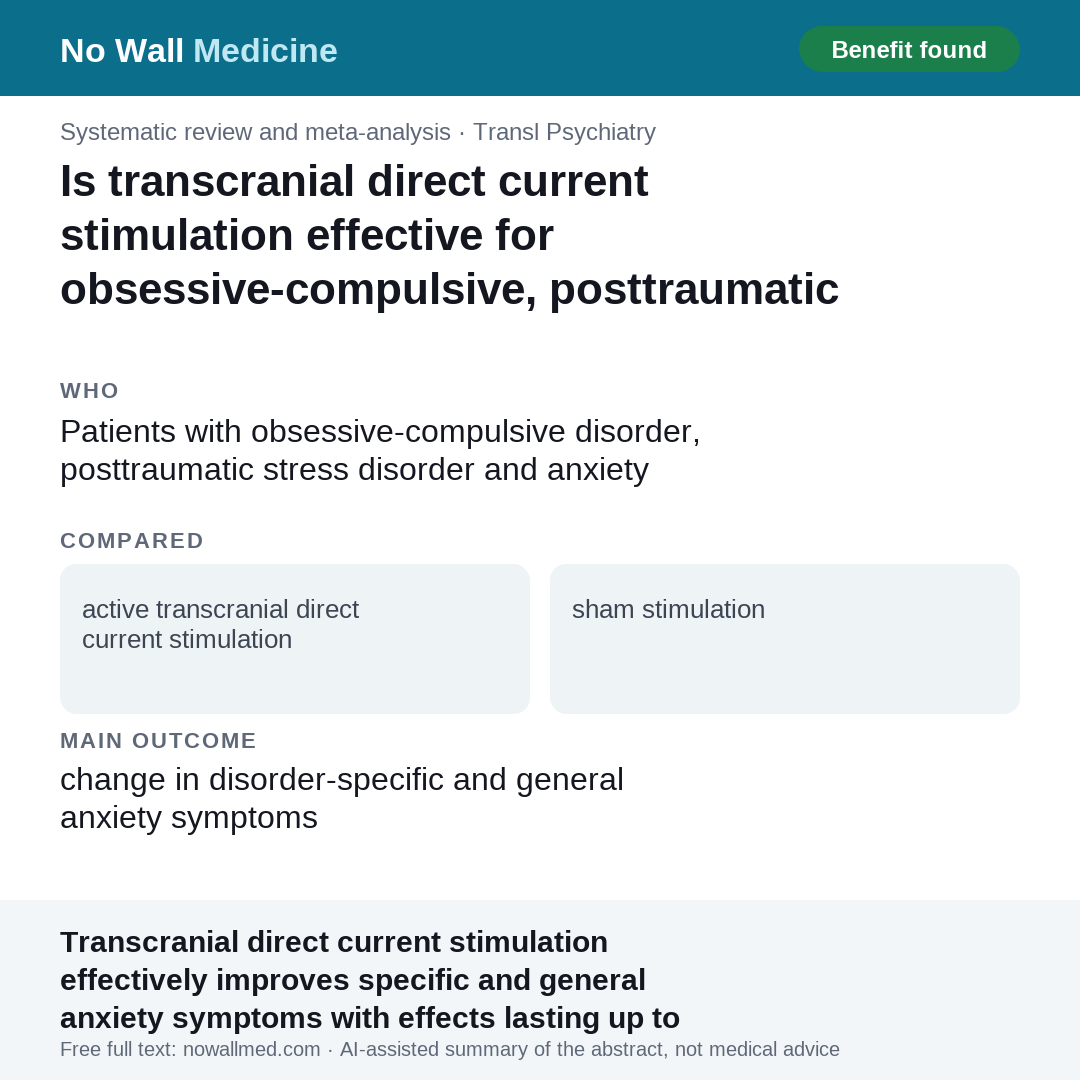
Clinical question: Is transcranial direct current stimulation effective for obsessive-compulsive, posttraumatic stress, and anxiety disorders?
Why it matters: There is ongoing debate regarding the effectiveness of transcranial direct current stimulation for treating obsessive-compulsive disorder, posttraumatic stress disorder, and anxiety disorders.
Key points
- Researchers analyzed 15 studies comparing active transcranial direct current stimulation, a non-invasive brain stimulation technique, against sham stimulation for three mental health disorders.
- The analysis showed high effects for specific symptoms (SMD = -0.73, 95% CI: -1.09 to -0.37) and general anxiety symptoms (SMD = -0.75; 95% CI: -1.23 to -0.26).
- The effects lasted up to 1 month and the stimulation was associated with immediate and significant alleviation of depressive symptoms.
Headline and key points written with AI from the paper’s abstract, with every number checked against it. Read the paper before relying on them.
Was this summary helpful?
Subject terms
Cite this article
Xie L, Hu P, Guo Z, Chen M, Wang X, Du X. Immediate and long-term efficacy of transcranial direct current stimulation (tCDS) in obsessive-compulsive disorder, posttraumatic stress disorder and anxiety disorders: a systematic review and meta-analysis. Transl Psychiatry. 2024. doi:10.1038/s41398-024-03053-0
Spotted a mistake? Suggest a correction
Top studies every Monday
The week’s key trials and guidelines in your specialties, plus any topics you follow. By email, free.
Get the weekly digest