Immediate brace removal shows similar spinal curve and balance results to gradual weaning in adolescents
Immediate vs Gradual Brace Weaning Protocols in Adolescent Idiopathic Scoliosis: A Randomized Clinical Trial
Open-labeled randomized clinical trialNo clear difference
Does gradual weaning result in better curve magnitude and truncal balance than immediate weaning?
Who
369
Adolescent idiopathic scoliosis patients ready to wean off brace wear · A territory-wide tertiary scoliosis clinic
Compared
Gradual weaning protocol: no significant difference in major Cobb angle change
Immediate weaning protocol: no significant difference in major Cobb angle change
Main outcome
Changes in major curve Cobb angle and truncal balance
Result: difference, -0.3°; 95% CI, -1.2 to 0.7 at 24-month follow-up
Bottom line: Gradual weaning did not show superiority to immediate weaning for maintaining Cobb angle, truncal balance, or health-related quality of life.
JAMA Pediatr · 2024-06-03Download image
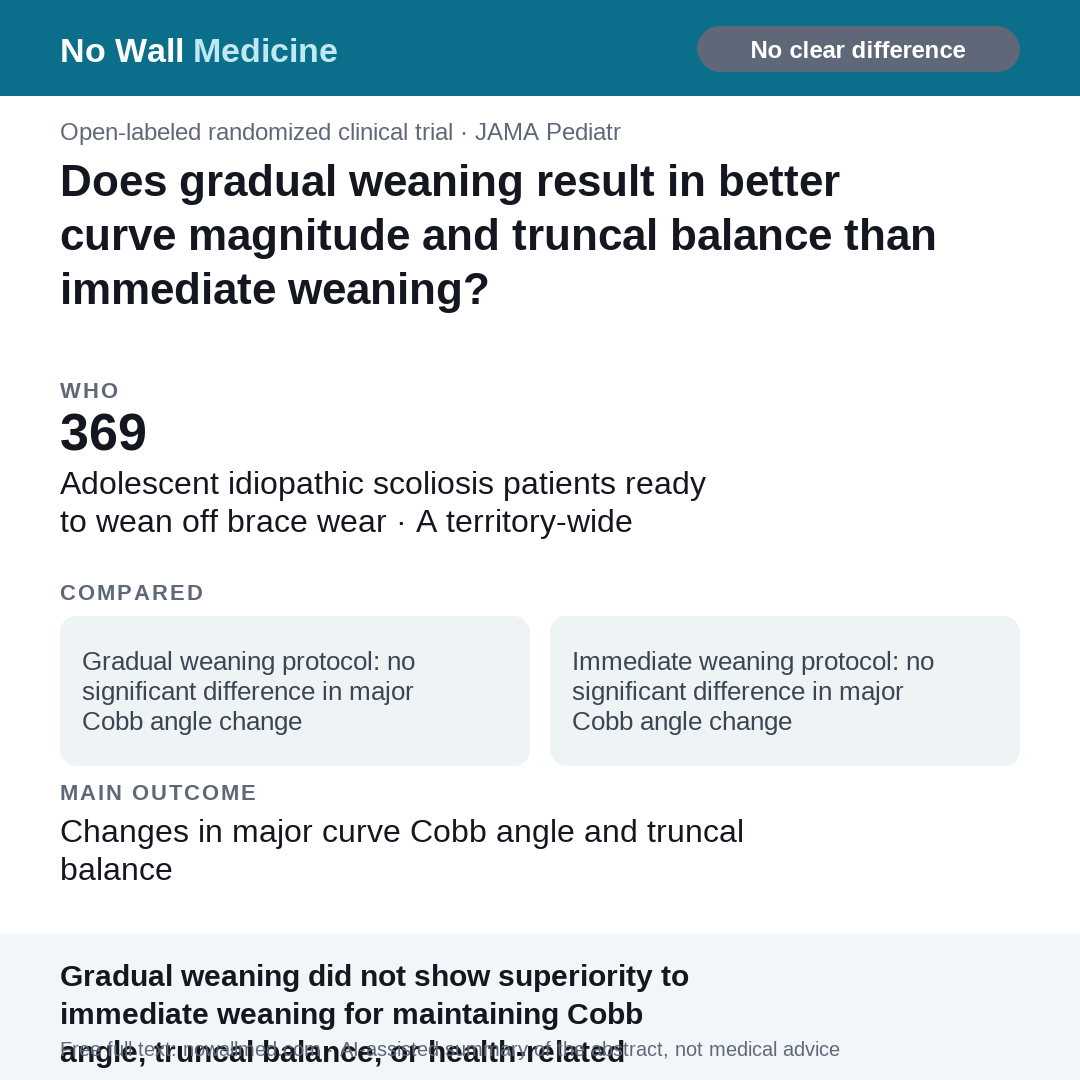
Clinical question: Does gradual weaning result in better curve magnitude and truncal balance than immediate weaning?
Why it matters: Clinicians lack consensus on whether gradual weaning prevents spinal curve deterioration better than immediate removal, which may affect spinal stiffness and quality of life.
Key points
- The study followed 369 patients with adolescent idiopathic scoliosis, comparing immediate brace removal to a gradual protocol involving 6 months of additional nighttime wear.
- There were no significant differences in the change of the major Cobb angle (the measurement of spinal curvature) at 6-month, 12-month, or 24-month follow-ups.
- Truncal balance and health-related quality of life scores also showed no significant differences between the immediate and gradual weaning groups.
Headline and key points written with AI from the paper’s abstract, with every number checked against it. Read the paper before relying on them.
Was this summary helpful?
Subject terms
Cite this article
Cheung PWH, Chan OKO, Wu H, Lai MKL, Wong LPK, Tang S. Immediate vs Gradual Brace Weaning Protocols in Adolescent Idiopathic Scoliosis: A Randomized Clinical Trial. JAMA Pediatr. 2024. doi:10.1001/jamapediatrics.2024.1484
Spotted a mistake? Suggest a correction
Top studies every Monday
The week’s key trials and guidelines in your specialties, plus any topics you follow. By email, free.
Get the weekly digest