Immersive technologies show potential for cognitive rehabilitation in dementia and mild cognitive impairment
Immersive Technologies for Cognitive Rehabilitation in Dementia and Mild Cognitive Impairment: Systematic Review
Systematic reviewMixed results
Are immersive technologies effective for cognitive rehabilitation in mild cognitive impairment and dementia?
Who
119
People with mild cognitive impairment and dementia
Compared
Virtual reality
Augmented reality
Cave Automatic Virtual Environment
Main outcome
Usability, therapeutic effects, and implementation challenges
Bottom line: Immersive technologies show promising therapeutic signals for cognitive rehabilitation but face substantial uncertainty due to methodological heterogeneity.
Limitation: Small samples, short follow-up periods, and heterogeneity in technologies and outcome measures.
J Med Internet Res · 2026-03-18Download image
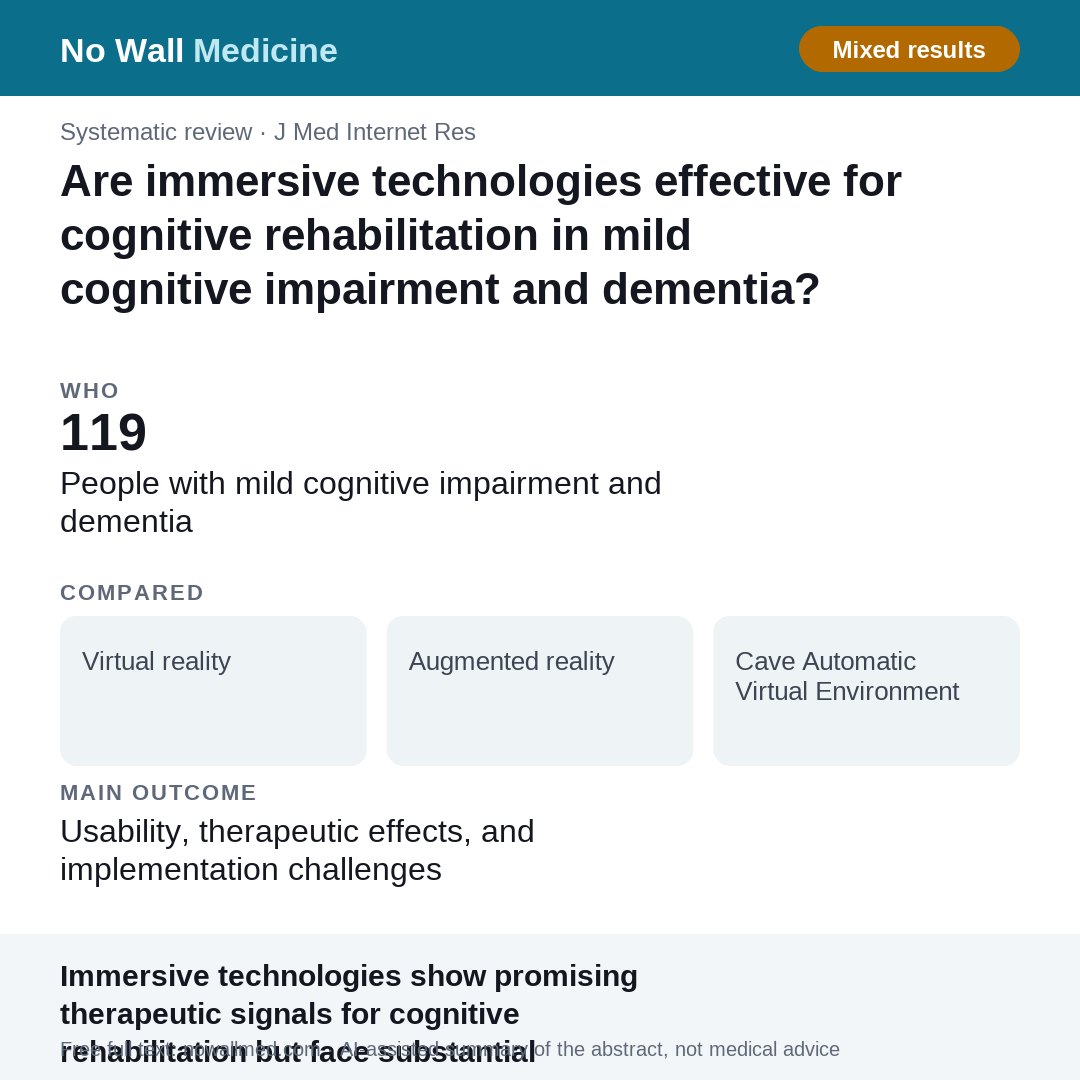
Clinical question: Are immersive technologies effective for cognitive rehabilitation in mild cognitive impairment and dementia?
Why it matters: Cognitive decline in mild cognitive impairment and dementia drives a loss of independence and increases health and social-care burdens.
Key points
- Researchers reviewed 119 studies investigating virtual reality, augmented reality, and Cave Automatic Virtual Environment systems for cognitive rehabilitation.
- Virtual reality interventions showed consistent signals of benefit for memory, attention, and executive functioning, which refers to mental skills like planning and problem-solving.
- Key barriers to using these technologies included cybersickness, interface complexity, high costs, and the need for significant staffing and space.
Limitation the authors note: The review noted that findings are limited by small sample sizes, short follow-up periods, and heterogeneity in technologies and outcome measures.
Headline and key points written with AI from the paper’s abstract, with every number checked against it. Read the paper before relying on them.
Topics
Cite this article
Konecny J, Lanza G, Buono S, Ferri R, Luca A, Martinek R. Immersive Technologies for Cognitive Rehabilitation in Dementia and Mild Cognitive Impairment: Systematic Review. J Med Internet Res. 2026. doi:10.2196/84349
Spotted a mistake? Suggest a correction