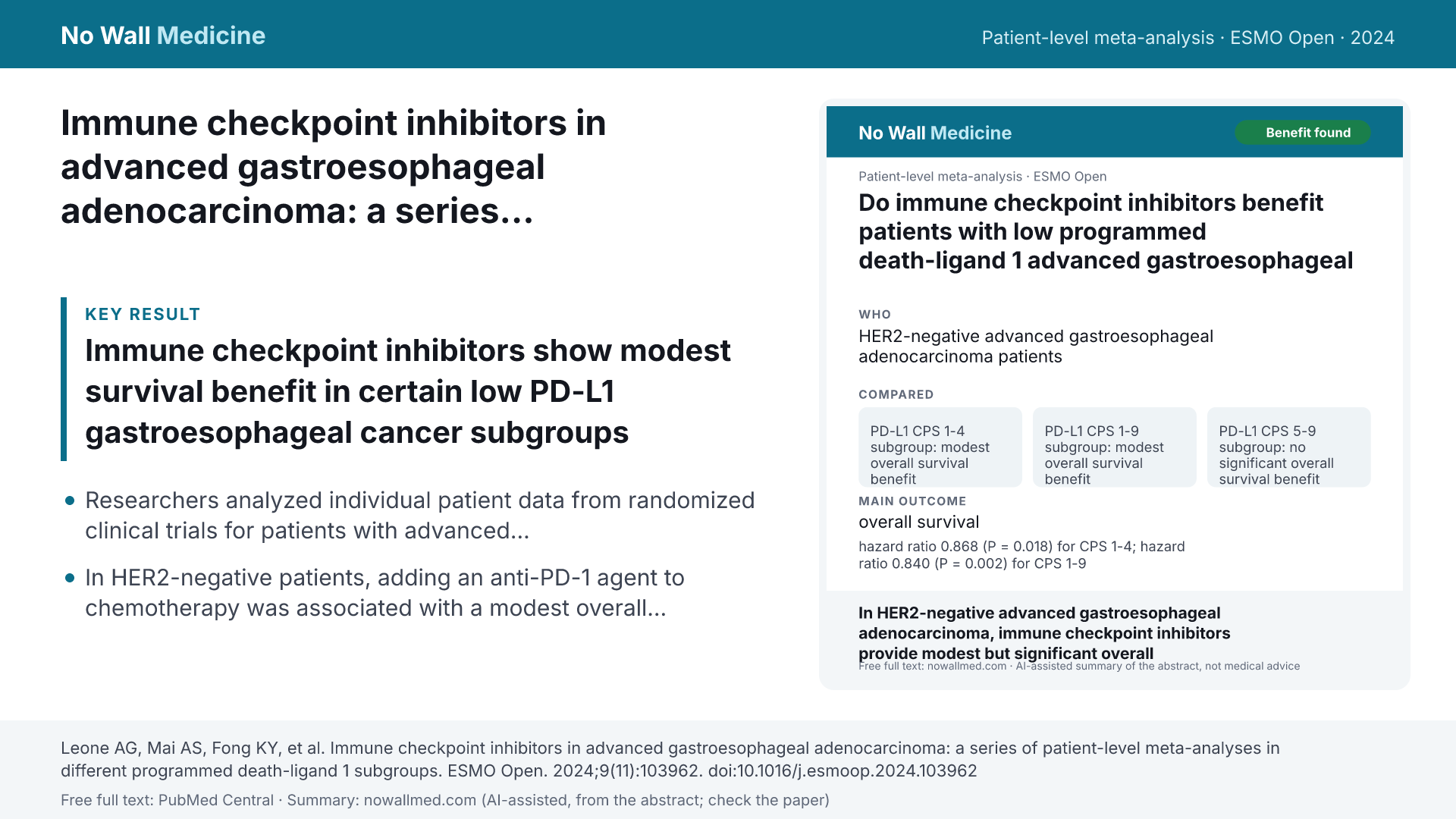
Immune checkpoint inhibitors show modest survival benefit in certain low PD-L1 gastroesophageal cancer subgroups
Immune checkpoint inhibitors in advanced gastroesophageal adenocarcinoma: a series of patient-level meta-analyses in different programmed death-ligand 1 subgroups
Patient-level meta-analysisBenefit found
Do immune checkpoint inhibitors benefit patients with low programmed death-ligand 1 advanced gastroesophageal adenocarcinoma?
Who
HER2-negative advanced gastroesophageal adenocarcinoma patients
Compared
PD-L1 CPS 1-4 subgroup: modest overall survival benefit
PD-L1 CPS 1-9 subgroup: modest overall survival benefit
PD-L1 CPS 5-9 subgroup: no significant overall survival benefit
Main outcome
overall survival
Result: hazard ratio 0.868 (P = 0.018) for CPS 1-4; hazard ratio 0.840 (P = 0.002) for CPS 1-9
Bottom line: In HER2-negative advanced gastroesophageal adenocarcinoma, immune checkpoint inhibitors provide modest but significant overall survival benefits in PD-L1 low subgroups.
ESMO Open · 2024-10-18Download image
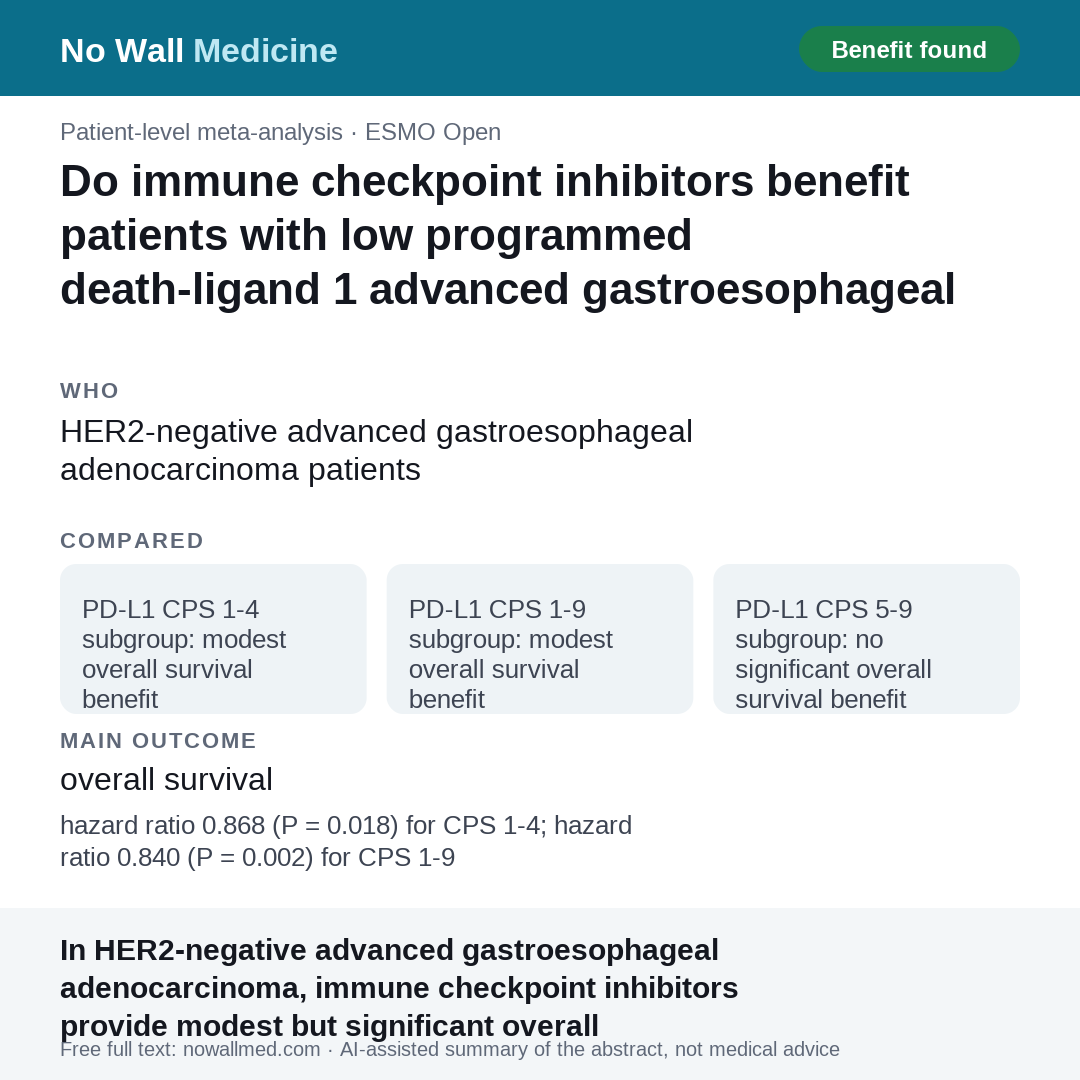
Clinical question: Do immune checkpoint inhibitors benefit patients with low programmed death-ligand 1 advanced gastroesophageal adenocarcinoma?
Why it matters: The benefit of immune checkpoint inhibitors in patients with low or negative programmed death-ligand 1 expression remains controversial.
Key points
- Researchers analyzed individual patient data from randomized clinical trials for patients with advanced gastroesophageal adenocarcinoma.
- In HER2-negative patients, adding an anti-PD-1 agent to chemotherapy was associated with a modest overall survival benefit in the PD-L1 combined positive score 1-4 subgroup (HR 0.868, P = 0.018).
- The PD-L1 combined positive score 1-9 subgroup also showed a modest overall survival benefit (HR 0.840, P = 0.002), but no significant benefit was found in the CPS 5-9 subgroup (HR 0.867, P = 0.181).
Limitation the authors note: The CPS 5-9 subgroup used in the analysis was relatively small.
Headline and key points written with AI from the paper’s abstract, with every number checked against it. Read the paper before relying on them.
Was this summary helpful?
Subject terms
Cite this article
Leone AG, Mai AS, Fong KY, et al. Immune checkpoint inhibitors in advanced gastroesophageal adenocarcinoma: a series of patient-level meta-analyses in different programmed death-ligand 1 subgroups. ESMO Open. 2024. doi:10.1016/j.esmoop.2024.103962
Spotted a mistake? Suggest a correction