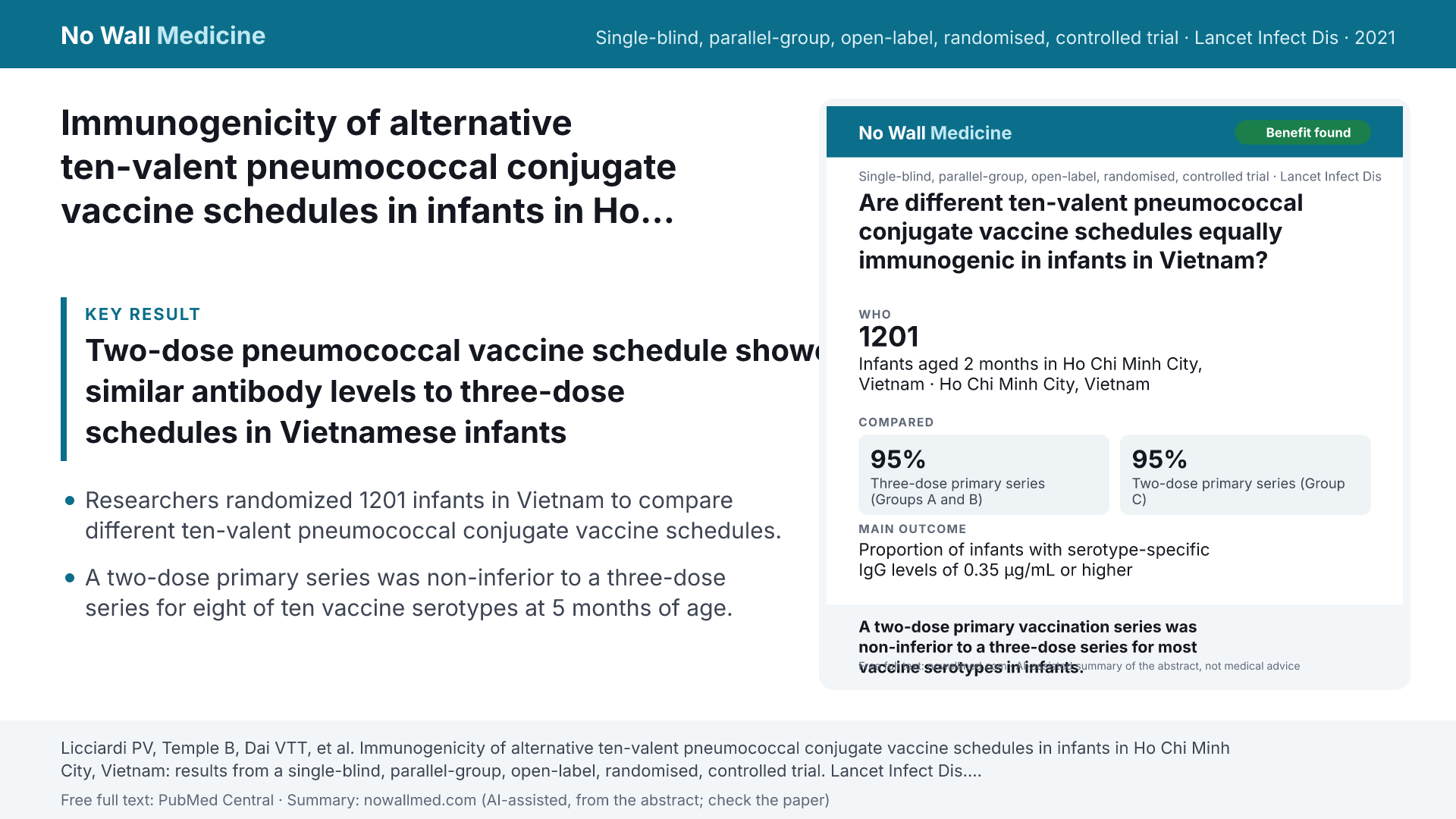
Two-dose pneumococcal vaccine schedule showed similar antibody levels to three-dose schedules in Vietnamese infants
Immunogenicity of alternative ten-valent pneumococcal conjugate vaccine schedules in infants in Ho Chi Minh City, Vietnam: results from a single-blind, parallel-group, open-label, randomised, controlled trial
Single-blind, parallel-group, open-label, randomised, controlled trialBenefit found
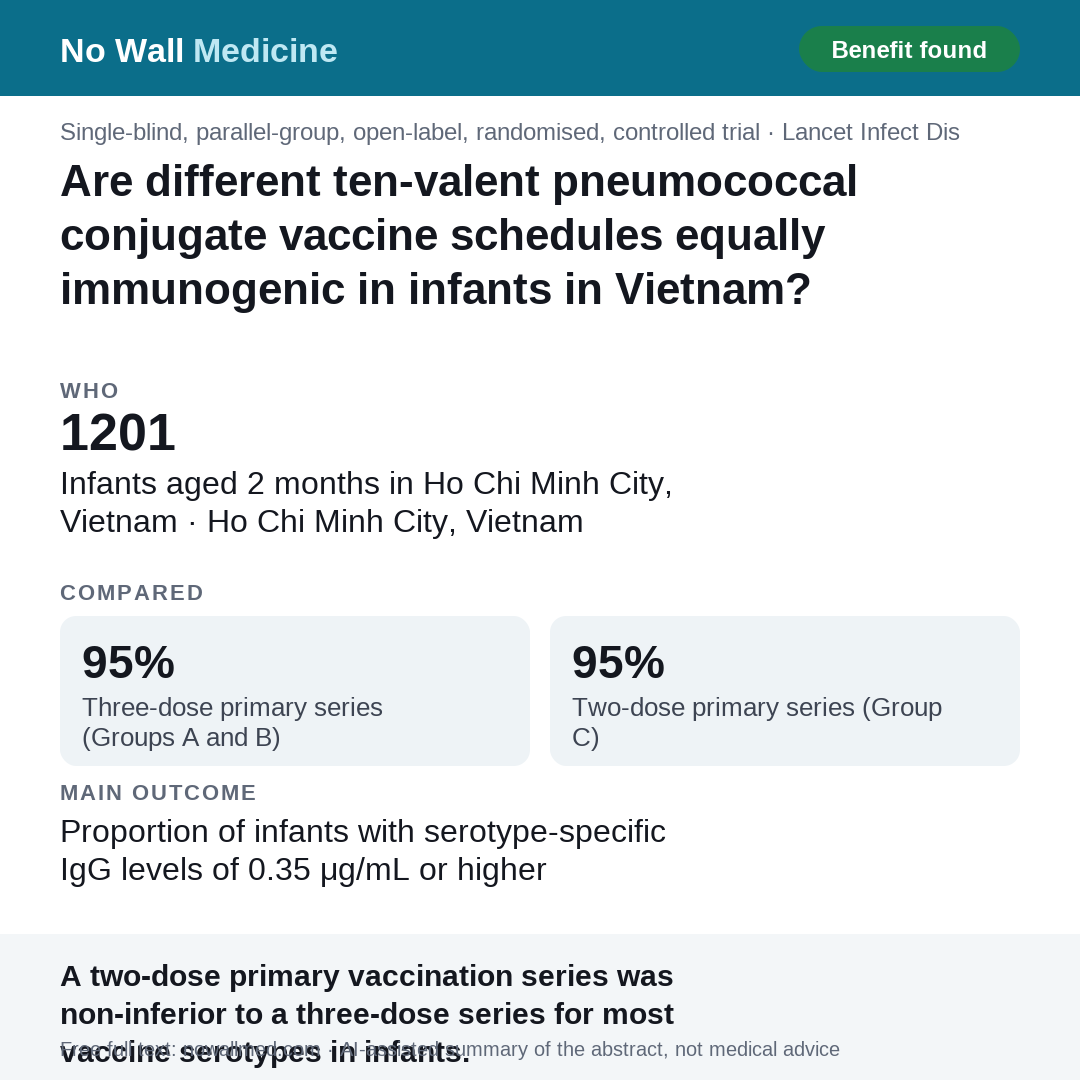
Are different ten-valent pneumococcal conjugate vaccine schedules equally immunogenic in infants in Vietnam?
Who
1201
Infants aged 2 months in Ho Chi Minh City, Vietnam · Ho Chi Minh City, Vietnam
Compared
95%Three-dose primary series (Groups A and B)
95%Two-dose primary series (Group C)
Main outcome
Proportion of infants with serotype-specific IgG levels of 0.35 μg/mL or higher
Result: non-inferior to a three-dose primary series for eight of ten vaccine serotypes
Bottom line: A two-dose primary vaccination series was non-inferior to a three-dose series for most vaccine serotypes in infants.
Funded by: Australian National Health and Medical Research Council, Bill & Melinda Gates Foundation
Lancet Infect Dis · 2021-06-23Download image
Clinical question: Are different ten-valent pneumococcal conjugate vaccine schedules equally immunogenic in infants in Vietnam?
Why it matters: Data are scarce from low-income and middle-income countries regarding which pneumococcal conjugate vaccine schedule is most effective for infant introduction.
Key points
- Researchers randomized 1201 infants in Vietnam to compare different ten-valent pneumococcal conjugate vaccine schedules.
- A two-dose primary series was non-inferior to a three-dose series for eight of ten vaccine serotypes at 5 months of age.
- Two doses given at 2 and 6 months produced higher antibody levels than doses at 2 and 4 months for most serotypes.
Headline and key points written with AI from the paper’s abstract, with every number checked against it. Read the paper before relying on them.
Was this summary helpful?
Abstract
Background
Data are scarce from low-income and middle-income countries (LMICs) to support the choice of vaccination schedule for the introduction of pneumococcal conjugate vaccines (PCV). We aimed to compare the immunogenicity of four different infant PCV10 schedules in infants in Vietnam. Methods
In this single-blind, parallel-group, open-label, randomised controlled trial, infants aged 2 months were recruited by community health staff in districts 4 and 7 of Ho Chi Minh City, Vietnam. Eligible infants had no clinically significant maternal or prenatal history and were born at or after 36 weeks' gestation. Participants were randomly assigned (3:3:5:4:5:4) using block randomisation, stratified by district, to one of six PCV10 or PCV13 vaccination schedules. Here we report results for four groups: group A, who were given PCV10 at ages 2, 3, 4, and 9 months (a 3 + 1 schedule); group B, who were vaccinated at ages 2, 3, and 4 months (3 + 0 schedule); group C, who were vaccinated at ages 2, 4, and 9·5 months (2 + 1 schedule); and group D, who were vaccinated at ages 2 and 6 months (two-dose schedule). Laboratory-based assessors were masked to group allocation. Blood samples were collected at different prespecified timepoints between ages 3-18 months depending on group allocation, within 27-43 days after vaccination, and these were analysed for serotype-specific IgG and opsonophagocytic responses. Participants were followed-up until age 24 months. The primary outcome was the proportion of infants with serotype-specific IgG levels of 0·35 μg/mL or higher at age 5 months, analysed as a non-inferiority comparison (10% margin) of the two-dose and three-dose primary series (group C vs groups A and B combined). We also compared responses 4 weeks after two doses administered at either ages 2 and 4 months (group C) or at ages 2 and 6 months (group D). The primary endpoint was analysed in the per-protocol population. Reactogenicity has been reported previously. This study is registered with ClinicalTrials.gov, NCT01953510, and is now closed to accrual. Findings
Between Sept 30, 2013, and Jan 9, 2015, 1201 infants were enrolled and randomly assigned to group A (n=152), group B (n=149), group C (n=250), group D (n=202), or groups E (n=251) and F (n=197). In groups A-D, 388 (52%) of 753 participants were female and 365 (48%) were male. 286 (95%) participants in groups A and B combined (three-dose primary series) and 237 (95%) in group C (two-dose primary series) completed the primary vaccination series and had blood samples taken within the specified time window at age 5 months (per-protocol population). At this timepoint, a two-dose primary series was non-inferior to a three-dose primary series for eight of ten vaccine serotypes; exceptions were 6B (84·6% [95% CI 79·9-88·6] of infants had protective IgG concentrations after three doses [groups A and B combined] vs 76·8% [70·9-82·0] of infants after two doses [group C]; risk difference 7·8% [90% CI 2·1-13·6]) and 23F (90·6% [95% CI 86·6-93·7] vs 77·6% [71·8-82·2]; 12·9% [90% CI 7·7-18·3]). Two doses at ages 2 and 6 months produced higher antibody levels than two doses at ages 2 and 4 months for all serotypes except 5 and 7F. Interpretation
A two-dose primary vaccination series was non-inferior to a three-dose primary vaccination series while two doses given with a wider interval between doses increased immunogenicity. The use of a two-dose primary vaccination schedule using a wider interval could be considered in LMIC settings to extend protection in the second year of life. Funding
Australian National Health and Medical Research Council, and The Bill & Melinda Gates Foundation.
Abstract reproduced under the article’s CC BY licence.
Subject terms
Cite this article
Licciardi PV, Temple B, Dai VTT, Toan NT, Uyen D, Nguyen CD. Immunogenicity of alternative ten-valent pneumococcal conjugate vaccine schedules in infants in Ho Chi Minh City, Vietnam: results from a single-blind, parallel-group, open-label, randomised, controlled trial. Lancet Infect Dis. 2021. doi:10.1016/S1473-3099(20)30775-1
Spotted a mistake? Suggest a correction