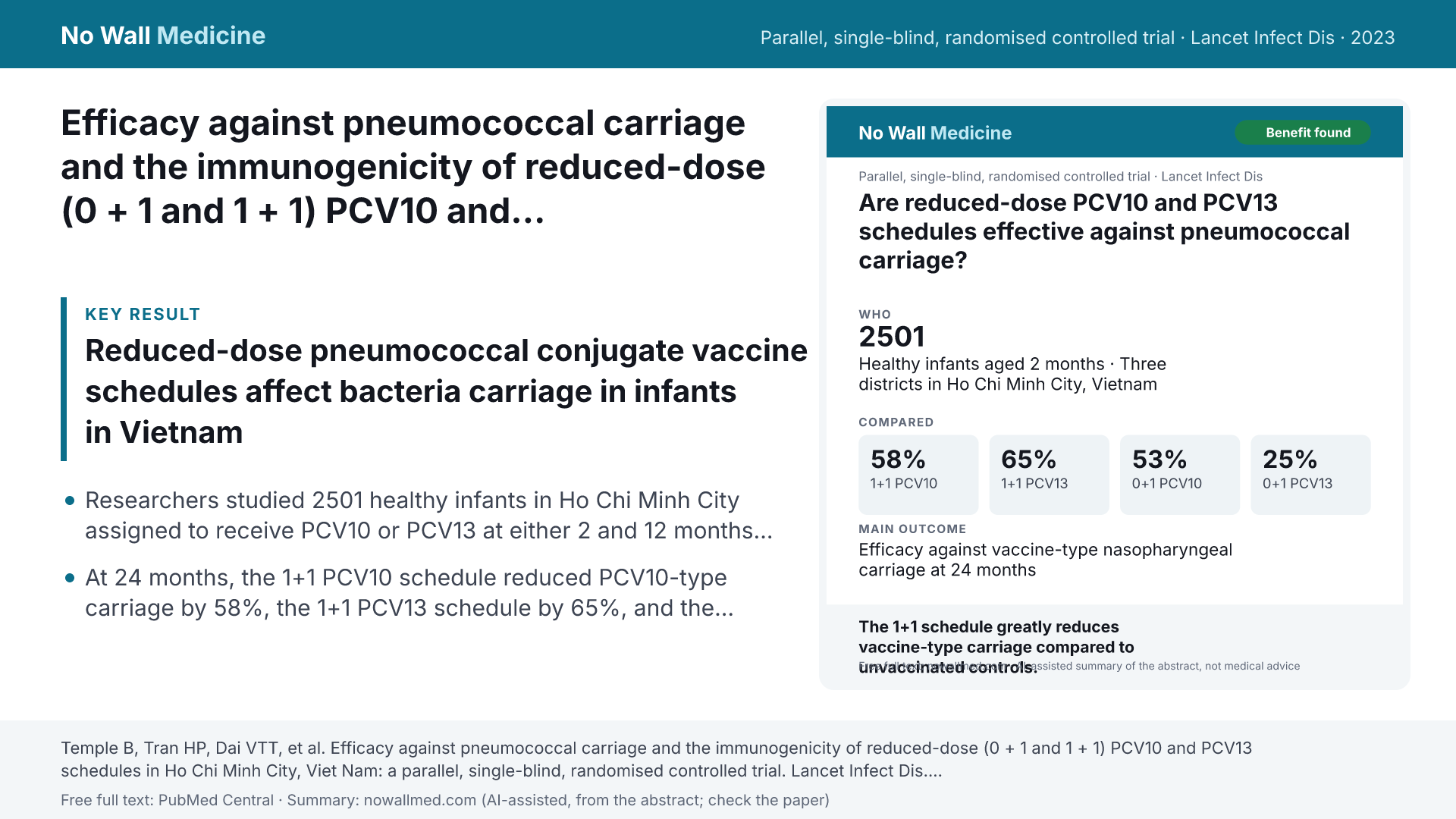
Reduced-dose pneumococcal conjugate vaccine schedules affect bacteria carriage in infants in Vietnam
Efficacy against pneumococcal carriage and the immunogenicity of reduced-dose (0 + 1 and 1 + 1) PCV10 and PCV13 schedules in Ho Chi Minh City, Viet Nam: a parallel, single-blind, randomised controlled trial
Parallel, single-blind, randomised controlled trialBenefit found
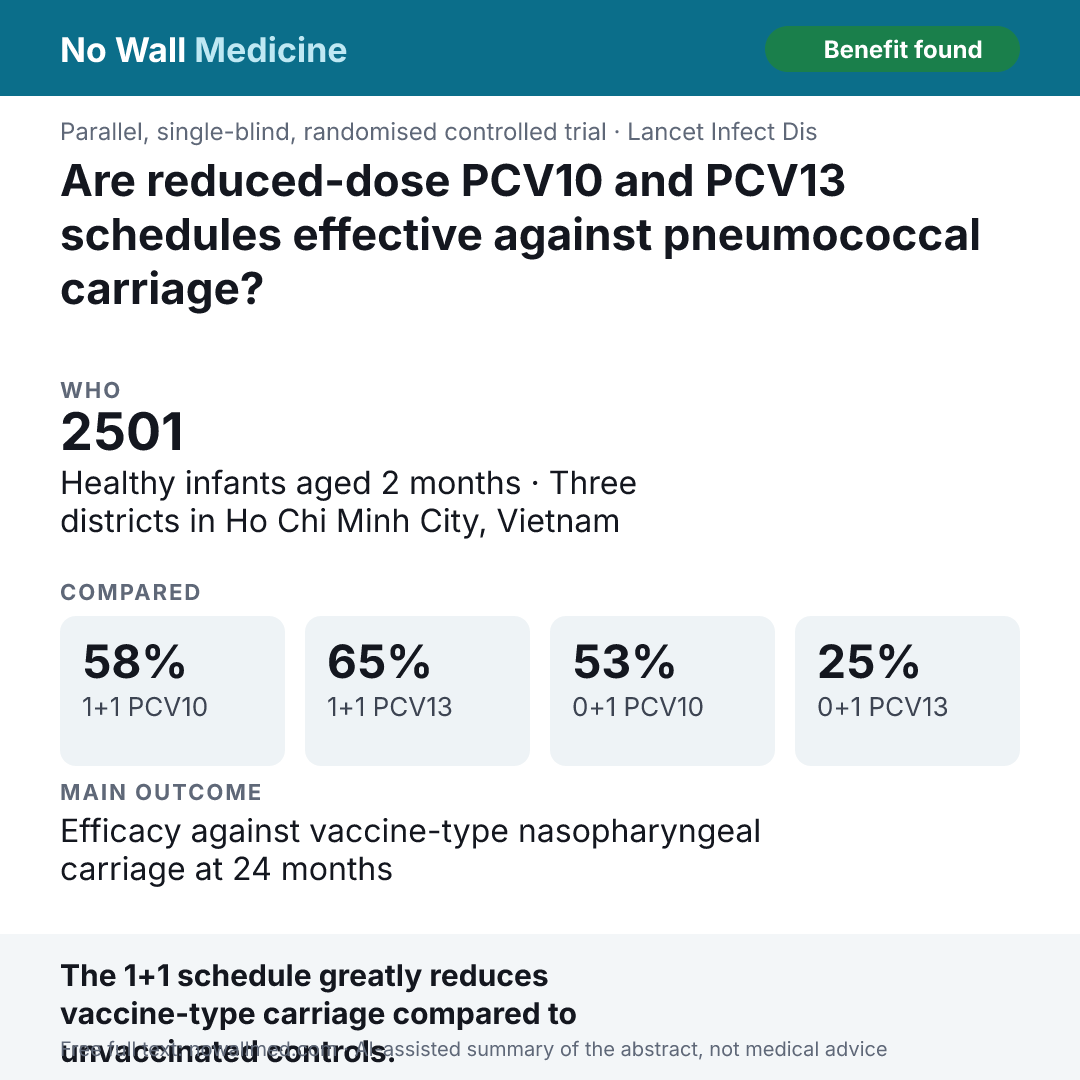
Are reduced-dose PCV10 and PCV13 schedules effective against pneumococcal carriage?
Who
2501
Healthy infants aged 2 months · Three districts in Ho Chi Minh City, Vietnam
Compared
58%1+1 PCV10 (95% CI 25 to 77)
65%1+1 PCV13 (42 to 79)
53%0+1 PCV10 (17 to 73)
25%0+1 PCV13 (-7 to 48)
Main outcome
Efficacy against vaccine-type nasopharyngeal carriage at 24 months
Bottom line: The 1+1 schedule greatly reduces vaccine-type carriage compared to unvaccinated controls.
Funded by: Bill & Melinda Gates Foundation
Lancet Infect Dis · 2023-04-14 · Save PNG
Clinical question: Are reduced-dose PCV10 and PCV13 schedules effective against pneumococcal carriage?
Key points
- Researchers studied 2501 healthy infants in Ho Chi Minh City assigned to receive PCV10 or PCV13 at either 2 and 12 months or only at 12 months.
- At 24 months, the 1+1 PCV10 schedule reduced PCV10-type carriage by 58%, the 1+1 PCV13 schedule by 65%, and the 0+1 PCV10 schedule by 53%.
- The 0+1 PCV13 schedule showed a non-significant 25% reduction in PCV13-type carriage compared to the unvaccinated control group.
Headline and key points written with AI from the paper’s abstract, with every number checked against it. Read the paper before relying on them.
Was this summary helpful?
Abstract
Background
Interest in reduced-dose pneumococcal conjugate vaccine (PCV) schedules is growing, but data on their ability to provide direct and indirect protection are scarce. We evaluated 1 + 1 (at 2 months and 12 months) and 0 + 1 (at 12 months) schedules of PCV10 or PCV13 in a predominately unvaccinated population. Methods
In this parallel, single-blind, randomised controlled trial, healthy infants aged 2 months were recruited from birth records in three districts in Ho Chi Minh City, Vietnam, and assigned (4:4:4:4:9) to one of five groups: PCV10 at 12 months of age (0 + 1 PCV10), PCV13 at 12 months of age (0 + 1 PCV13), PCV10 at 2 months and 12 months of age (1 + 1 PCV10), PCV13 at 2 months and 12 months of age (1 + 1 PCV13), and unvaccinated control. Outcome assessors were masked to group allocation, and the infants' caregivers and those administering vaccines were not. Nasopharyngeal swabs collected at 6 months, 12 months, 18 months, and 24 months were analysed for pneumococcal carriage. Blood samples collected from a subset of participants (200 per group) at various timepoints were analysed by ELISA and opsonophagocytic assay. The primary outcome was the efficacy of each schedule against vaccine-type carriage at 24 months, analysed by intention to treat for all those with a nasopharyngeal swab available. This trial is registered at ClinicalTrials.gov, NCT03098628. Findings
2501 infants were enrolled between March 8, 2017, and July 24, 2018 and randomly assigned to study groups (400 to 0 + 1 PCV10, 400 to 0 + 1 PCV13, 402 to 1 + 1 PCV10, 401 to 1 + 1 PCV13, and 898 to control). Analysis of the primary endpoint included 341 participants for 0 + 1 PCV10, 356 0 + 1 PCV13, 358 1 + 1 PCV10, 350 1 + 1 PCV13, and 758 control. At 24 months, a 1 + 1 PCV10 schedule reduced PCV10-type carriage by 58% (95% CI 25 to 77), a 1 + 1 PCV13 schedule reduced PCV13-type carriage by 65% (42 to 79), a 0 + 1 PCV10 schedule reduced PCV10-type carriage by 53% (17 to 73), and a 0 + 1 PCV13 schedule non-significantly reduced PCV13-type carriage by 25% (-7 to 48) compared with the unvaccinated control group. Reactogenicity and serious adverse events were similar across groups. Interpretation
A 1 + 1 PCV schedule greatly reduces vaccine-type carriage and is likely to generate substantial herd protection and provide some degree of individual protection during the first year of life. Such a schedule is suitable for mature PCV programmes or for introduction in conjunction with a comprehensive catch-up campaign, and potentially could be most effective given as a mixed regimen (PCV10 then PCV13). A 0 + 1 PCV schedule has some effect on carriage along with a reasonable immune response and could be considered for use in humanitarian crises or remote settings. Funding
Bill & Melinda Gates Foundation. Translation
For the Vietnamese translation of the abstract see Supplementary Materials section.
Abstract reproduced under the article’s CC BY licence.
Subject terms
Headline, design, result, key points, caveat and citation as plain text.
Cite this article
Temple B, Tran HP, Dai VTT, et al. Efficacy against pneumococcal carriage and the immunogenicity of reduced-dose (0 + 1 and 1 + 1) PCV10 and PCV13 schedules in Ho Chi Minh City, Viet Nam: a parallel, single-blind, randomised controlled trial. Lancet Infect Dis. 2023;23(8):933-944. doi:10.1016/S1473-3099(23)00061-0
Spotted a mistake? Suggest a correction