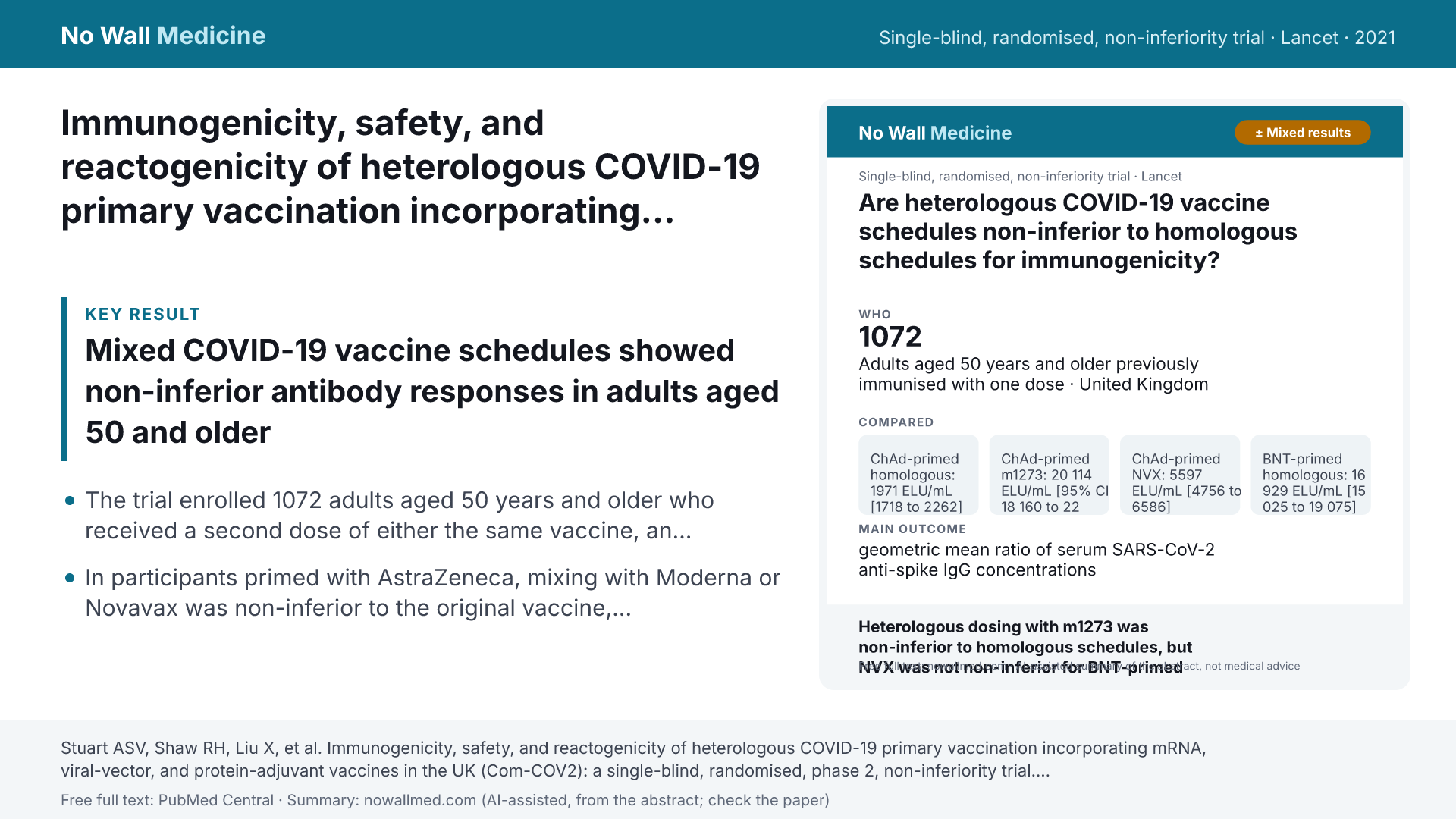
Mixed COVID-19 vaccine schedules showed non-inferior antibody responses in adults aged 50 and older
Immunogenicity, safety, and reactogenicity of heterologous COVID-19 primary vaccination incorporating mRNA, viral-vector, and protein-adjuvant vaccines in the UK (Com-COV2): a single-blind, randomised, phase 2, non-inferiority trial
Single-blind, randomised, non-inferiority trialMixed results
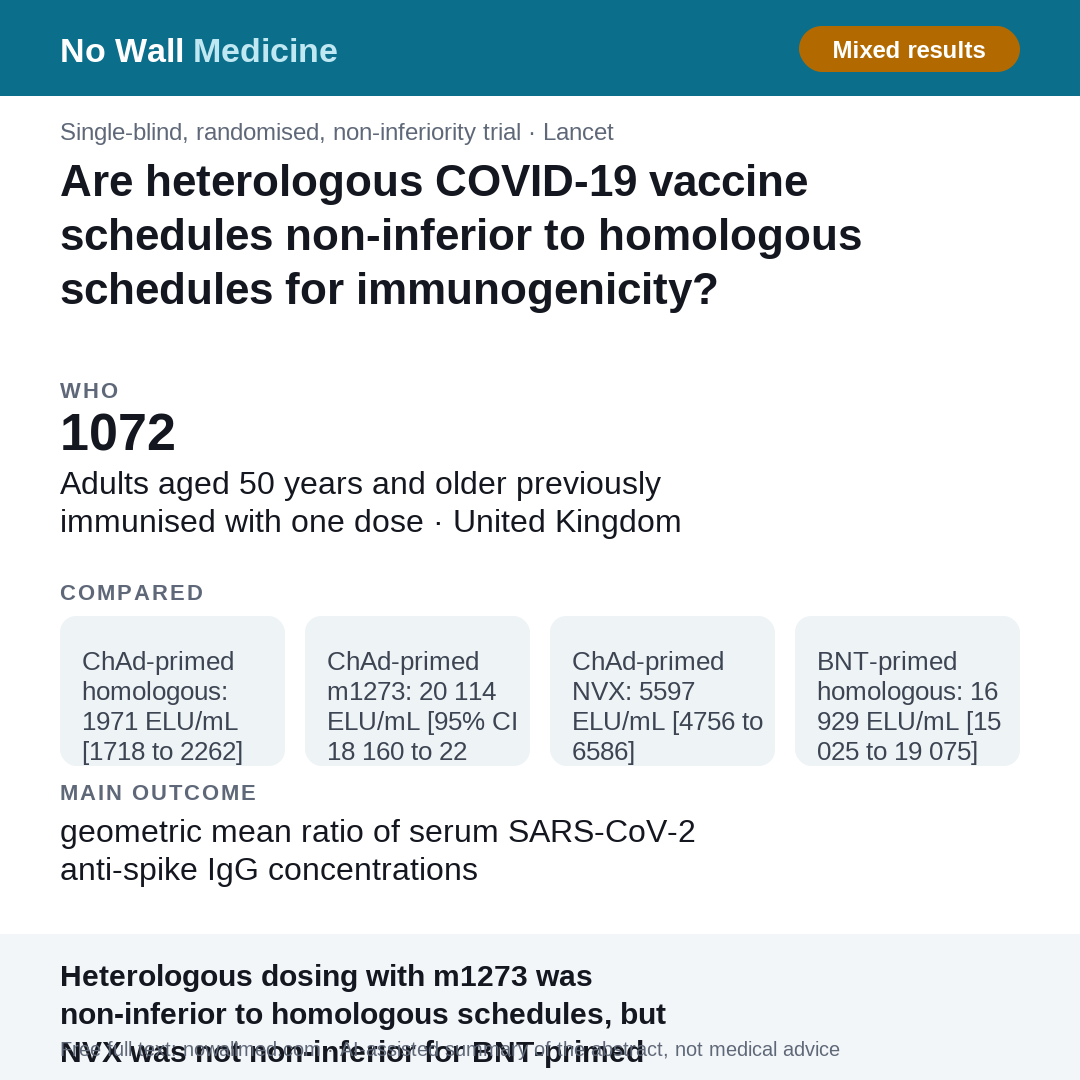
Are heterologous COVID-19 vaccine schedules non-inferior to homologous schedules for immunogenicity?
Who
1072
Adults aged 50 years and older previously immunised with one dose · United Kingdom
Compared
ChAd-primed homologous: 1971 ELU/mL [1718 to 2262]
ChAd-primed m1273: 20 114 ELU/mL [95% CI 18 160 to 22 279]
ChAd-primed NVX: 5597 ELU/mL [4756 to 6586]
BNT-primed homologous: 16 929 ELU/mL [15 025 to 19 075]
Main outcome
geometric mean ratio of serum SARS-CoV-2 anti-spike IgG concentrations
Result: GMR 10·2 (one-sided 98·75% CI 8·4 to ∞) for ChAd/m1273; GMR 1·3 (one-sided 98·75% CI 1·1 to ∞) for BNT/m1273
Bottom line: Heterologous dosing with m1273 was non-inferior to homologous schedules, but NVX was not non-inferior for BNT-primed participants.
Funded by: UK Vaccine Task Force, CEPI, and National Institute for Health Research
Lancet · 2021-12-06Download image
Clinical question: Are heterologous COVID-19 vaccine schedules non-inferior to homologous schedules for immunogenicity?
Why it matters: It was unknown if using different types of COVID-19 vaccines for the second dose would provide sufficient antibody responses compared to using the same vaccine twice.
Key points
- The trial enrolled 1072 adults aged 50 years and older who received a second dose of either the same vaccine, an mRNA vaccine, or a protein-adjuvant vaccine.
- In participants primed with AstraZeneca, mixing with Moderna or Novavax was non-inferior to the original vaccine, with geometric mean concentrations of 20114 ELU/mL and 5597 ELU/mL respectively.
- In participants primed with Pfizer-BioNTech, mixing with Moderna was non-inferior, but mixing with Novavax did not meet the non-inferiority criterion despite an 18-fold rise in antibodies.
Headline and key points written with AI from the paper’s abstract, with every number checked against it. Read the paper before relying on them.
Was this summary helpful?
Subject terms
Cite this article
Stuart ASV, Shaw RH, Liu X, Greenland M, Aley PK, Andrews NJ. Immunogenicity, safety, and reactogenicity of heterologous COVID-19 primary vaccination incorporating mRNA, viral-vector, and protein-adjuvant vaccines in the UK (Com-COV2): a single-blind, randomised, phase 2, non-inferiority trial. Lancet. 2021. doi:10.1016/S0140-6736(21)02718-5
Spotted a mistake? Suggest a correction
Top studies every Monday
The week’s key trials and guidelines in your specialties, plus any topics you follow. By email, free.
Get the weekly digest