mRNA COVID-19 fourth-dose boosters increase antibody levels and T-cell immune responses
Safety, immunogenicity, and reactogenicity of BNT162b2 and mRNA-1273 COVID-19 vaccines given as fourth-dose boosters following two doses of ChAdOx1 nCoV-19 or BNT162b2 and a third dose of BNT162b2 (COV-BOOST): a multicentre, blinded, phase 2, randomised trial
Multicentre, blinded, phase 2, randomised controlled trialBenefit found
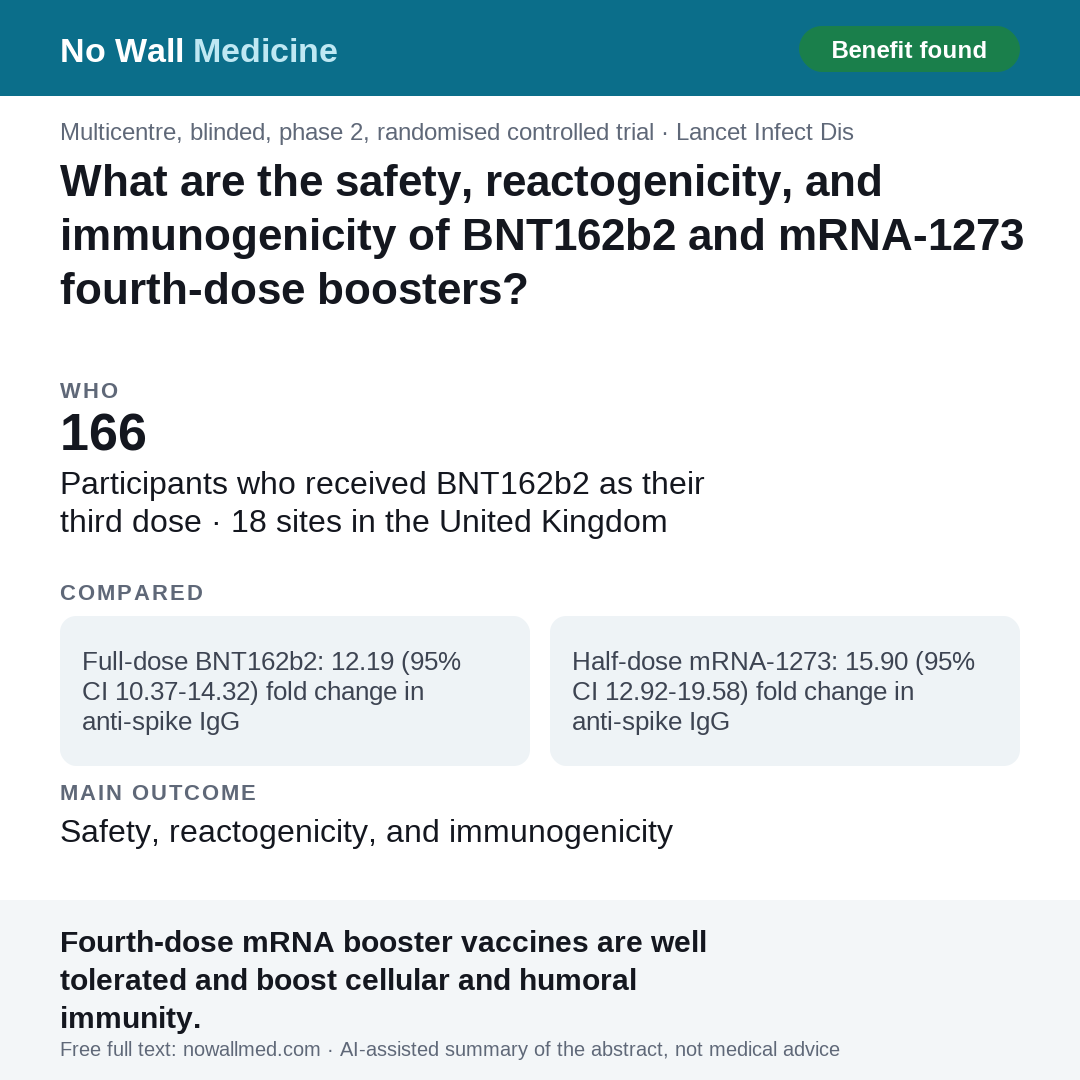
What are the safety, reactogenicity, and immunogenicity of BNT162b2 and mRNA-1273 fourth-dose boosters?
Who
166
Participants who received BNT162b2 as their third dose · 18 sites in the United Kingdom
Compared
Full-dose BNT162b2: 12.19 (95% CI 10.37-14.32) fold change in anti-spike IgG
Half-dose mRNA-1273: 15.90 (95% CI 12.92-19.58) fold change in anti-spike IgG
Main outcome
Safety, reactogenicity, and immunogenicity
Bottom line: Fourth-dose mRNA booster vaccines are well tolerated and boost cellular and humoral immunity.
Funded by: UK Vaccine Task Force and National Institute for Health Research
Lancet Infect Dis · 2022-05-09Download image
Clinical question: What are the safety, reactogenicity, and immunogenicity of BNT162b2 and mRNA-1273 fourth-dose boosters?
Why it matters: The clinical need, effectiveness, timing, and dose of a fourth COVID-19 vaccine dose remain uncertain.
Key points
- The trial randomized 166 participants who had previously received a third dose of BNT162b2 to receive either a full dose of BNT162b2 or a half dose of mRNA-1273.
- After the fourth dose, anti-spike protein IgG concentrations increased by a geometric mean fold change of 12.19 in the BNT162b2 group and 15.90 in the mRNA-1273 group.
- T-cell responses also increased, with fold changes for the wild-type variant of 7.32 in the BNT162b2 group and 6.22 in the mRNA-1273 group.
Headline and key points written with AI from the paper’s abstract, with every number checked against it. Read the paper before relying on them.
Was this summary helpful?
Abstract
Background
Some high-income countries have deployed fourth doses of COVID-19 vaccines, but the clinical need, effectiveness, timing, and dose of a fourth dose remain uncertain. We aimed to investigate the safety, reactogenicity, and immunogenicity of fourth-dose boosters against COVID-19. Methods
The COV-BOOST trial is a multicentre, blinded, phase 2, randomised controlled trial of seven COVID-19 vaccines given as third-dose boosters at 18 sites in the UK. This sub-study enrolled participants who had received BNT162b2 (Pfizer-BioNTech) as their third dose in COV-BOOST and randomly assigned them (1:1) to receive a fourth dose of either BNT162b2 (30 μg in 0·30 mL; full dose) or mRNA-1273 (Moderna; 50 μg in 0·25 mL; half dose) via intramuscular injection into the upper arm. The computer-generated randomisation list was created by the study statisticians with random block sizes of two or four. Participants and all study staff not delivering the vaccines were masked to treatment allocation. The coprimary outcomes were safety and reactogenicity, and immunogenicity (anti-spike protein IgG titres by ELISA and cellular immune response by ELISpot). We compared immunogenicity at 28 days after the third dose versus 14 days after the fourth dose and at day 0 versus day 14 relative to the fourth dose. Safety and reactogenicity were assessed in the per-protocol population, which comprised all participants who received a fourth-dose booster regardless of their SARS-CoV-2 serostatus. Immunogenicity was primarily analysed in a modified intention-to-treat population comprising seronegative participants who had received a fourth-dose booster and had available endpoint data. This trial is registered with ISRCTN, 73765130, and is ongoing. Findings
Between Jan 11 and Jan 25, 2022, 166 participants were screened, randomly assigned, and received either full-dose BNT162b2 (n=83) or half-dose mRNA-1273 (n=83) as a fourth dose. The median age of these participants was 70·1 years (IQR 51·6-77·5) and 86 (52%) of 166 participants were female and 80 (48%) were male. The median interval between the third and fourth doses was 208·5 days (IQR 203·3-214·8). Pain was the most common local solicited adverse event and fatigue was the most common systemic solicited adverse event after BNT162b2 or mRNA-1273 booster doses. None of three serious adverse events reported after a fourth dose with BNT162b2 were related to the study vaccine. In the BNT162b2 group, geometric mean anti-spike protein IgG concentration at day 28 after the third dose was 23 325 ELISA laboratory units (ELU)/mL (95% CI 20 030-27 162), which increased to 37 460 ELU/mL (31 996-43 857) at day 14 after the fourth dose, representing a significant fold change (geometric mean 1·59, 95% CI 1·41-1·78). There was a significant increase in geometric mean anti-spike protein IgG concentration from 28 days after the third dose (25 317 ELU/mL, 95% CI 20 996-30 528) to 14 days after a fourth dose of mRNA-1273 (54 936 ELU/mL, 46 826-64 452), with a geometric mean fold change of 2·19 (1·90-2·52). The fold changes in anti-spike protein IgG titres from before (day 0) to after (day 14) the fourth dose were 12·19 (95% CI 10·37-14·32) and 15·90 (12·92-19·58) in the BNT162b2 and mRNA-1273 groups, respectively. T-cell responses were also boosted after the fourth dose (eg, the fold changes for the wild-type variant from before to after the fourth dose were 7·32 [95% CI 3·24-16·54] in the BNT162b2 group and 6·22 [3·90-9·92] in the mRNA-1273 group). Interpretation
Fourth-dose COVID-19 mRNA booster vaccines are well tolerated and boost cellular and humoral immunity. Peak responses after the fourth dose were similar to, and possibly better than, peak responses after the third dose. Funding
UK Vaccine Task Force and National Institute for Health Research.
Abstract reproduced under the article’s CC BY licence.
Subject terms
Cite this article
Munro APS, Feng S, Janani L, Cornelius V, Aley PK, Babbage G. Safety, immunogenicity, and reactogenicity of BNT162b2 and mRNA-1273 COVID-19 vaccines given as fourth-dose boosters following two doses of ChAdOx1 nCoV-19 or BNT162b2 and a third dose of BNT162b2 (COV-BOOST): a multicentre, blinded, phase 2, randomised trial. Lancet Infect Dis. 2022. doi:10.1016/S1473-3099(22)00271-7
Spotted a mistake? Suggest a correction
Top studies every Monday
The week’s key trials and guidelines in your specialties, plus any topics you follow. By email, free.
Get the weekly digest