Immunological biomarkers in early-stage lung cancer radiation therapy mostly predict outcomes rather than treatment response
Immunological biomarkers for precision stereotactic body radiation therapy in early-stage non-small cell lung cancer: a systematic review
Systematic reviewMixed results
What are the immunological biomarkers for early-stage non-small cell lung cancer treated with SBRT?
Who
1019
Patients with stage I-II non-small cell lung cancer treated with SBRT
Compared
Elevated neutrophil-to-lymphocyte ratio or platelet-to-lymphocyte ratio: consistently associated with poorer survival
Higher CD44 expression: increased risk of recurrence after SBRT
Main outcome
Prognostic and predictive immunological biomarkers and oncological outcomes
Bottom line: Current evidence highlights the predominance of prognostic rather than predictive immunological biomarkers in early-stage non-small cell lung cancer.
Limitation: Heterogeneity in biomarkers, outcome definitions, and analytical approaches prevented formal meta-analysis.
Funded by: MONDRIAN trial
eClinicalMedicine · 2026-07-24Download image
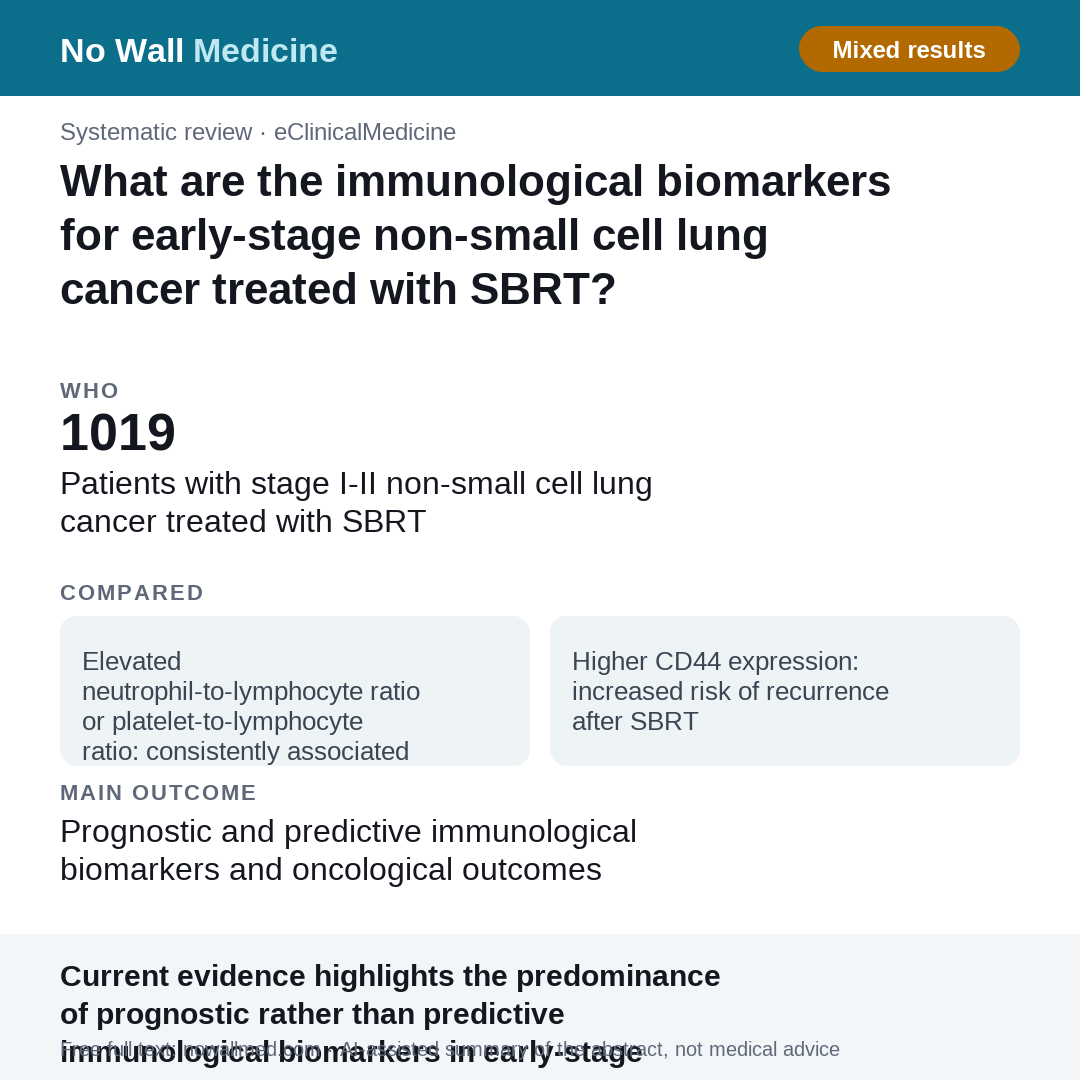
Clinical question: What are the immunological biomarkers for early-stage non-small cell lung cancer treated with SBRT?
Why it matters: Doctors need biomarkers to guide treatment selection, estimate recurrence risk, or identify patients who might benefit from intensified treatment for early-stage lung cancer.
Key points
- Researchers reviewed ten studies involving 1019 patients to examine how immune system markers relate to outcomes after stereotactic body radiation therapy.
- Elevated baseline levels of the neutrophil-to-lymphocyte ratio and platelet-to-lymphocyte ratio were consistently linked to poorer survival.
- While CD44 expression correlated with higher recurrence risk, immune-profiling signatures did not demonstrate predictive value for how patients respond to radiation.
Limitation the authors note: The authors could not perform a formal meta-analysis or assess publication bias due to the heterogeneity of biomarkers, outcome definitions, and analytical approaches.
Headline and key points written with AI from the paper’s abstract, with every number checked against it. Read the paper before relying on them.
Spotted a mistake? Suggest a correction