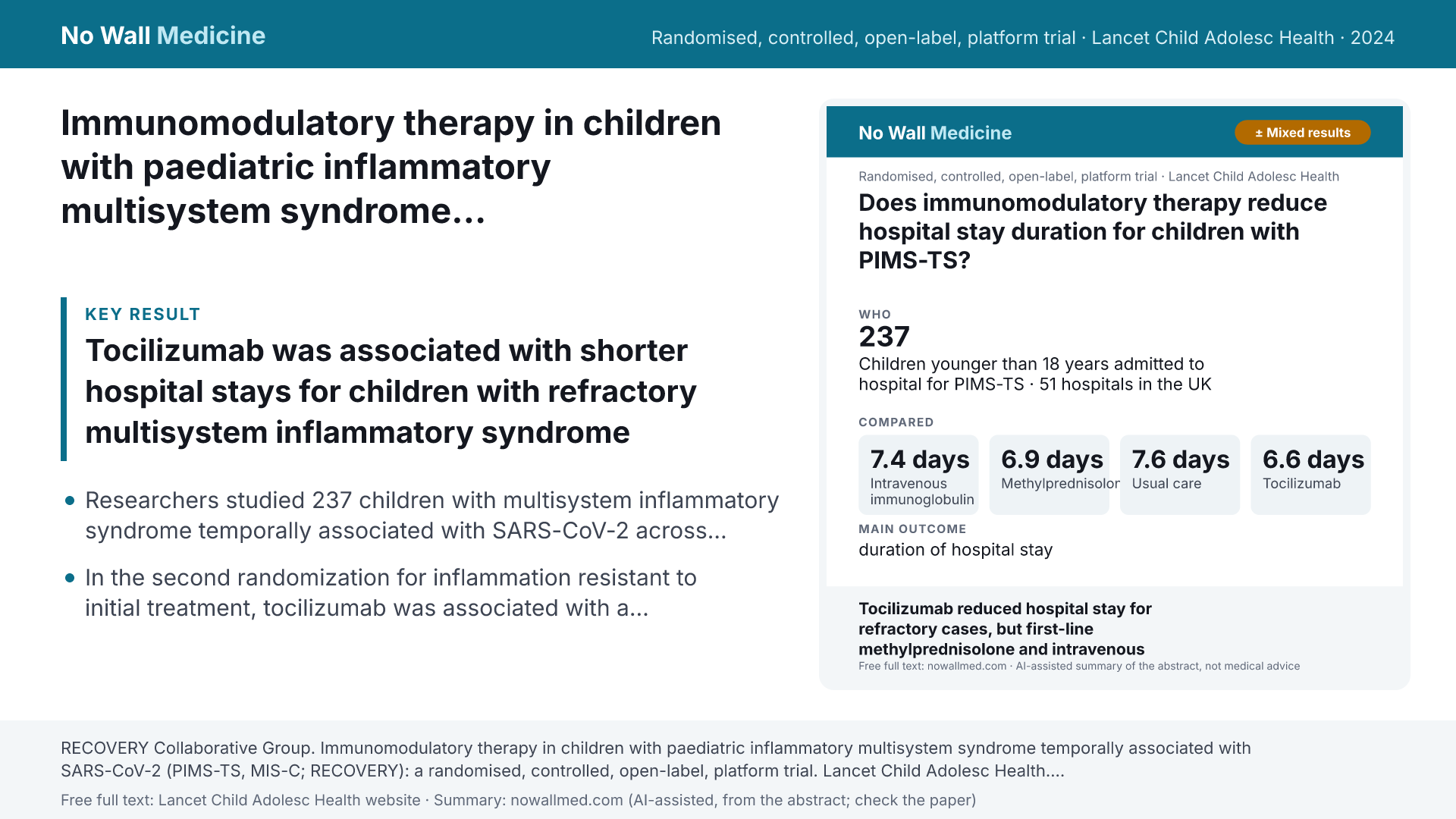
Tocilizumab was associated with shorter hospital stays for children with refractory multisystem inflammatory syndrome
Immunomodulatory therapy in children with paediatric inflammatory multisystem syndrome temporally associated with SARS-CoV-2 (PIMS-TS, MIS-C; RECOVERY): a randomised, controlled, open-label, platform trial
Randomised, controlled, open-label, platform trialMixed results
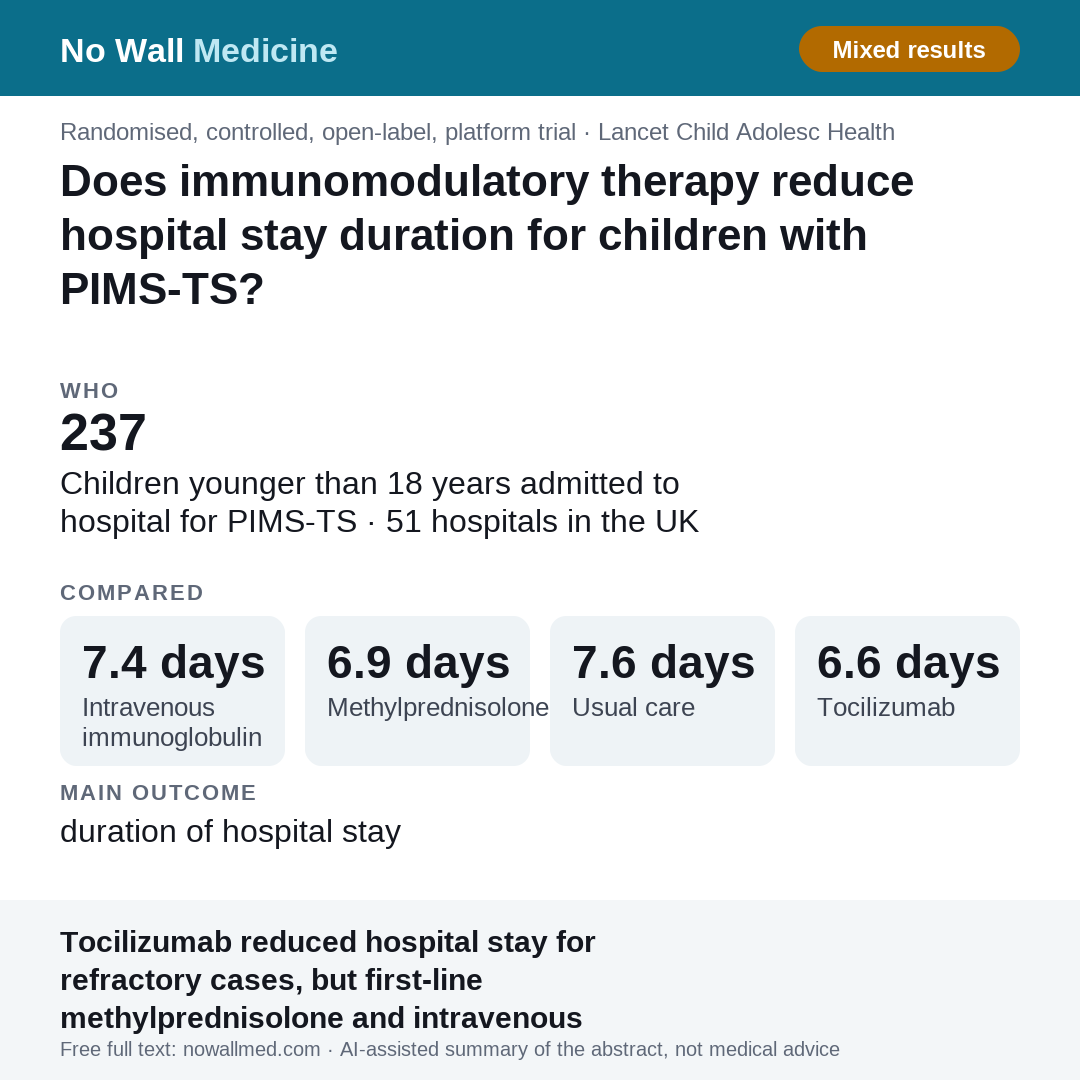
Does immunomodulatory therapy reduce hospital stay duration for children with PIMS-TS?
Who
237
Children younger than 18 years admitted to hospital for PIMS-TS · 51 hospitals in the UK
Compared
7.4 daysIntravenous immunoglobulin (SD 0.4)
6.9 daysMethylprednisolone (SD 0.5)
7.6 daysUsual care (0.4)
6.6 daysTocilizumab (SD 0.7)
Main outcome
duration of hospital stay
Result: difference -3.3 days, 95% CrI -5.6 to -1.0
Bottom line: Tocilizumab reduced hospital stay for refractory cases, but first-line methylprednisolone and intravenous immunoglobulin showed no significant difference from usual care.
Lancet Child Adolesc Health · 2024-01-22Download image
Clinical question: Does immunomodulatory therapy reduce hospital stay duration for children with PIMS-TS?
Why it matters: It was unknown whether intravenous immunoglobulin, corticosteroids, tocilizumab, or anakinra could affect the duration of hospital stays for children with multisystem inflammatory syndrome.
Key points
- Researchers studied 237 children with multisystem inflammatory syndrome temporally associated with SARS-CoV-2 across 51 hospitals in the UK.
- In the second randomization for inflammation resistant to initial treatment, tocilizumab was associated with a mean hospital stay of 6.6 days compared to 9.9 days for usual care.
- In the first randomization, methylprednisolone was associated with a mean hospital stay of 6.9 days compared to 7.6 days for usual care.
Headline and key points written with AI from the paper’s abstract, with every number checked against it. Read the paper before relying on them.
Was this summary helpful?
Abstract
Background
Paediatric multisystem inflammatory syndrome temporally associated with SARS-CoV-2 (PIMS-TS), also known as multisystem inflammatory syndrome in children (MIS-C) emerged in April, 2020. The paediatric comparisons within the RECOVERY trial aimed to assess the effect of intravenous immunoglobulin or corticosteroids compared with usual care on duration of hospital stay for children with PIMS-TS and to compare tocilizumab (anti-IL-6 receptor monoclonal antibody) or anakinra (anti-IL-1 receptor antagonist) with usual care for those with inflammation refractory to initial treatment. Methods
We did this randomised, controlled, open-label, platform trial in 51 hospitals in the UK. Eligible patients were younger than 18 years and had been admitted to hospital for PIMS-TS. In the first randomisation, patients were randomly assigned (1:1:1) to usual care (no additional treatments), usual care plus methylprednisolone (10mg/kg per day for 3 consecutive days), or usual care plus intravenous immunoglobulin (a single dose of 2 g/kg). If further anti-inflammatory treatment was considered necessary, children aged at least 1 year could be considered for a second randomisation, in which patients were randomly assigned (1:2:2) to usual care, intravenous tocilizumab (12 mg/kg in patients <30 kg; 8mg/kg in patients ≥30 kg, up to a maximum dose of 800 mg), or subcutaneous anakinra (2 mg/kg once per day in patients ≥10 kg). Randomisation was by use of a web-based simple (unstratified) randomisation with allocation concealment. The primary outcome was duration of hospital stay. Analysis was by intention to treat. For treatments assessed in each randomisation, a single Bayesian framework assuming uninformative priors for treatment was used to jointly assess the efficacy of each intervention compared with usual care. The trial was registered with ISRCTN (50189673) and ClinicalTrials.gov (NCT04381936). Findings
Between May 18, 2020, and Jan 20, 2022, 237 children with PIMS-TS were enrolled and included in the intention-to-treat analysis. Of the 214 patients who entered the first randomisation, 73 were assigned to receive intravenous immunoglobulin, 61 methylprednisolone, and 80 usual care. Of the 70 children who entered the second randomisation (including 23 who did not enter the first randomisation), 28 were assigned to receive tocilizumab, 14 anakinra, and 28 usual care. Mean age was 9·5 years (SD 3·8) in the randomisation and 9·6 years (3·6) in the second randomisation. 118 (55%) of 214 patients in the first randomisation and 39 (56%) of 70 patients in the second randomisation were male. 130 (55%) of 237 patients were Black, Asian, or minority ethnic, and 105 (44%) were White. Mean duration of hospital stay was 7·4 days (SD 0·4) in children assigned to intravenous immunoglobulin and 7·6 days (0·4) in children assigned to usual care (difference -0·1 days, 95% credible interval [CrI] -1·3 to 1·0; posterior probability 59%). Mean duration of hospital stay was 6·9 days (SD 0·5) in children assigned to methylprednisolone (difference from usual care -0·7 days, 95% CrI -1·9 to 0·6; posterior probability 87%). Mean duration of hospital stay was 6·6 days (SD 0·7) in children assigned to second-line tocilizumab and 9·9 days (0·9) in children assigned to usual care (difference -3·3 days, 95% CrI -5·6 to -1·0; posterior probability >99%). Mean duration of hospital stay was 8·5 days (SD 1·2) in children assigned to anakinra (difference from usual care -1·4 days, 95% CrI -4·3 to 1·8; posterior probability 84%). Two persistent coronary artery aneurysms were reported among patients assigned to usual care in the first randomisation. There were few cardiac arrythmias, bleeding, or thrombotic events in any group. Two children died; neither was considered related to study treatment. Interpretation
Moderate evidence suggests that, compared with usual care, first-line intravenous methylprednisolone reduces duration of hospital stay for children with PIMS-TS. Good evidence suggests that second-line tocilizumab reduces duration of hospital stay for children with inflammation refractory to initial treatment. Neither intravenous immunoglobulin nor anakinra had any effect on duration of hospital stay compared with usual care. Funding
Medical Research Council and National Institute of Health Research.
Abstract reproduced under the article’s CC BY licence.
Subject terms
Cite this article
RECOVERY Collaborative Group. Immunomodulatory therapy in children with paediatric inflammatory multisystem syndrome temporally associated with SARS-CoV-2 (PIMS-TS, MIS-C; RECOVERY): a randomised, controlled, open-label, platform trial. Lancet Child Adolesc Health. 2024. doi:10.1016/S2352-4642(23)00316-4
Spotted a mistake? Suggest a correction