Low-dose immunosuppression showed no difference in successful kidney transplantation for older recipients
Immunosuppression in Older Kidney Transplant Recipients: A Randomized Controlled Trial
Randomized clinical trialNo clear difference
Does low-dose immunosuppression improve outcomes in older kidney transplant recipients?
Who
379
Kidney transplant recipients age 65 years or older
Compared
50%Low-dose tacrolimus, everolimus, and prednisolone
57%Standard-dose tacrolimus, mycophenolate mofetil, and prednisolone
Main outcome
Successful transplantation at 2 years
Result: difference 7% (95% confidence interval, -17 to 3)
Bottom line: Low-dose immunosuppression did not improve successful transplantation rates compared to standard-dose therapy in older kidney transplant recipients.
JASN · 2025-11-07Download image
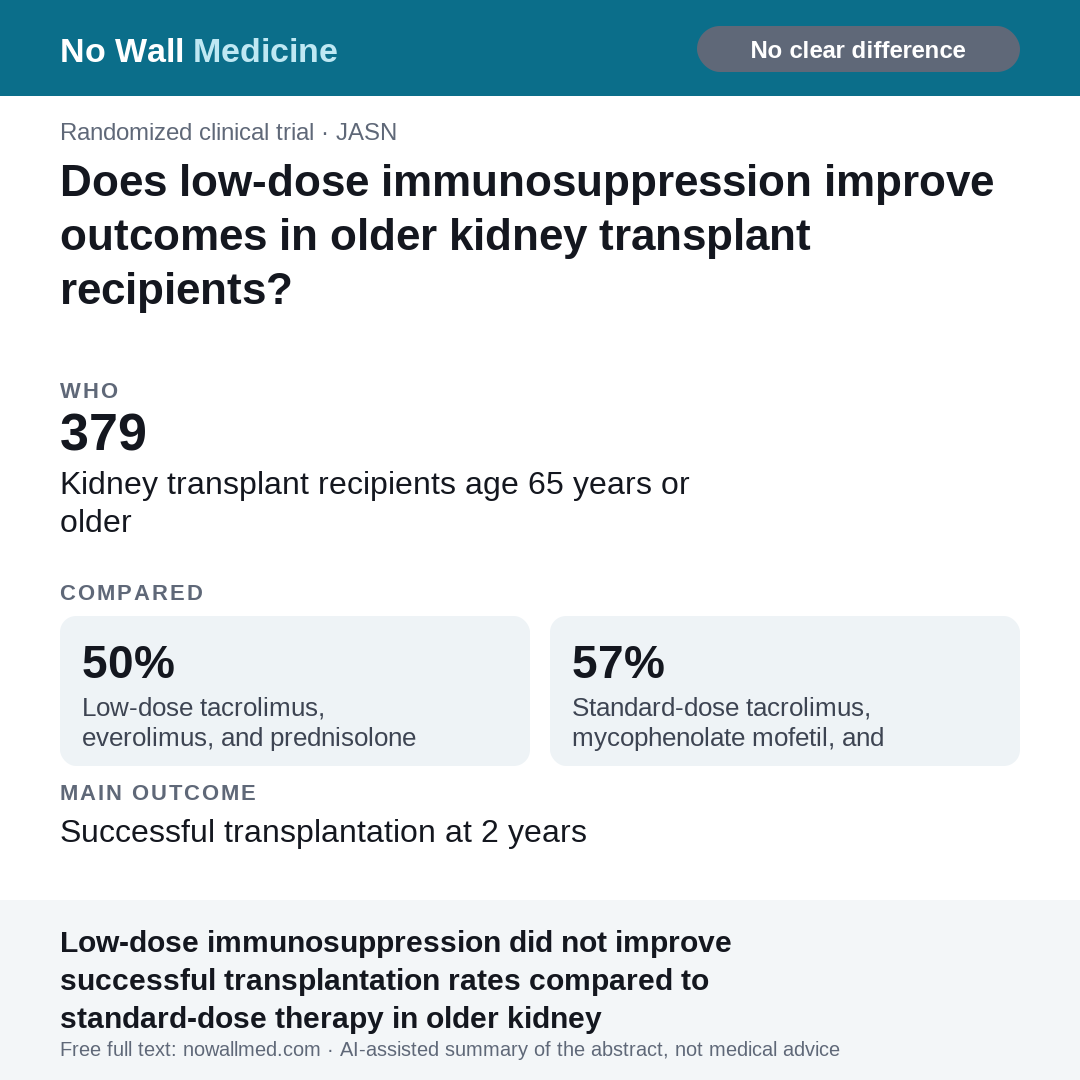
Clinical question: Does low-dose immunosuppression improve outcomes in older kidney transplant recipients?
Why it matters: It was unknown if a low-dose immunosuppression regimen would provide better outcomes for older kidney transplant recipients compared to standard-dose therapy.
Key points
- The OPTIMIZE study randomized 379 kidney transplant recipients aged 65 years or older to receive either low-dose tacrolimus, everolimus, and prednisolone or standard-dose tacrolimus, mycophenolate mofetil, and prednisolone.
- At 2 years, successful transplantation rates were 50% for the low-dose group and 57% for the standard-dose group, showing no statistically significant difference.
- There were no significant differences between the groups regarding patient survival, which was 89% for both, or graft survival, which was 83% versus 84%.
Headline and key points written with AI from the paper’s abstract, with every number checked against it. Read the paper before relying on them.
Was this summary helpful?
Subject terms
Cite this article
Sanders JF, de Boer SE, Jonker J, Bemelman FJ, Betjes MGH, de Vries APJ. Immunosuppression in Older Kidney Transplant Recipients: A Randomized Controlled Trial. JASN. 2025. doi:10.1681/ASN.0000000924
Spotted a mistake? Suggest a correction
Top studies every Monday
The week’s key trials and guidelines in your specialties, plus any topics you follow. By email, free.
Get the weekly digest