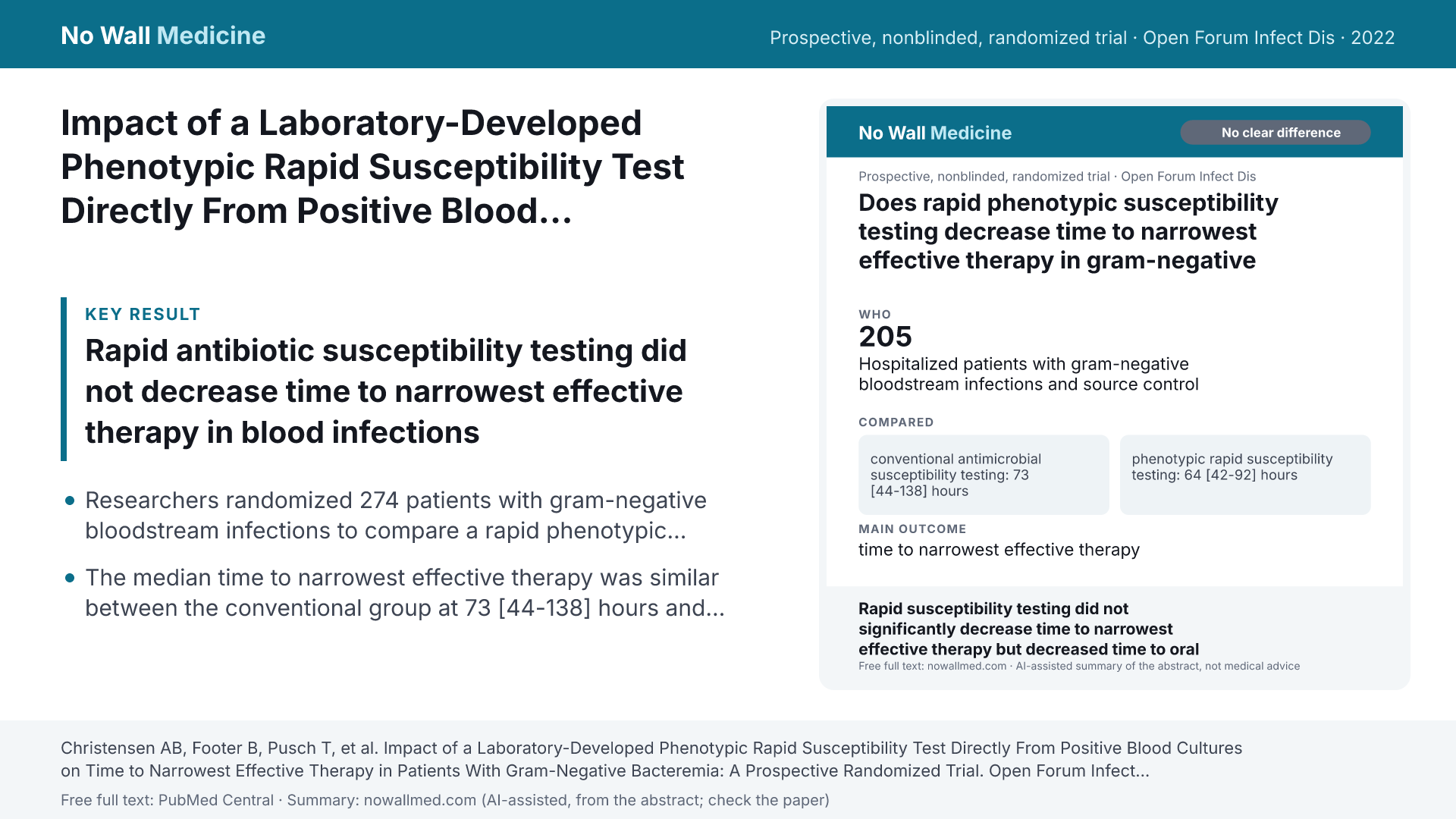
Impact of a Laboratory-Developed Phenotypic Rapid Susceptibility Test Directly From Positive Blood Cultures on Time to Narrowest Effective Therapy in Patients With Gram-Negative Bacteremia: A Prospective Randomized Trial
Key result: Rapid antibiotic susceptibility testing did not decrease time to narrowest effective therapy in blood infections
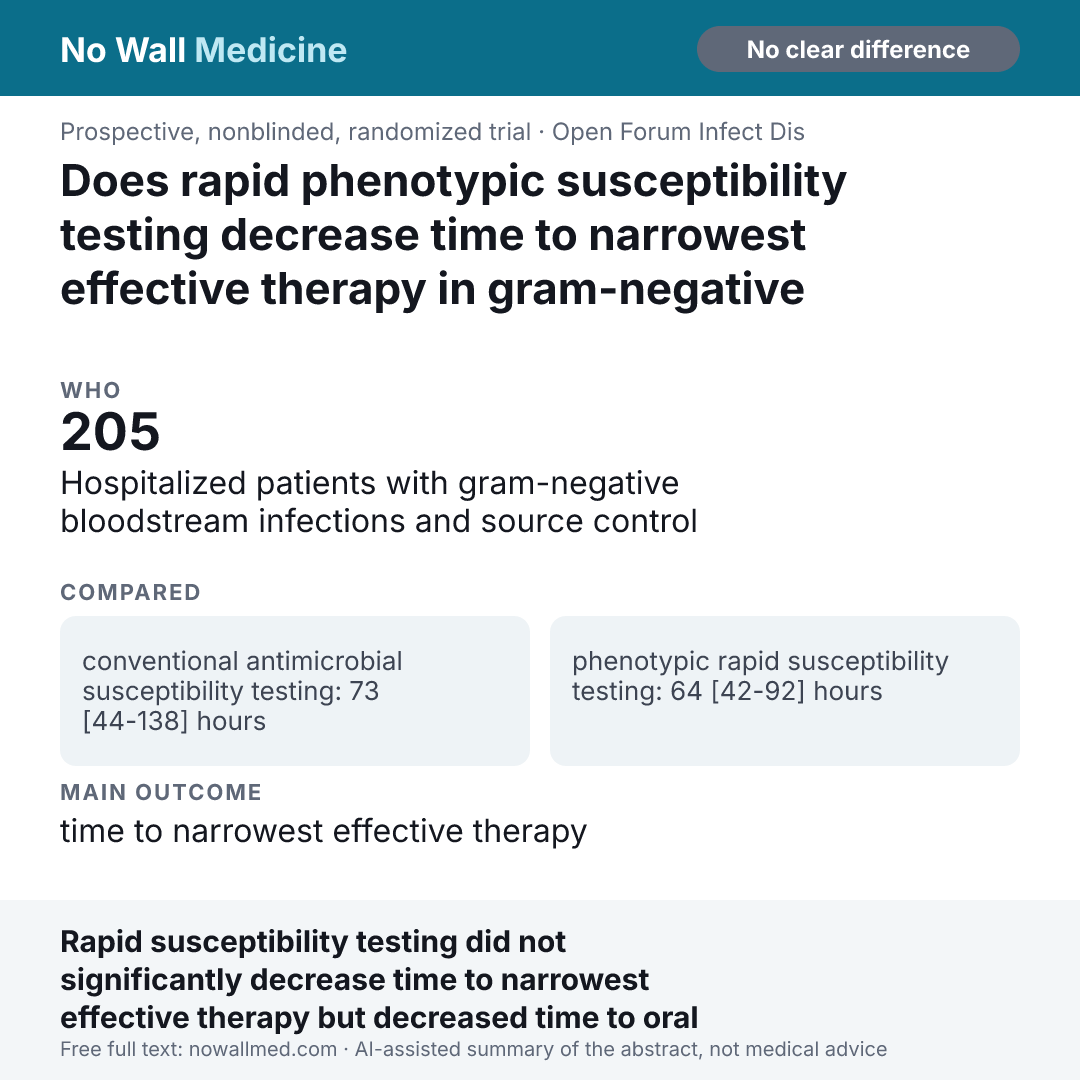
Prospective, nonblinded, randomized trialNo clear difference
Does rapid phenotypic susceptibility testing decrease time to narrowest effective therapy in gram-negative bacteremia?
Who
205
Hospitalized patients with gram-negative bloodstream infections and source control
Compared
conventional antimicrobial susceptibility testing: 73 [44-138] hours
phenotypic rapid susceptibility testing: 64 [42-92] hours
Main outcome
time to narrowest effective therapy
Bottom line: Rapid susceptibility testing did not significantly decrease time to narrowest effective therapy but decreased time to oral antibiotics and hospital stay.
Open Forum Infect Dis · 2022-07-22 · Save PNG
Key points
- Researchers randomized 274 patients with gram-negative bloodstream infections to compare a rapid phenotypic antibiotic susceptibility test against conventional testing methods.
- The median time to narrowest effective therapy was similar between the conventional group at 73 [44-138] hours and the rapid group at 64 [42-92] hours.
- The rapid testing group had a shorter median time to oral therapy of 91 [66-154] hours compared to 126 [76-209] hours in the conventional group.
Discussion prompts
- Would these patients look like yours? Who was left out?
- Is the main outcome one that matters to patients?
- Is the difference large enough to change what you do?
Cite: Christensen AB, Footer B, Pusch T, et al. Impact of a Laboratory-Developed Phenotypic Rapid Susceptibility Test Directly From Positive Blood Cultures on Time to Narrowest Effective Therapy in Patients With Gram-Negative Bacteremia: A Prospective Randomized Trial. Open Forum Infect Dis. 2022;9(7):ofac347. doi:10.1093/ofid/ofac347
Free full text: PubMed Central · Summary and visual abstract: nowallmed.com/a/impact-of-a-laboratory-developed-phenotypic-rapid-susceptibility-test-1s5op14/ (AI-assisted from the abstract; check the paper before relying on it).