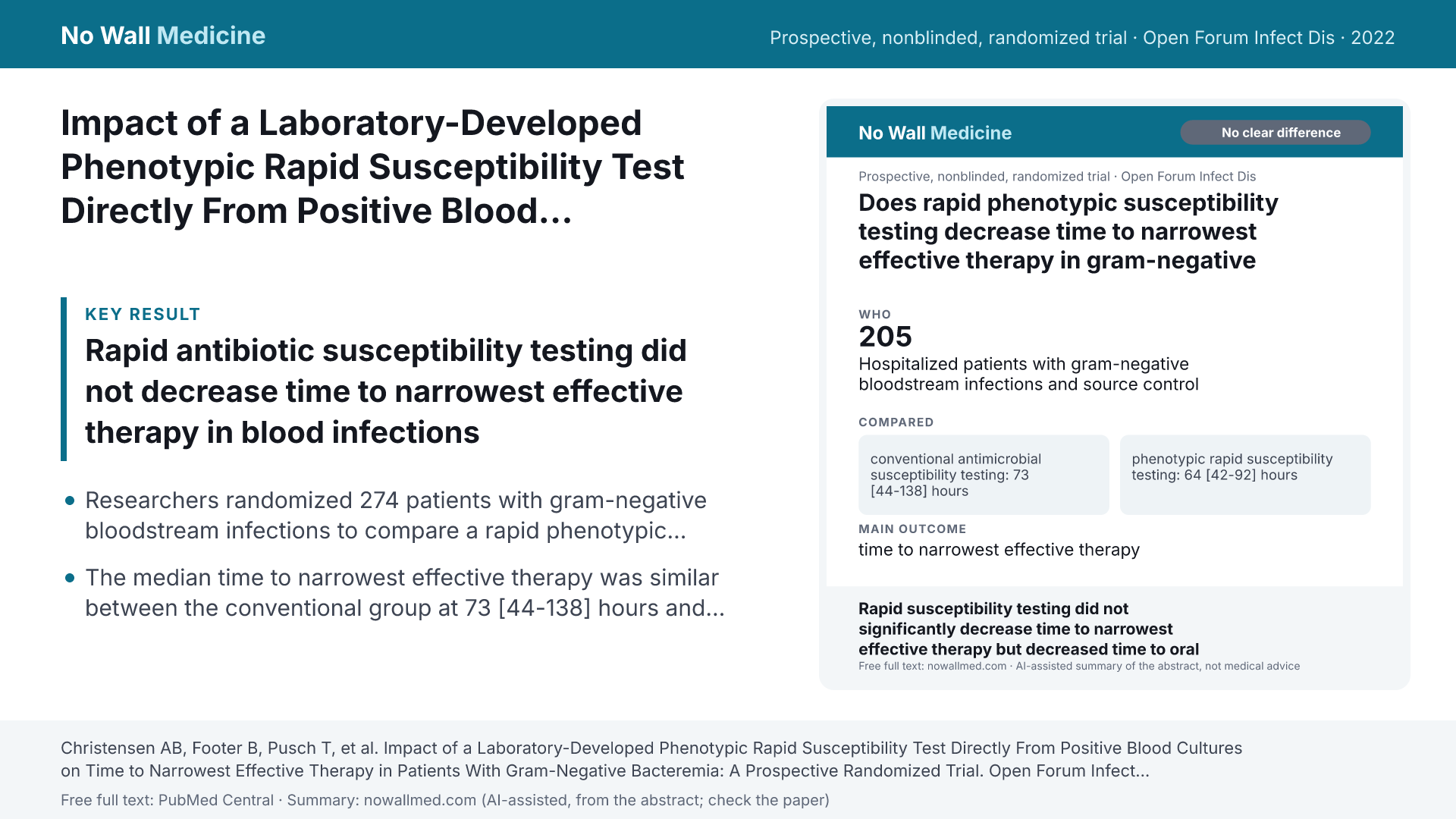
Rapid antibiotic susceptibility testing did not decrease time to narrowest effective therapy in blood infections
Impact of a Laboratory-Developed Phenotypic Rapid Susceptibility Test Directly From Positive Blood Cultures on Time to Narrowest Effective Therapy in Patients With Gram-Negative Bacteremia: A Prospective Randomized Trial
Prospective, nonblinded, randomized trialNo clear difference
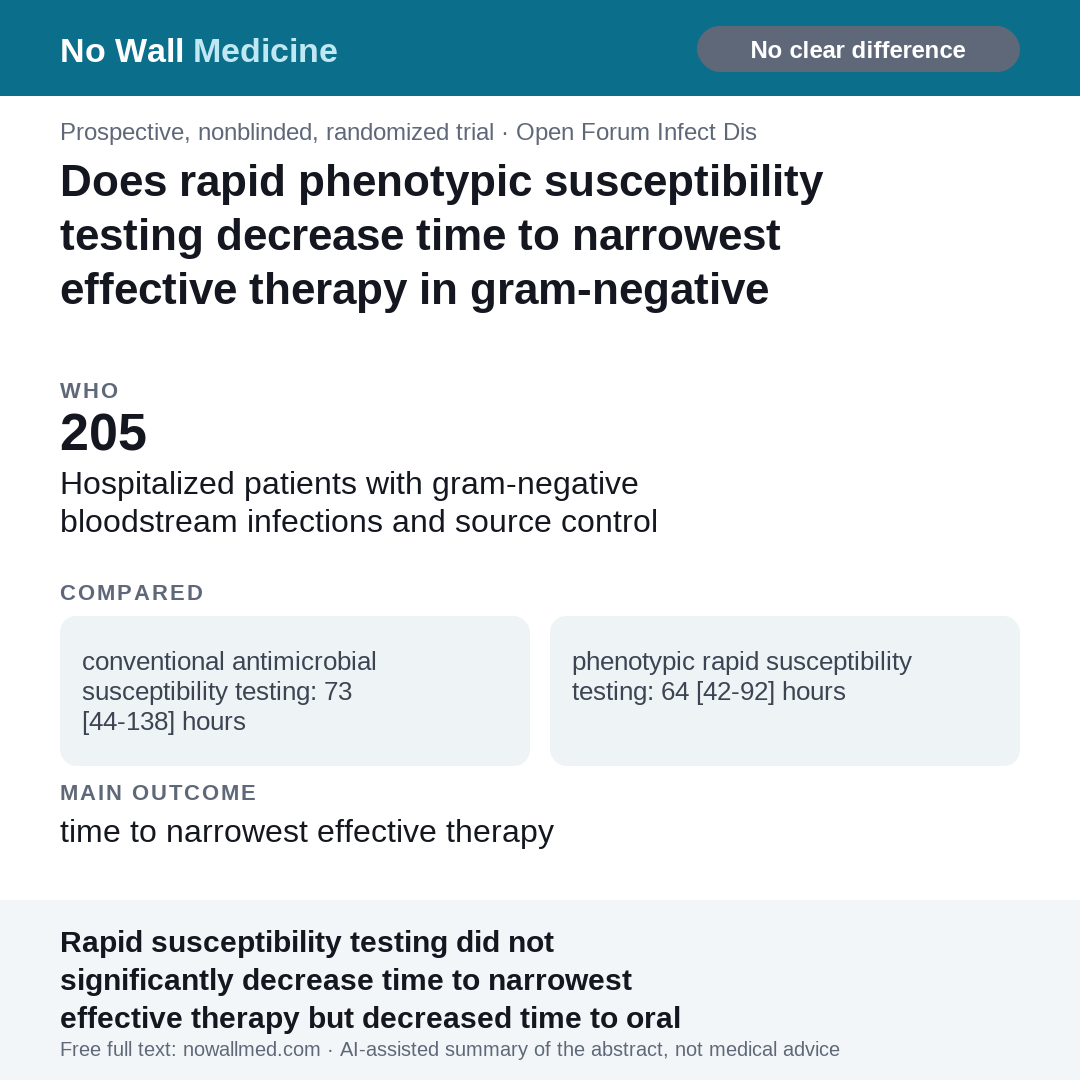
Does rapid phenotypic susceptibility testing decrease time to narrowest effective therapy in gram-negative bacteremia?
Who
205
Hospitalized patients with gram-negative bloodstream infections and source control
Compared
conventional antimicrobial susceptibility testing: 73 [44-138] hours
phenotypic rapid susceptibility testing: 64 [42-92] hours
Main outcome
time to narrowest effective therapy
Bottom line: Rapid susceptibility testing did not significantly decrease time to narrowest effective therapy but decreased time to oral antibiotics and hospital stay.
Open Forum Infect Dis · 2022-07-22Download image
Clinical question: Does rapid phenotypic susceptibility testing decrease time to narrowest effective therapy in gram-negative bacteremia?
Why it matters: It is unknown if rapid phenotypic antibiotic susceptibility testing can decrease the time required to administer the narrowest effective antibiotic for patients with gram-negative bloodstream infections.
Key points
- Researchers randomized 274 patients with gram-negative bloodstream infections to compare a rapid phenotypic antibiotic susceptibility test against conventional testing methods.
- The median time to narrowest effective therapy was similar between the conventional group at 73 [44-138] hours and the rapid group at 64 [42-92] hours.
- The rapid testing group had a shorter median time to oral therapy of 91 [66-154] hours compared to 126 [76-209] hours in the conventional group.
Headline and key points written with AI from the paper’s abstract, with every number checked against it. Read the paper before relying on them.
Was this summary helpful?
Cite this article
Christensen AB, Footer B, Pusch T, et al. Impact of a Laboratory-Developed Phenotypic Rapid Susceptibility Test Directly From Positive Blood Cultures on Time to Narrowest Effective Therapy in Patients With Gram-Negative Bacteremia: A Prospective Randomized Trial. Open Forum Infect Dis. 2022. doi:10.1093/ofid/ofac347
Spotted a mistake? Suggest a correction