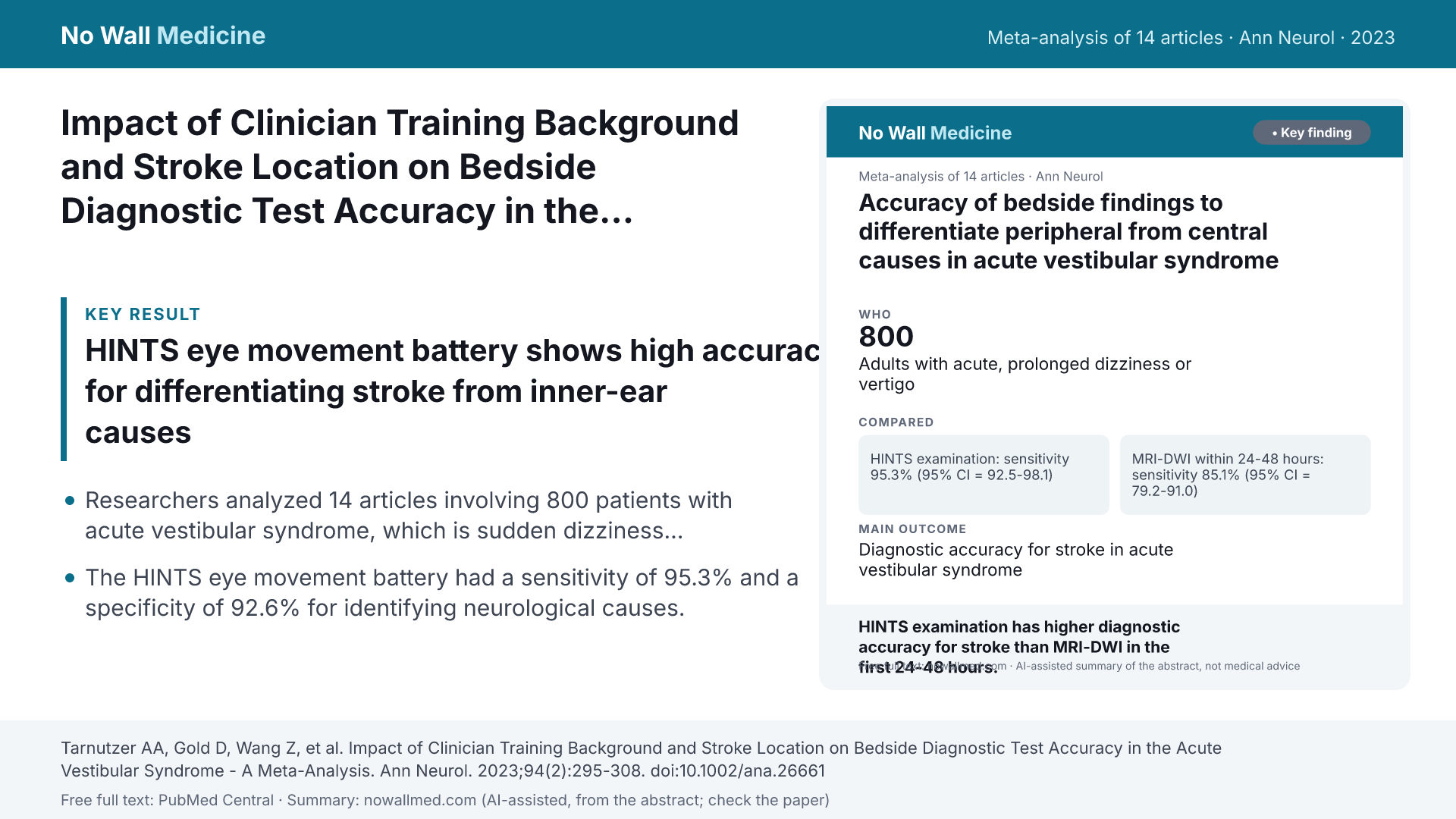
HINTS eye movement battery shows high accuracy for differentiating stroke from inner-ear causes
Impact of Clinician Training Background and Stroke Location on Bedside Diagnostic Test Accuracy in the Acute Vestibular Syndrome - A Meta-Analysis
Meta-analysis of 14 articlesKey finding
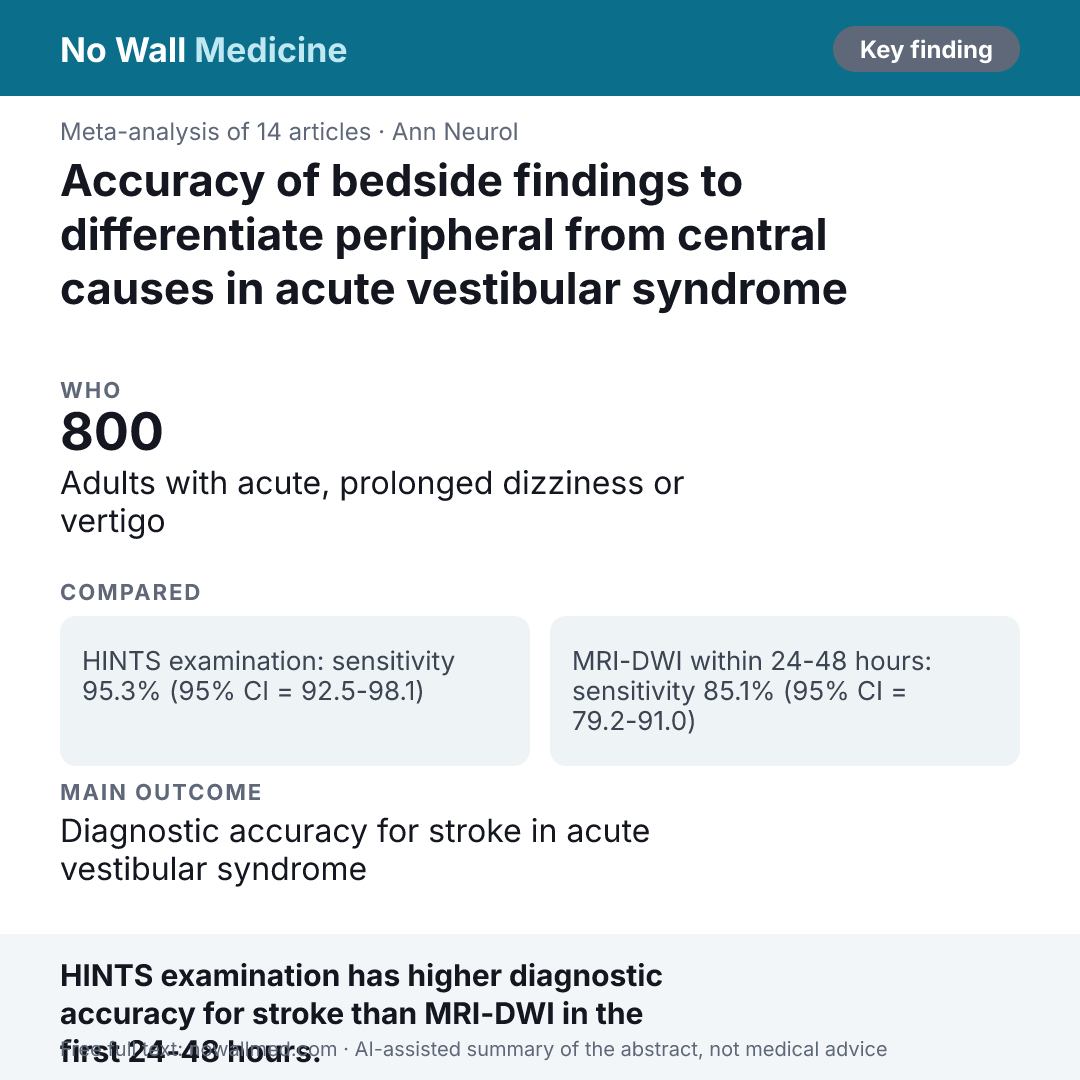
Accuracy of bedside findings to differentiate peripheral from central causes in acute vestibular syndrome
Who
800
Adults with acute, prolonged dizziness or vertigo
Compared
HINTS examination: sensitivity 95.3% (95% CI = 92.5-98.1)
MRI-DWI within 24-48 hours: sensitivity 85.1% (95% CI = 79.2-91.0)
Main outcome
Diagnostic accuracy for stroke in acute vestibular syndrome
Result: HINTS sensitivity 95.3% (95% CI = 92.5-98.1) vs MRI-DWI 85.1% (95% CI = 79.2-91.0)
Bottom line: HINTS examination has higher diagnostic accuracy for stroke than MRI-DWI in the first 24-48 hours.
Ann Neurol · 2023-04-27 · Save PNG
Key points
- Researchers analyzed 14 articles involving 800 patients with acute vestibular syndrome, which is sudden dizziness or vertigo.
- The HINTS eye movement battery had a sensitivity of 95.3% and a specificity of 92.6% for identifying neurological causes.
- Subspecialists had a higher specificity of 97.6% compared to 89.1% for non-subspecialists, though sensitivity was similar between groups.
Headline and key points written with AI from the paper’s abstract, with every number checked against it. Read the paper before relying on them.
Was this summary helpful?
Subject terms
Headline, design, result, key points, caveat and citation as plain text.
Cite this article
Tarnutzer AA, Gold D, Wang Z, et al. Impact of Clinician Training Background and Stroke Location on Bedside Diagnostic Test Accuracy in the Acute Vestibular Syndrome - A Meta-Analysis. Ann Neurol. 2023;94(2):295-308. doi:10.1002/ana.26661
Spotted a mistake? Suggest a correction