Intensive blood pressure management was associated with lower functional independence after successful stroke procedure
Intensive vs Conventional Blood Pressure Lowering After Endovascular Thrombectomy in Acute Ischemic Stroke: The OPTIMAL-BP Randomized Clinical Trial
Multicenter, randomized, open-label trialHarm found
Does intensive versus conventional blood pressure management improve clinical outcomes after successful endovascular thrombectomy?
Who
306
Patients with large vessel occlusion acute ischemic stroke treated with endovascular thrombectomy · 19 stroke centers in South Korea
Compared
39.4%Intensive blood pressure management
54.4%Conventional blood pressure management
Main outcome
Functional independence at 3 months
Result: risk difference -15.1% (95% CI, -26.2% to -3.9%)
Bottom line: Intensive blood pressure management led to a lower likelihood of functional independence compared with conventional management after successful endovascular thrombectomy.
JAMA · 2023-09-05Download image
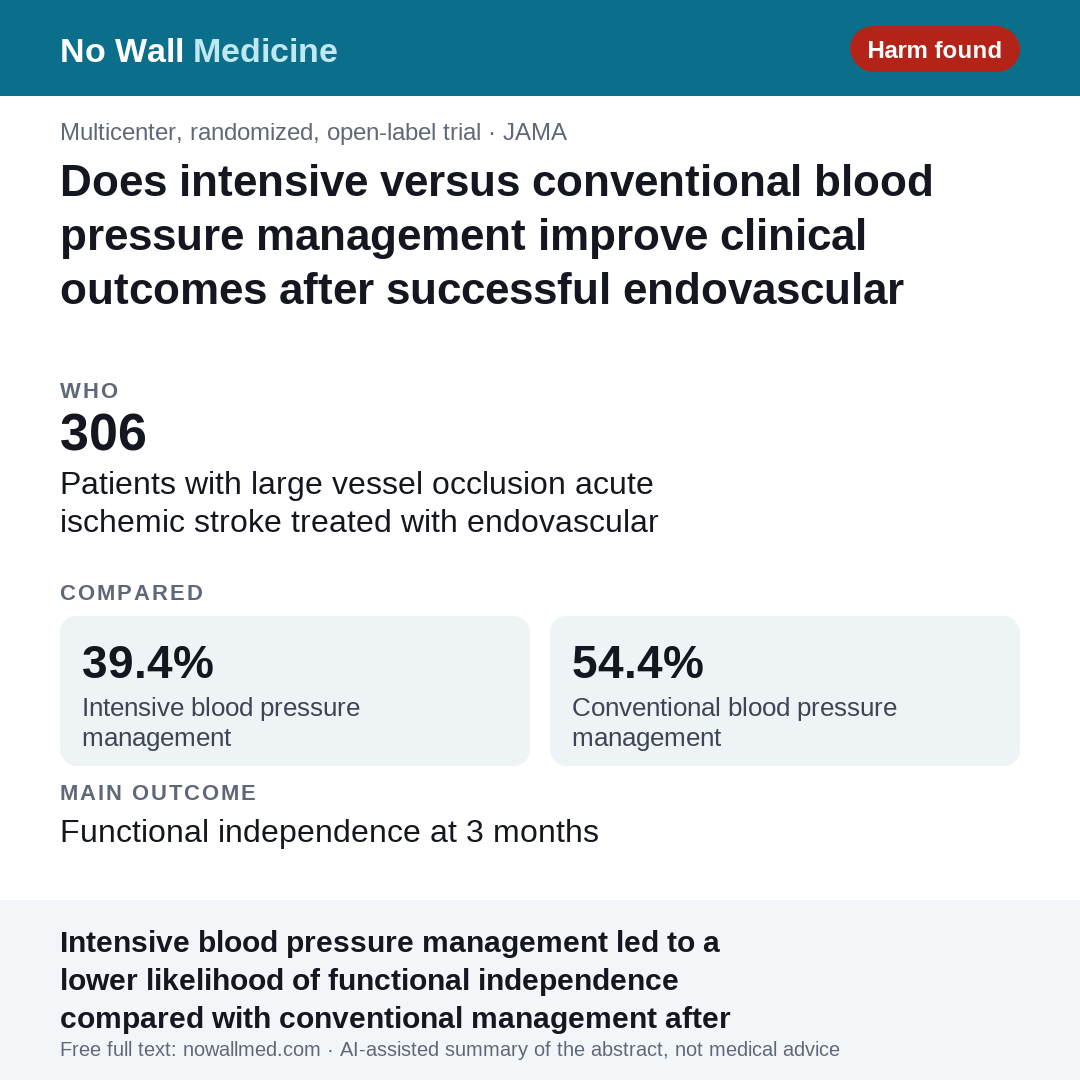
Clinical question: Does intensive versus conventional blood pressure management improve clinical outcomes after successful endovascular thrombectomy?
Why it matters: The optimal blood pressure control during the first 24 hours after successful reperfusion with endovascular thrombectomy for acute ischemic stroke is unclear.
Key points
- Researchers studied 306 patients with large vessel occlusion acute ischemic stroke who underwent endovascular thrombectomy, comparing intensive and conventional blood pressure management.
- The intensive group had a lower proportion of functional independence at 3 months (39.4%) compared to the conventional group (54.4%).
- There were no significant differences in symptomatic intracerebral hemorrhage rates or stroke-related death between the two management groups.
Headline and key points written with AI from the paper’s abstract, with every number checked against it. Read the paper before relying on them.
Topics
Cite this article
Nam HS, Kim YD, Heo J, Lee H, Jung JW, Choi JK. Intensive vs Conventional Blood Pressure Lowering After Endovascular Thrombectomy in Acute Ischemic Stroke: The OPTIMAL-BP Randomized Clinical Trial. JAMA. 2023. doi:10.1001/jama.2023.14590
Spotted a mistake? Suggest a correction