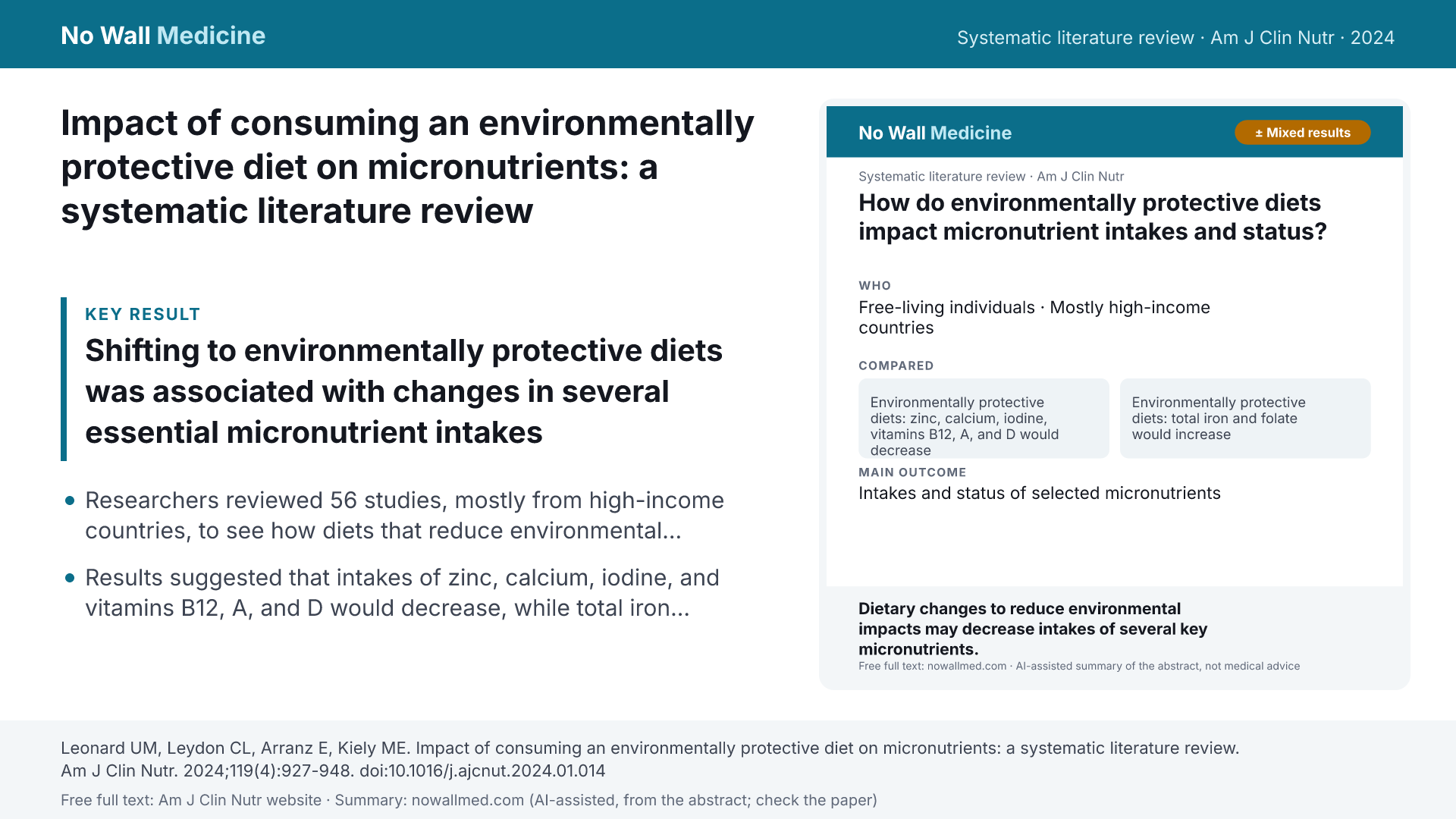
Shifting to environmentally protective diets was associated with changes in several essential micronutrient intakes
Impact of consuming an environmentally protective diet on micronutrients: a systematic literature review
Systematic literature reviewMixed results
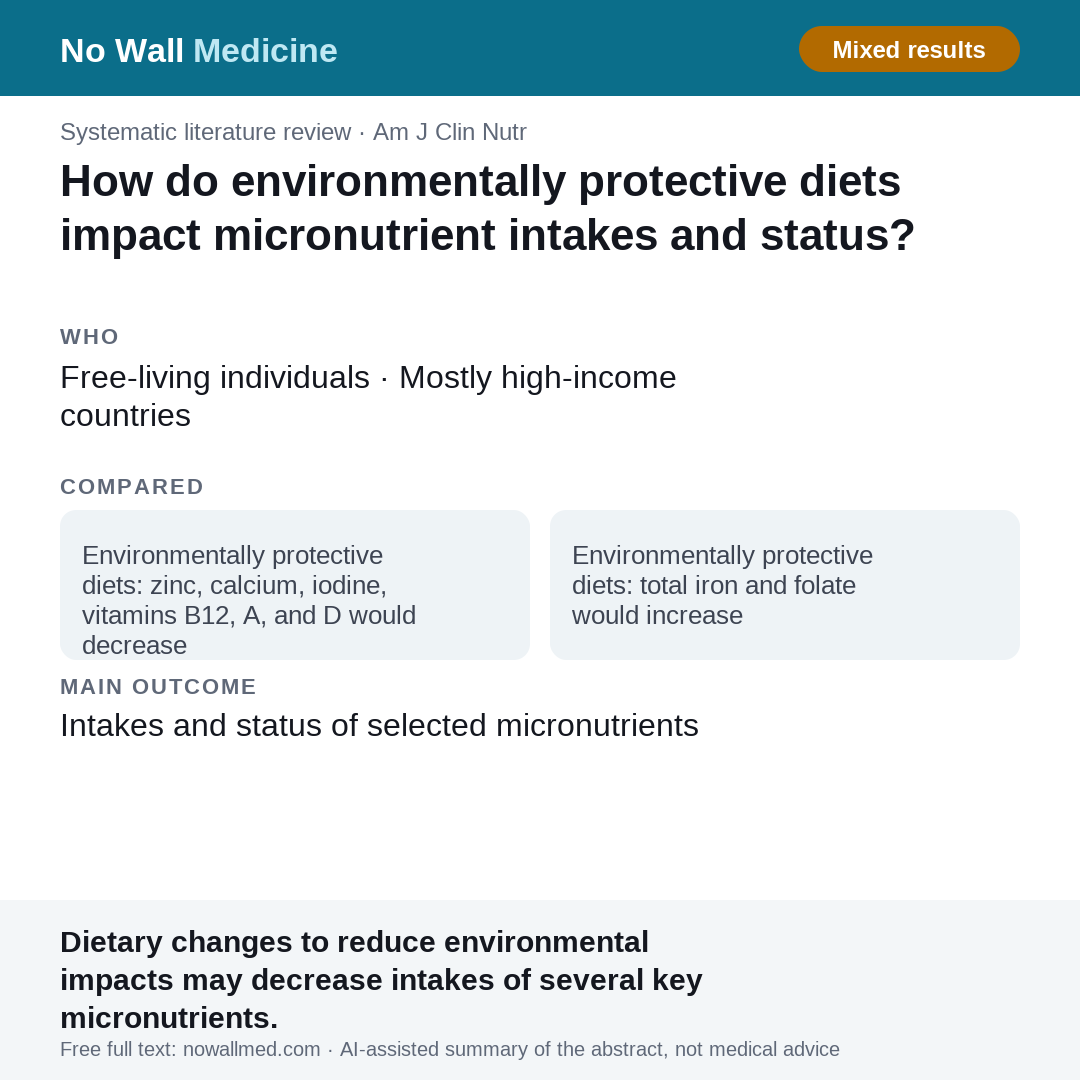
How do environmentally protective diets impact micronutrient intakes and status?
Who
Free-living individuals · Mostly high-income countries
Compared
Environmentally protective diets: zinc, calcium, iodine, vitamins B12, A, and D would decrease
Environmentally protective diets: total iron and folate would increase
Main outcome
Intakes and status of selected micronutrients
Bottom line: Dietary changes to reduce environmental impacts may decrease intakes of several key micronutrients.
Am J Clin Nutr · 2024-03-11Download image
Clinical question: How do environmentally protective diets impact micronutrient intakes and status?
Why it matters: The impact of transitioning to plant-based protein sources to protect planetary health on the intake and status of micronutrients is unknown.
Key points
- Researchers reviewed 56 studies, mostly from high-income countries, to see how diets that reduce environmental impact affect micronutrient levels.
- Results suggested that intakes of zinc, calcium, iodine, and vitamins B12, A, and D would decrease, while total iron and folate would increase.
- In 10 studies reporting nutrient adequacy, a higher risk of inadequate intakes for zinc, calcium, and vitamins A, B12, and D was noted.
Headline and key points written with AI from the paper’s abstract, with every number checked against it. Read the paper before relying on them.
Was this summary helpful?
Subject terms
Cite this article
Leonard UM, Leydon CL, Arranz E, Kiely ME. Impact of consuming an environmentally protective diet on micronutrients: a systematic literature review. Am J Clin Nutr. 2024. doi:10.1016/j.ajcnut.2024.01.014
Spotted a mistake? Suggest a correction