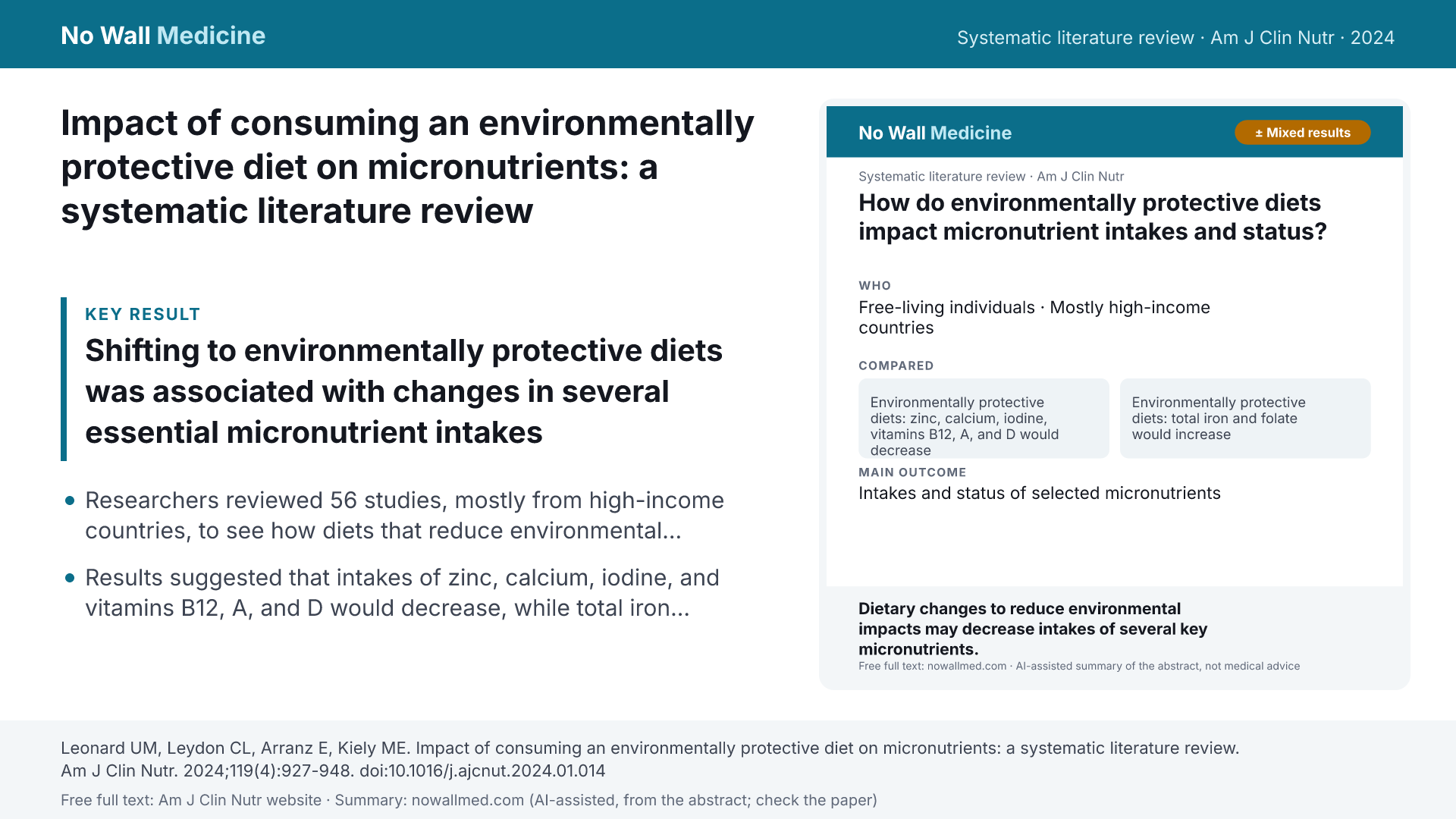
Impact of consuming an environmentally protective diet on micronutrients: a systematic literature review
Key result: Shifting to environmentally protective diets was associated with changes in several essential micronutrient intakes
Systematic literature reviewMixed results
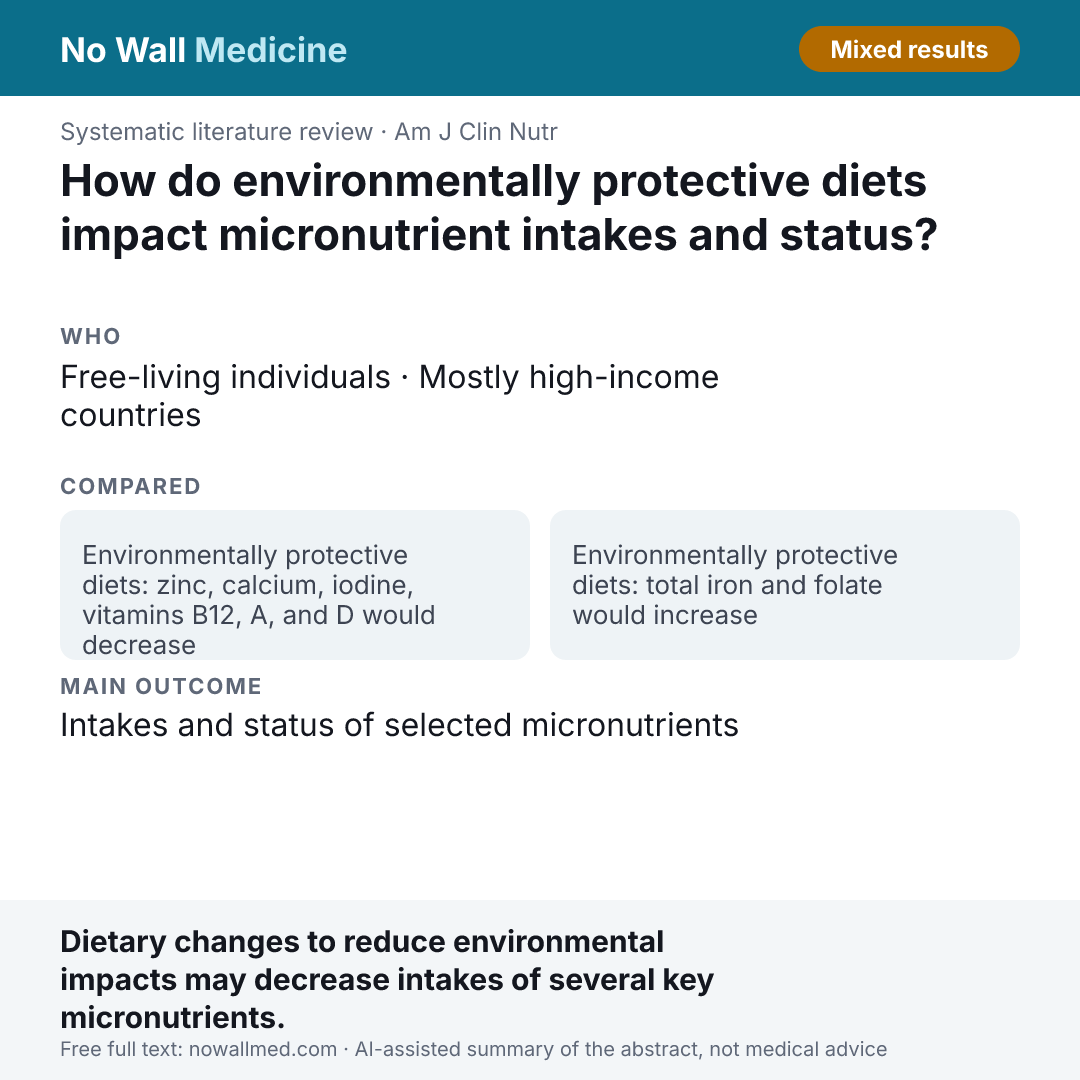
How do environmentally protective diets impact micronutrient intakes and status?
Who
Free-living individuals · Mostly high-income countries
Compared
Environmentally protective diets: zinc, calcium, iodine, vitamins B12, A, and D would decrease
Environmentally protective diets: total iron and folate would increase
Main outcome
Intakes and status of selected micronutrients
Bottom line: Dietary changes to reduce environmental impacts may decrease intakes of several key micronutrients.
Am J Clin Nutr · 2024-03-11 · Save PNG
Key points
- Researchers reviewed 56 studies, mostly from high-income countries, to see how diets that reduce environmental impact affect micronutrient levels.
- Results suggested that intakes of zinc, calcium, iodine, and vitamins B12, A, and D would decrease, while total iron and folate would increase.
- In 10 studies reporting nutrient adequacy, a higher risk of inadequate intakes for zinc, calcium, and vitamins A, B12, and D was noted.
Discussion prompts
- Would these patients look like yours? Who was left out?
- Is the main outcome one that matters to patients?
- Is the difference large enough to change what you do?
Cite: Leonard UM, Leydon CL, Arranz E, Kiely ME. Impact of consuming an environmentally protective diet on micronutrients: a systematic literature review. Am J Clin Nutr. 2024;119(4):927-948. doi:10.1016/j.ajcnut.2024.01.014
Free full text: Am J Clin Nutr website · Summary and visual abstract: nowallmed.com/a/impact-of-consuming-an-environmentally-protective-diet-on-1q6t01e/ (AI-assisted from the abstract; check the paper before relying on it).