Continuous hypertonic saline infusion was not associated with acute kidney injury after traumatic brain injury
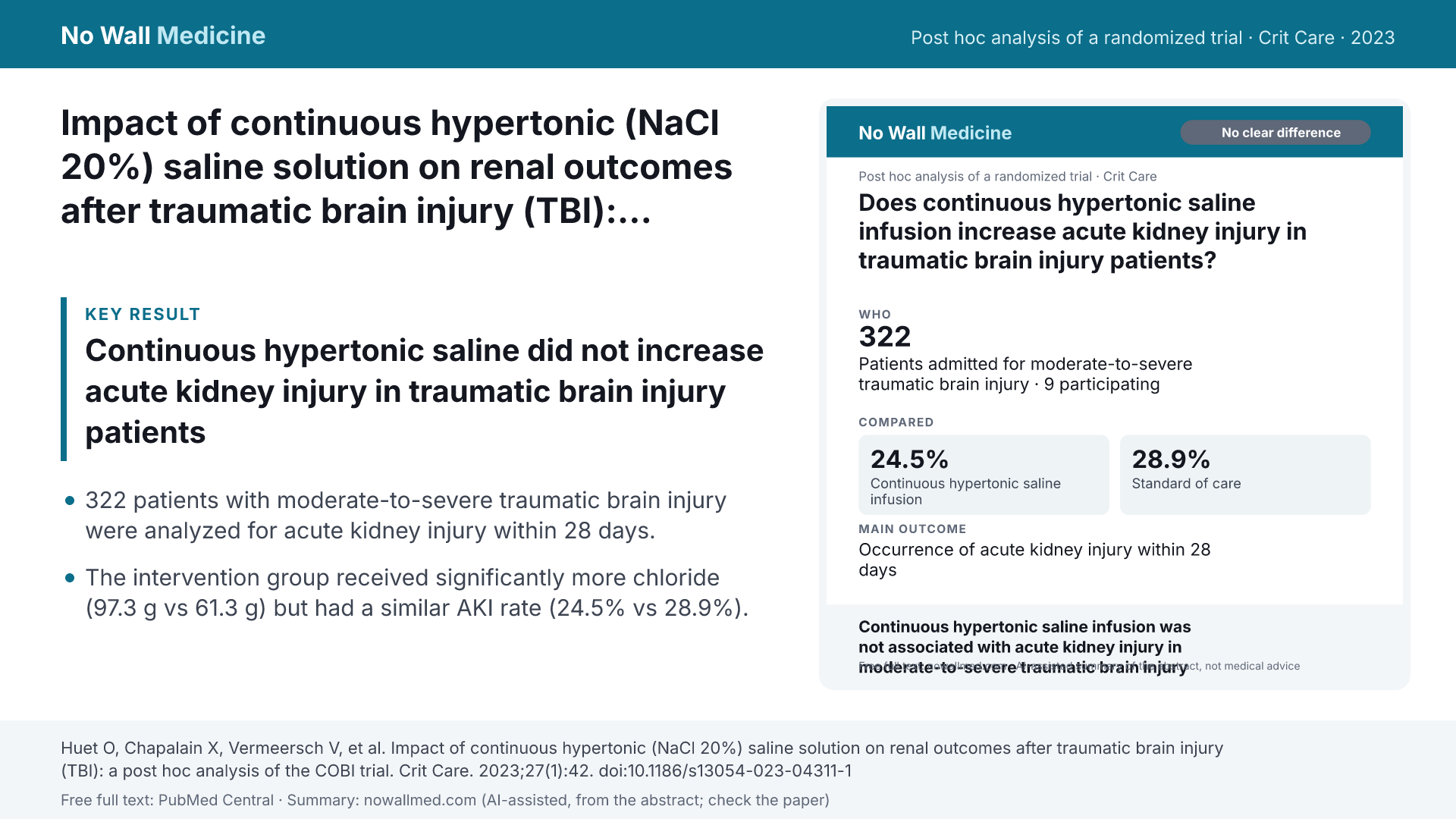
Impact of continuous hypertonic (NaCl 20%) saline solution on renal outcomes after traumatic brain injury (TBI): a post hoc analysis of the COBI trial
Post hoc analysis of a randomized trialNo clear difference
Does continuous hypertonic saline infusion increase acute kidney injury in traumatic brain injury patients?
Who
322
Patients admitted for moderate-to-severe traumatic brain injury · 9 participating intensive care units
Compared
24.5%Continuous hypertonic saline infusion
28.9%Standard of care
Main outcome
Occurrence of acute kidney injury within 28 days
Bottom line: Continuous hypertonic saline infusion was not associated with acute kidney injury in moderate-to-severe traumatic brain injury patients.
Crit Care · 2023-01-27Download image
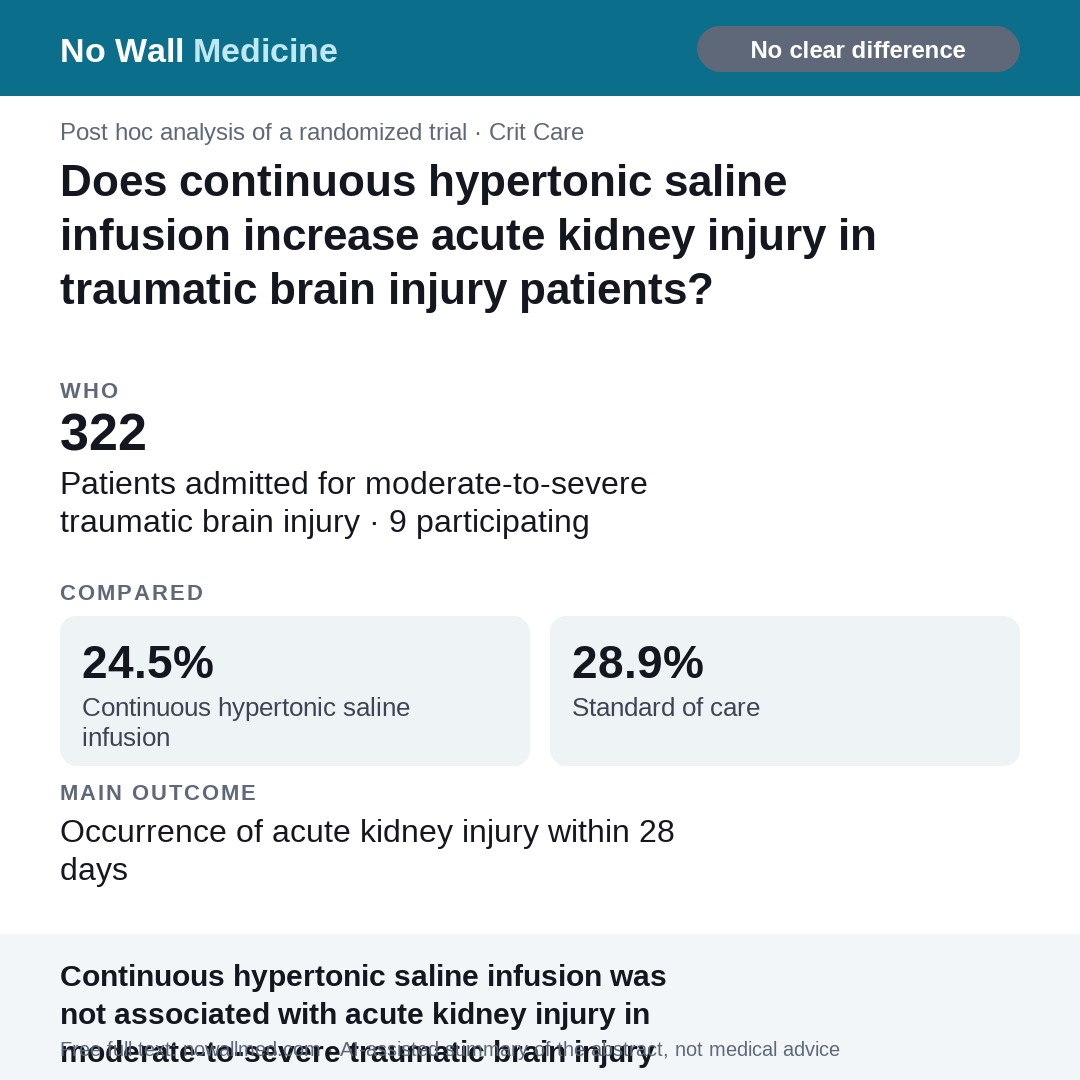
Clinical question: Does continuous hypertonic saline infusion increase acute kidney injury in traumatic brain injury patients?
Why it matters: It was unknown if increased chloride intake from continuous hypertonic saline infusions is associated with an increased incidence of acute kidney injury in traumatic brain injury patients.
Key points
- Researchers analyzed 322 patients with moderate-to-severe traumatic brain injury who received either continuous hypertonic saline or standard care.
- The incidence of stage 2 or 3 acute kidney injury, a sudden loss of kidney function, was 24.5% in the saline group and 28.9% in the control group.
- Patients receiving continuous hypertonic saline had a higher chloride intake of 97.3 ± 31.6 g compared to 61.3 ± 38.1 g in the control group.
Headline and key points written with AI from the paper’s abstract, with every number checked against it. Read the paper before relying on them.
Was this summary helpful?
Subject terms
Cite this article
Huet O, Chapalain X, Vermeersch V, Moyer JD, Lasocki S, Cohen B. Impact of continuous hypertonic (NaCl 20%) saline solution on renal outcomes after traumatic brain injury (TBI): a post hoc analysis of the COBI trial. Crit Care. 2023. doi:10.1186/s13054-023-04311-1
Spotted a mistake? Suggest a correction
Top studies every Monday
The week’s key trials and guidelines in your specialties, plus any topics you follow. By email, free.
Get the weekly digest