Extending lymph node removal to the superior mesenteric artery is associated with more diarrhea and leakage
Impact of D3 lymph node dissection extent on postoperative bowel function and nutritional status in right-sided colon cancer: a prospective randomized controlled trial
Prospective, randomized controlled trialHarm found
Does D3 lymph node dissection extent impact postoperative bowel function and nutritional status?
Who
76
Patients with right-sided colon cancer · High-volume tertiary hospital
Compared
18.4%Superior mesenteric vein group
39.5%Superior mesenteric artery group
Main outcome
Incidence of postoperative diarrhea
Bottom line: Extending dissection to the superior mesenteric artery increases postoperative diarrhea and chylous leakage without clear oncologic benefit.
Int J Surg · 2025-09-09Download image
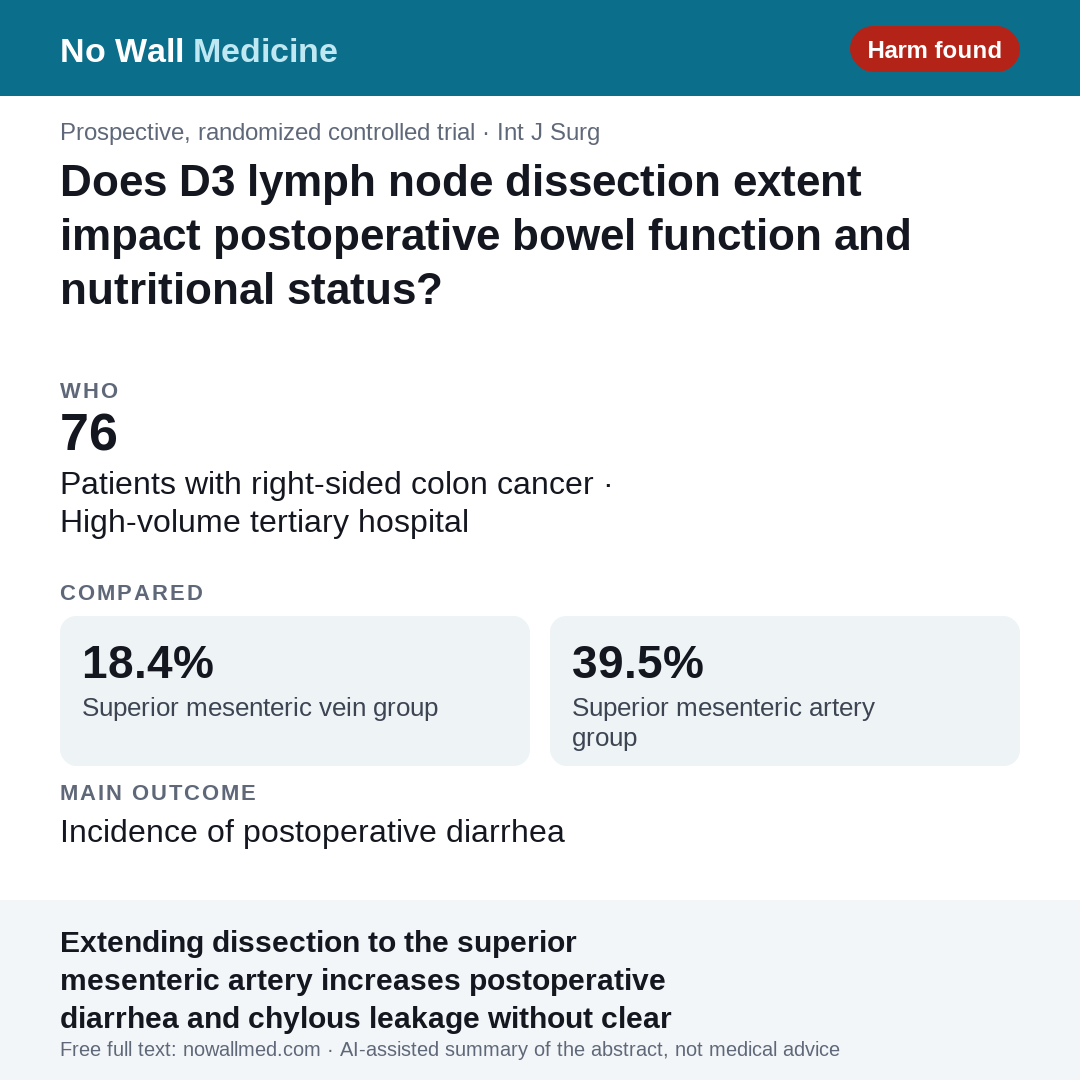
Clinical question: Does D3 lymph node dissection extent impact postoperative bowel function and nutritional status?
Why it matters: It is unclear how the extent of lymph node dissection affects postoperative bowel function and nutritional status in patients undergoing surgery for right-sided colon cancer.
Key points
- Researchers studied 76 patients with right-sided colon cancer randomized to receive lymph node removal up to the superior mesenteric vein or the superior mesenteric artery.
- The superior mesenteric artery group had higher rates of postoperative diarrhea (39.5% vs. 18.4%) and chylous leakage (21.1% vs. 5.3%) compared to the superior mesenteric vein group.
- While more lymph nodes were retrieved in the superior mesenteric artery group, there were no significant differences in nutritional status, recurrence, or survival.
Headline and key points written with AI from the paper’s abstract, with every number checked against it. Read the paper before relying on them.
Topics
Cite this article
Zhou X, Shang Z, Tian F, Liu J, Zhang B, Bai M. Impact of D3 lymph node dissection extent on postoperative bowel function and nutritional status in right-sided colon cancer: a prospective randomized controlled trial. Int J Surg. 2025. doi:10.1097/JS9.0000000000003485
Spotted a mistake? Suggest a correction
Top studies every Monday
The week’s key trials and guidelines in your specialties, by email. Free.
Get the weekly digest