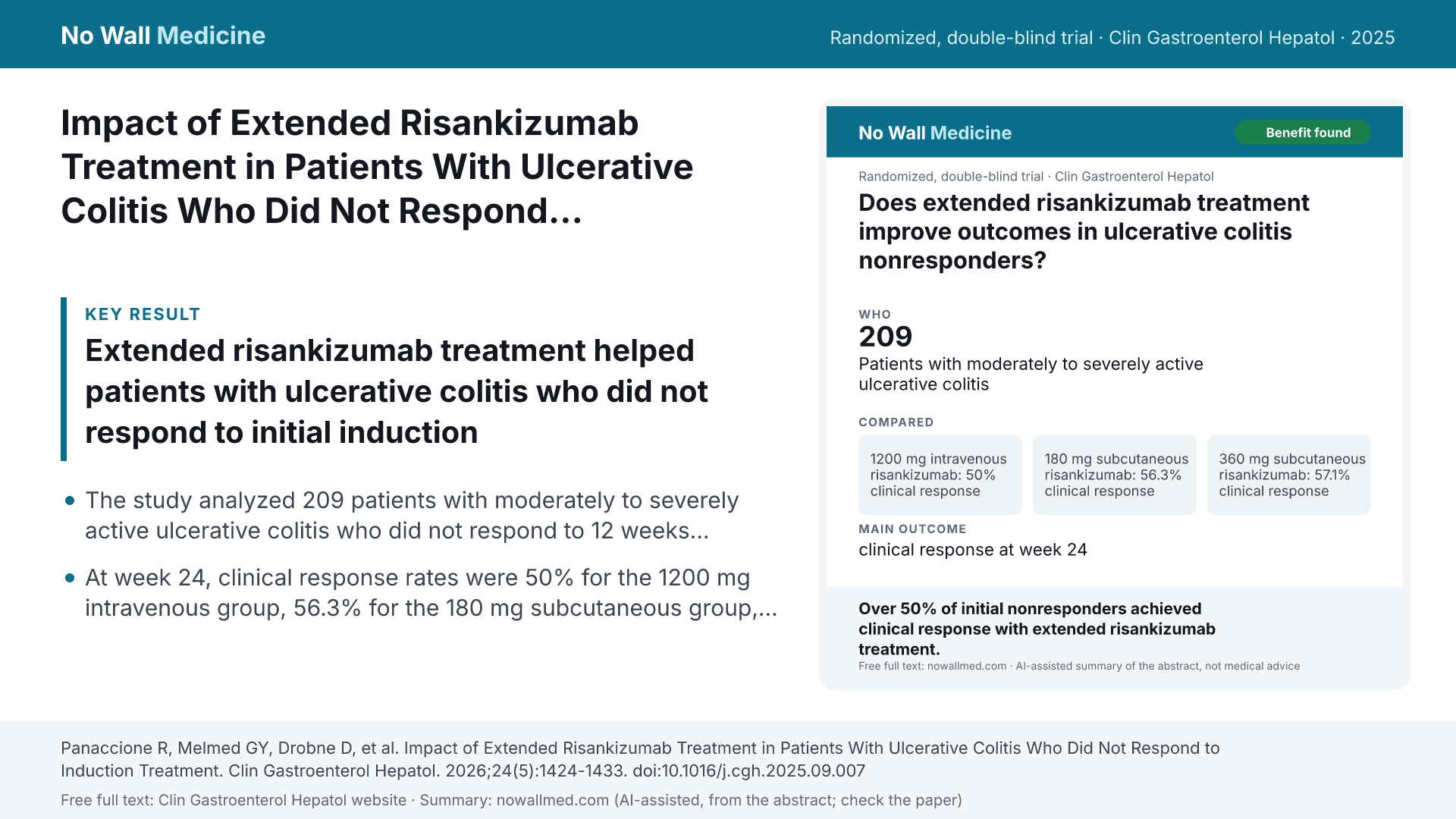
Extended risankizumab treatment helped patients with ulcerative colitis who did not respond to initial induction
Impact of Extended Risankizumab Treatment in Patients With Ulcerative Colitis Who Did Not Respond to Induction Treatment
Randomized, double-blind trialBenefit found
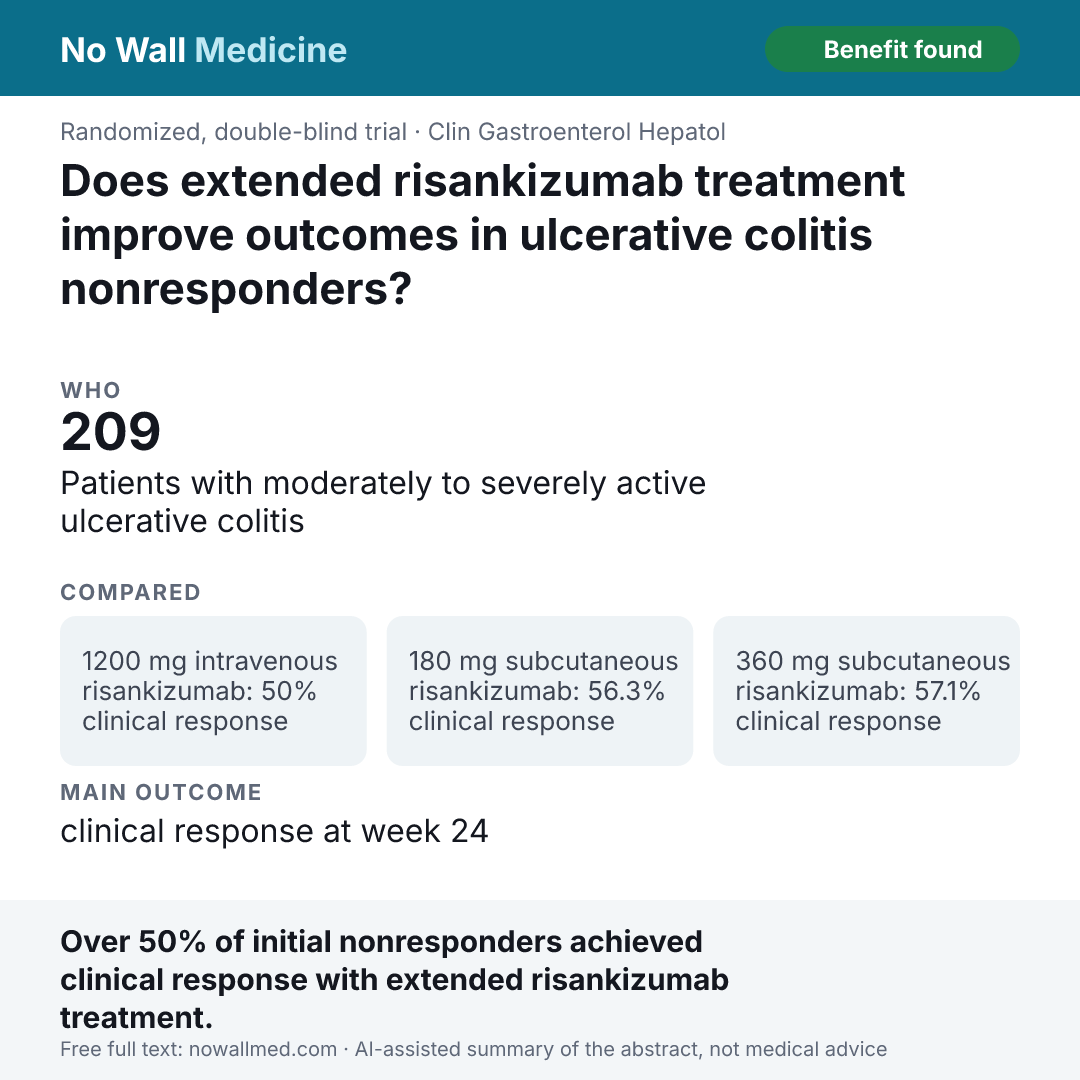
Does extended risankizumab treatment improve outcomes in ulcerative colitis nonresponders?
Who
209
Patients with moderately to severely active ulcerative colitis
Compared
1200 mg intravenous risankizumab: 50% clinical response
180 mg subcutaneous risankizumab: 56.3% clinical response
360 mg subcutaneous risankizumab: 57.1% clinical response
Main outcome
clinical response at week 24
Bottom line: Over 50% of initial nonresponders achieved clinical response with extended risankizumab treatment.
Clin Gastroenterol Hepatol · 2025-09-13 · Save PNG
Same trial (NCT03398148, NCT03398135)
Papers we list that report this registered trial, oldest first. Read a secondary analysis alongside the main results.
- Main results Benefit found
Risankizumab improved clinical remission rates for patients with moderately to severely active ulcerative colitis JAMA 2024-07 - Related analysis Benefit found
This paper Clin Gastroenterol Hepatol 2025-09
Clinical question: Does extended risankizumab treatment improve outcomes in ulcerative colitis nonresponders?
Key points
- The study analyzed 209 patients with moderately to severely active ulcerative colitis who did not respond to 12 weeks of 1200 mg intravenous risankizumab.
- At week 24, clinical response rates were 50% for the 1200 mg intravenous group, 56.3% for the 180 mg subcutaneous group, and 57.1% for the 360 mg subcutaneous group.
- The 360 mg subcutaneous dose showed the highest rates for endoscopic remission at 5.7% and histologic endoscopic mucosal improvement at 15.7%.
Headline and key points written with AI from the paper’s abstract, with every number checked against it. Read the paper before relying on them.
Was this summary helpful?
Subject terms
Headline, design, result, key points, caveat and citation as plain text.
Cite this article
Panaccione R, Melmed GY, Drobne D, et al. Impact of Extended Risankizumab Treatment in Patients With Ulcerative Colitis Who Did Not Respond to Induction Treatment. Clin Gastroenterol Hepatol. 2026;24(5):1424-1433. doi:10.1016/j.cgh.2025.09.007
Spotted a mistake? Suggest a correction