Computerised decision support did not significantly reduce antibiotic use in Swiss hospitals
Impact of interactive computerised decision support for hospital antibiotic use (COMPASS): an open-label, cluster-randomised trial in three Swiss hospitals
Cluster-randomised, parallel-group, open-label superiority trialNo clear difference
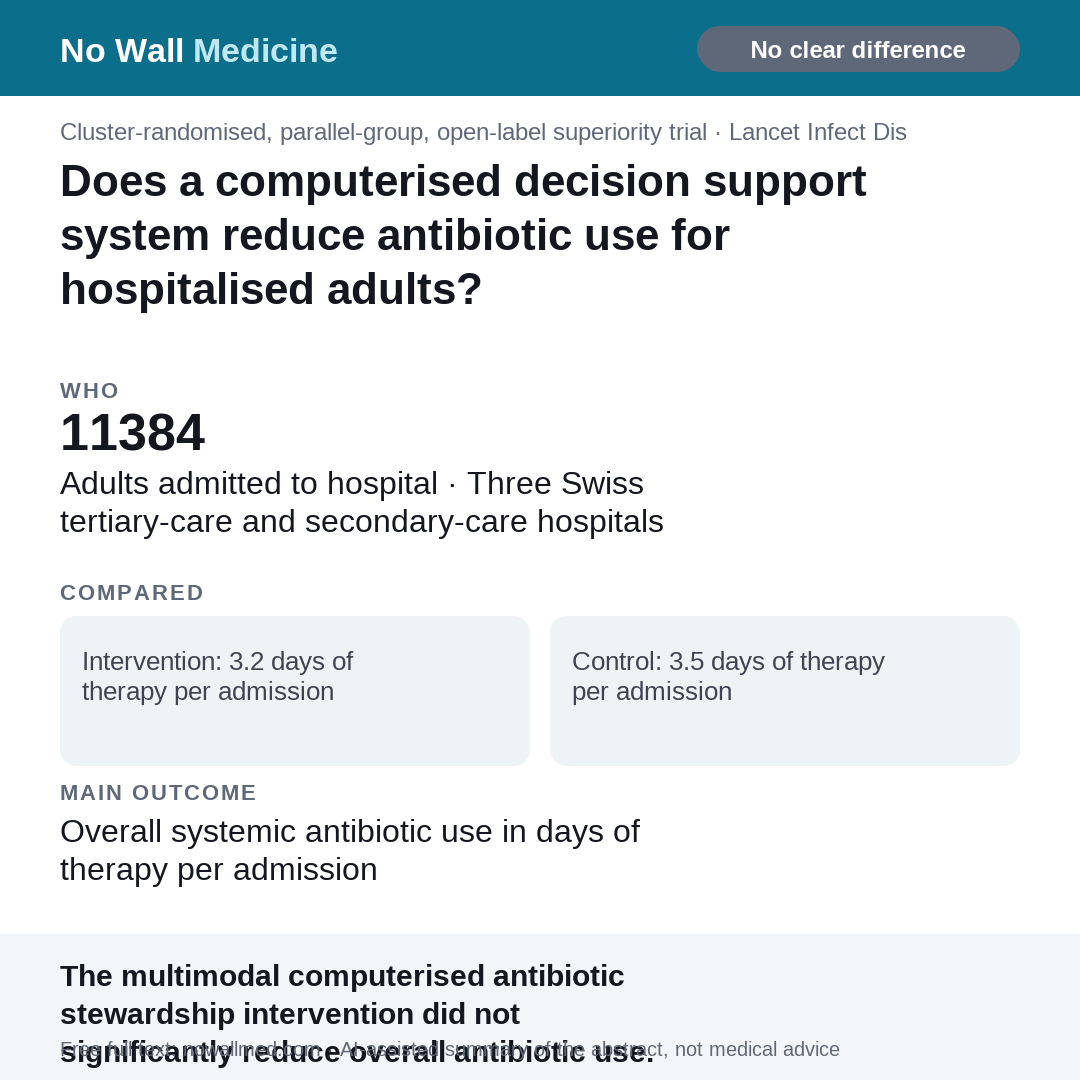
Does a computerised decision support system reduce antibiotic use for hospitalised adults?
Who
11384
Adults admitted to hospital · Three Swiss tertiary-care and secondary-care hospitals
Compared
Intervention: 3.2 days of therapy per admission
Control: 3.5 days of therapy per admission
Main outcome
Overall systemic antibiotic use in days of therapy per admission
Result: incidence rate ratio 0.98 (95% CI 0.90-1.07)
Bottom line: The multimodal computerised antibiotic stewardship intervention did not significantly reduce overall antibiotic use.
Limitation: Insufficient uptake, low baseline antibiotic use, and delays in system use.
Funded by: Swiss National Science Foundation
Lancet Infect Dis · 2022-07-20Download image
Clinical question: Does a computerised decision support system reduce antibiotic use for hospitalised adults?
Why it matters: High-quality evidence is scarce regarding whether computerised decision support systems can reduce the quantity and quality of antibiotic use for hospitalized adults.
Key points
- Researchers studied 24 hospital wards across three Swiss hospitals, comparing a computerised decision support system to standard antibiotic stewardship measures.
- The intervention did not significantly change the days of therapy per admission for patients receiving antibiotics, with 7.9 days in the intervention group versus 8.1 days in the control group.
- After adjusting for confounders, the transition from intravenous to oral therapy was more frequent in the intervention group, with 76.6% of 201 patients compared to 87% of 215 in the control group.
Limitation the authors note: The authors noted that insufficient uptake, low baseline antibiotic use, and delays in using the system may have contributed to the results.
Headline and key points written with AI from the paper’s abstract, with every number checked against it. Read the paper before relying on them.
Was this summary helpful?
Subject terms
Cite this article
Catho G, Sauser J, Coray V, Da Silva S, Elzi L, Harbarth S. Impact of interactive computerised decision support for hospital antibiotic use (COMPASS): an open-label, cluster-randomised trial in three Swiss hospitals. Lancet Infect Dis. 2022. doi:10.1016/S1473-3099(22)00308-5
Spotted a mistake? Suggest a correction
Top studies every Monday
The week’s key trials and guidelines in your specialties, plus any topics you follow. By email, free.
Get the weekly digest