Impact of long-course neoadjuvant radiation on postoperative low anterior resection syndrome and stoma status in rectal cancer: long-term functional follow-up of a randomized clinical trial
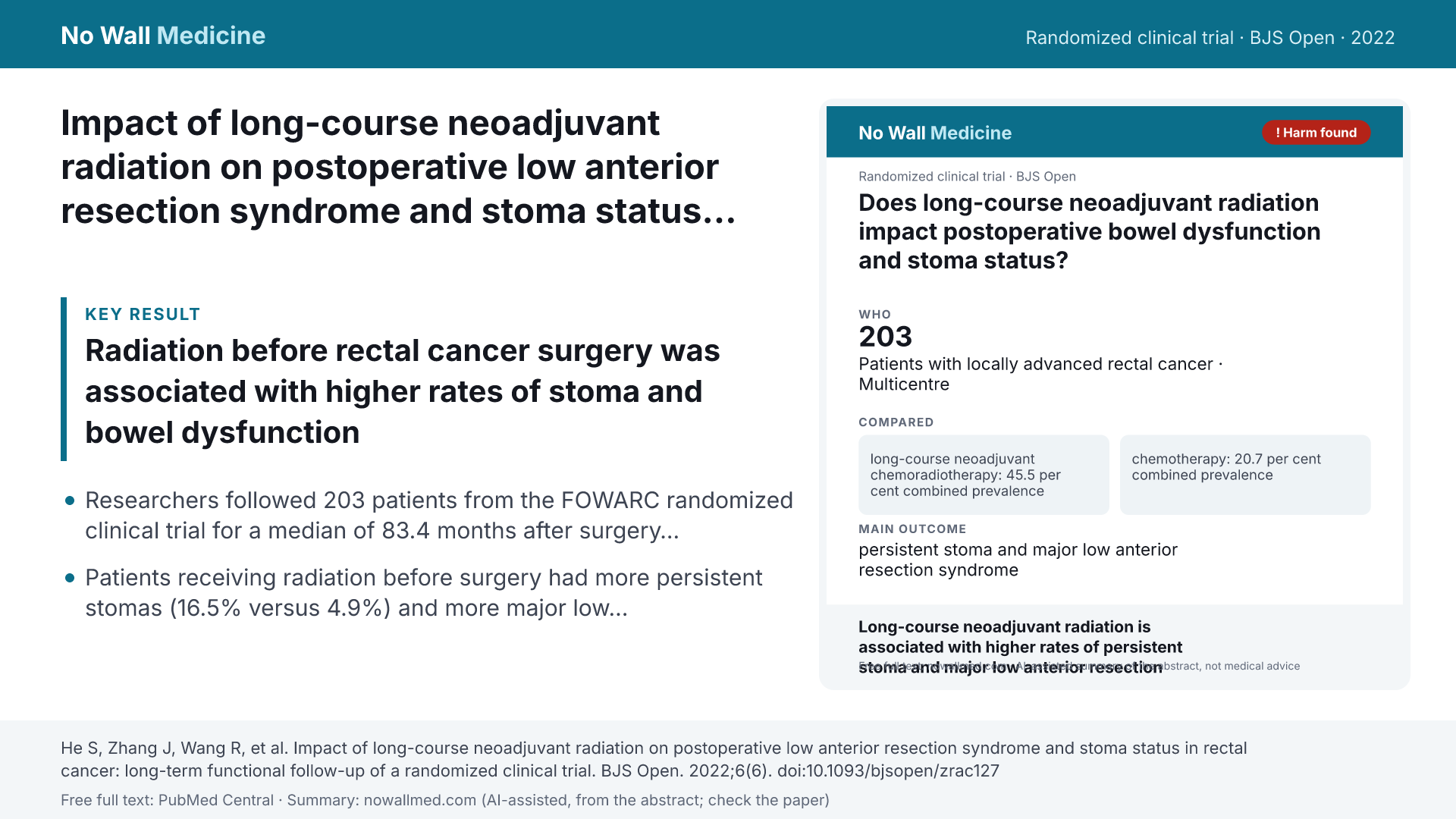
Key result: Radiation before rectal cancer surgery was associated with higher rates of stoma and bowel dysfunction
Randomized clinical trialHarm found
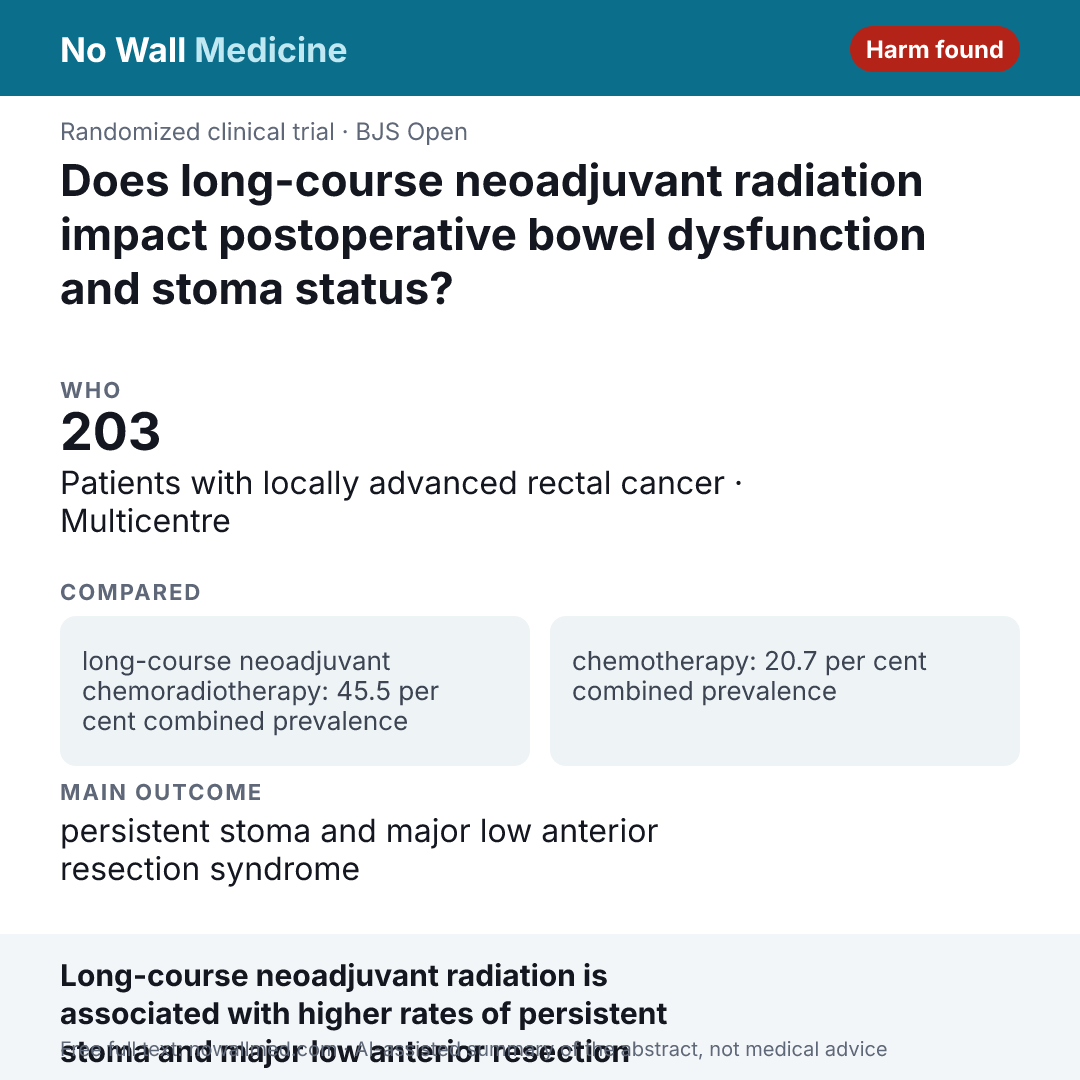
Does long-course neoadjuvant radiation impact postoperative bowel dysfunction and stoma status?
Who
203
Patients with locally advanced rectal cancer · Multicentre
Compared
long-course neoadjuvant chemoradiotherapy: 45.5 per cent combined prevalence
chemotherapy: 20.7 per cent combined prevalence
Main outcome
persistent stoma and major low anterior resection syndrome
Result: odds ratio 2.20 (95% confidence interval 1.10 to 4.40)
Bottom line: Long-course neoadjuvant radiation is associated with higher rates of persistent stoma and major low anterior resection syndrome.
BJS Open · 2022-11-02 · Save PNG
Key points
- Researchers followed 203 patients from the FOWARC randomized clinical trial for a median of 83.4 months after surgery for rectal cancer.
- Patients receiving radiation before surgery had more persistent stomas (16.5% versus 4.9%) and more major low anterior resection syndrome (34.7% versus 16.7%).
- The combined prevalence of persistent stoma and major low anterior resection syndrome was 45.5% in the radiation group compared to 20.7% in the chemotherapy group.
Discussion prompts
- Would these patients look like yours? Who was left out?
- Is the main outcome one that matters to patients?
- Is the difference large enough to change what you do?
Cite: He S, Zhang J, Wang R, et al. Impact of long-course neoadjuvant radiation on postoperative low anterior resection syndrome and stoma status in rectal cancer: long-term functional follow-up of a randomized clinical trial. BJS Open. 2022;6(6). doi:10.1093/bjsopen/zrac127
Free full text: PubMed Central · Summary and visual abstract: nowallmed.com/a/impact-of-long-course-neoadjuvant-radiation-on-postoperative-low-1mnqg52/ (AI-assisted from the abstract; check the paper before relying on it).