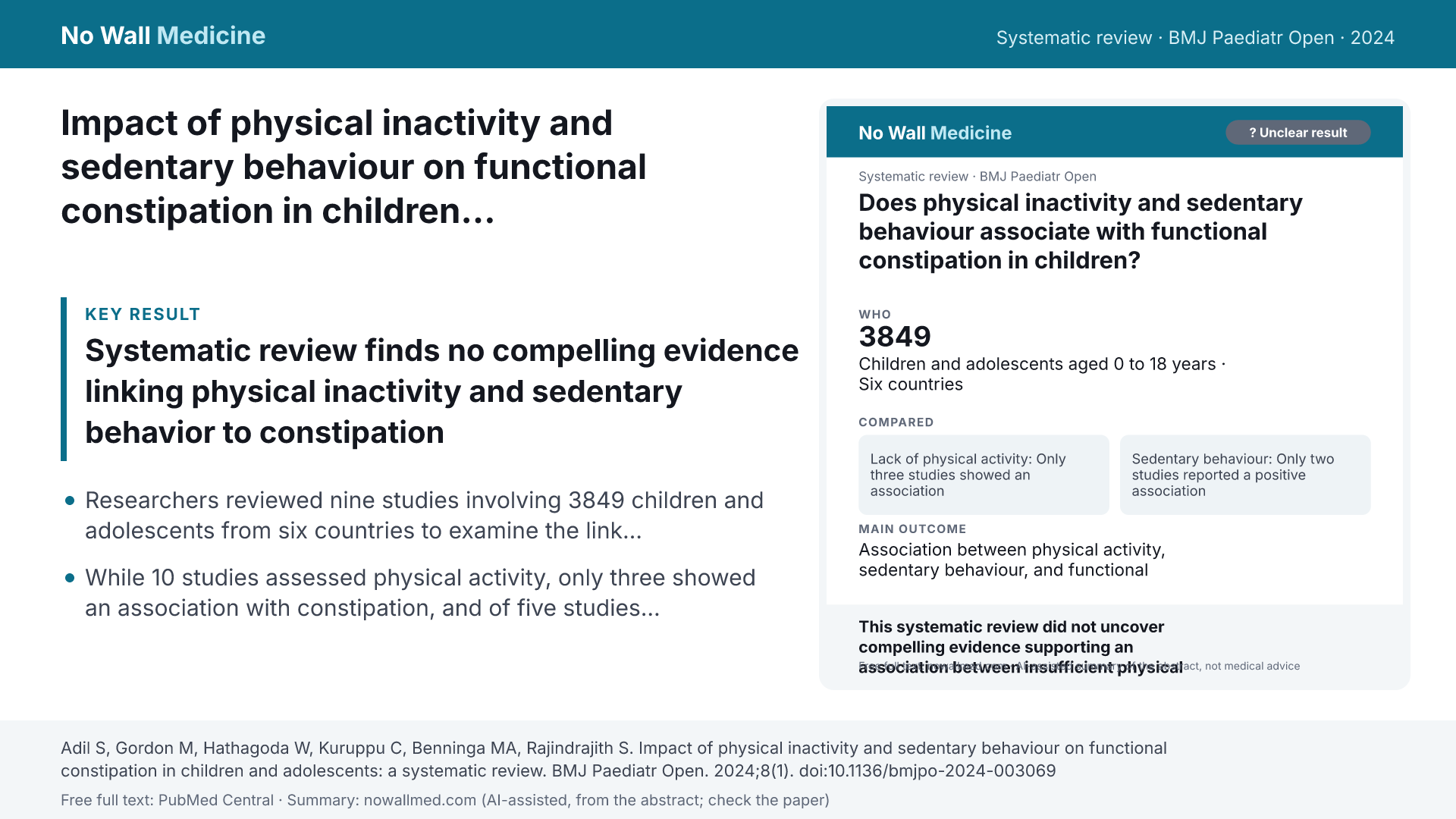
Systematic review finds no compelling evidence linking physical inactivity and sedentary behavior to constipation
Impact of physical inactivity and sedentary behaviour on functional constipation in children and adolescents: a systematic review
Systematic reviewUnclear result
Does physical inactivity and sedentary behaviour associate with functional constipation in children?
Who
3849
Children and adolescents aged 0 to 18 years · Six countries
Compared
Lack of physical activity: Only three studies showed an association
Sedentary behaviour: Only two studies reported a positive association
Main outcome
Association between physical activity, sedentary behaviour, and functional constipation
Bottom line: This systematic review did not uncover compelling evidence supporting an association between insufficient physical activity, sedentary behaviour, and functional constipation.
Limitation: All nine studies included in the systematic review were rated as having high risk of bias.
BMJ Paediatr Open · 2024-12-05Download image
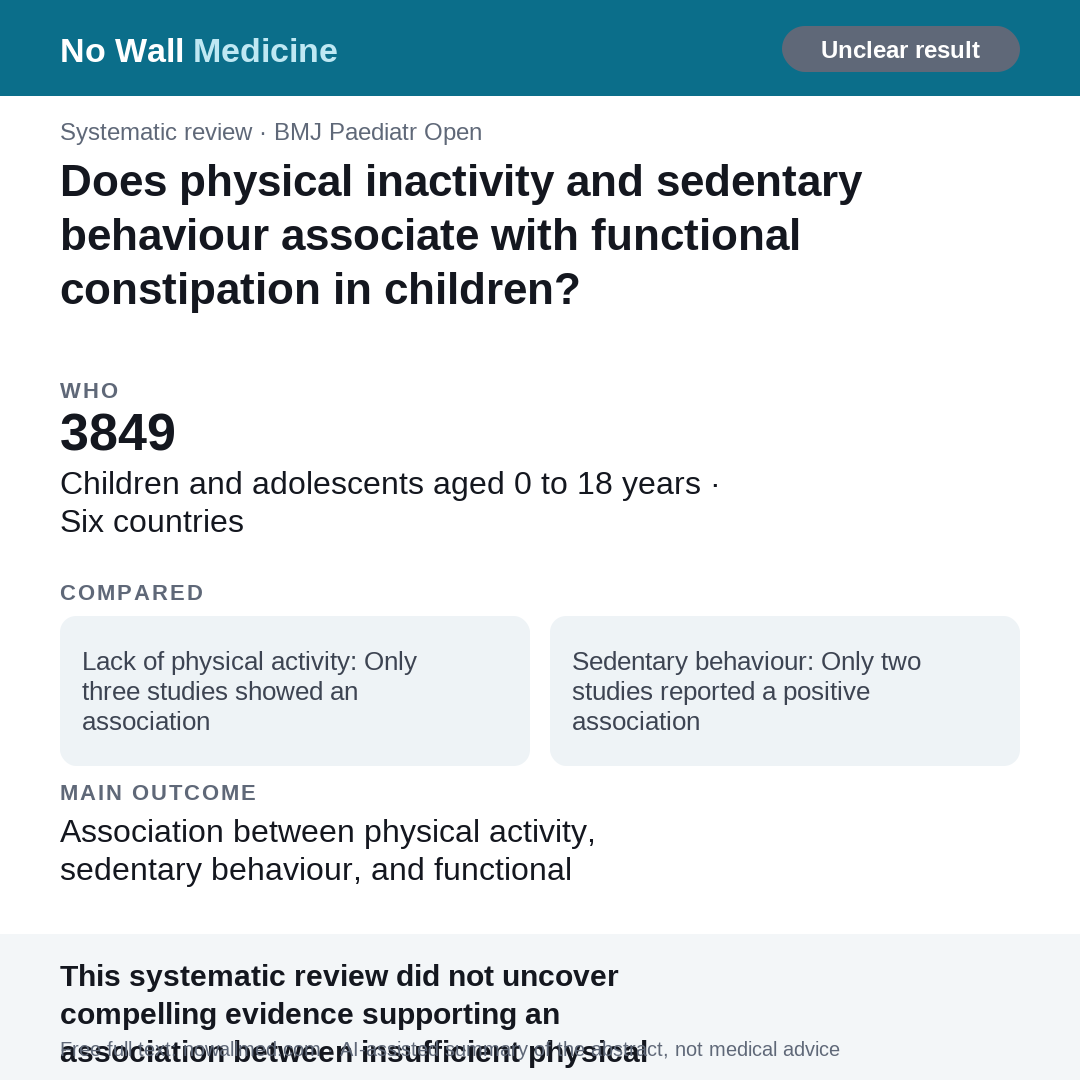
Clinical question: Does physical inactivity and sedentary behaviour associate with functional constipation in children?
Why it matters: It is unclear if insufficient physical activity or high levels of sedentary behavior, such as sitting for long periods, are associated with functional constipation in young people.
Key points
- Researchers reviewed nine studies involving 3849 children and adolescents from six countries to examine the link between physical activity, sedentary behavior, and functional constipation.
- While 10 studies assessed physical activity, only three showed an association with constipation, and of five studies on sedentary behavior, only two reported a positive association.
- All nine studies included in this systematic review were rated as having a high risk of bias.
Limitation the authors note: All nine studies included in the systematic review were rated as having a high risk of bias.
Headline and key points written with AI from the paper’s abstract, with every number checked against it. Read the paper before relying on them.
Was this summary helpful?
Abstract
Objective
Lack of physical activity (PA) and sedentary behaviour (SB) have emerged as critical global health concerns in children and are believed to be associated with functional constipation (FC). The present study aims to explore this potential association. Design
A comprehensive search of PubMed, Scopus, Web of Science, Embase, Cochrane Library and PsycInfo databases was conducted through 2023 using terms related to constipation and PA and SB in ages 0-18 years. Titles and abstracts were screened against eligibility criteria. Constipation was diagnosed using Rome (II-IV) criteria. Full-text reviews were reviewed, and data were extracted. Risk of Bias in Non-randomized Follow-up Studies of Exposure quality assessment tool was used to evaluate the risk of bias of studies. Main outcome measures
We assessed the association between lack of PA/SB and FC. Results
A total of 2170 titles were screened. Nine studies encompassing 3849 children from six countries were included. Of these, four were community/school-based studies, one was a birth cohort, three were case series and two were hospital-based case-controlled studies. All 10 studies assessed the association between PA and FC. Only three showed an association between lack of PA and FC. Five studies evaluated the effects of SB on FC, and only two reported a positive association. The methods used to assess PA/SB differed across the studies. All nine studies included in the systematic review were rated as having high risk of bias. Conclusions
Despite numerous studies suggesting a link between insufficient PA/SB and FC, this systematic review did not uncover compelling evidence supporting such an association.
Abstract reproduced under the article’s CC BY NC licence.
Subject terms
Cite this article
Adil S, Gordon M, Hathagoda W, Kuruppu C, Benninga MA, Rajindrajith S. Impact of physical inactivity and sedentary behaviour on functional constipation in children and adolescents: a systematic review. BMJ Paediatr Open. 2024. doi:10.1136/bmjpo-2024-003069
Spotted a mistake? Suggest a correction