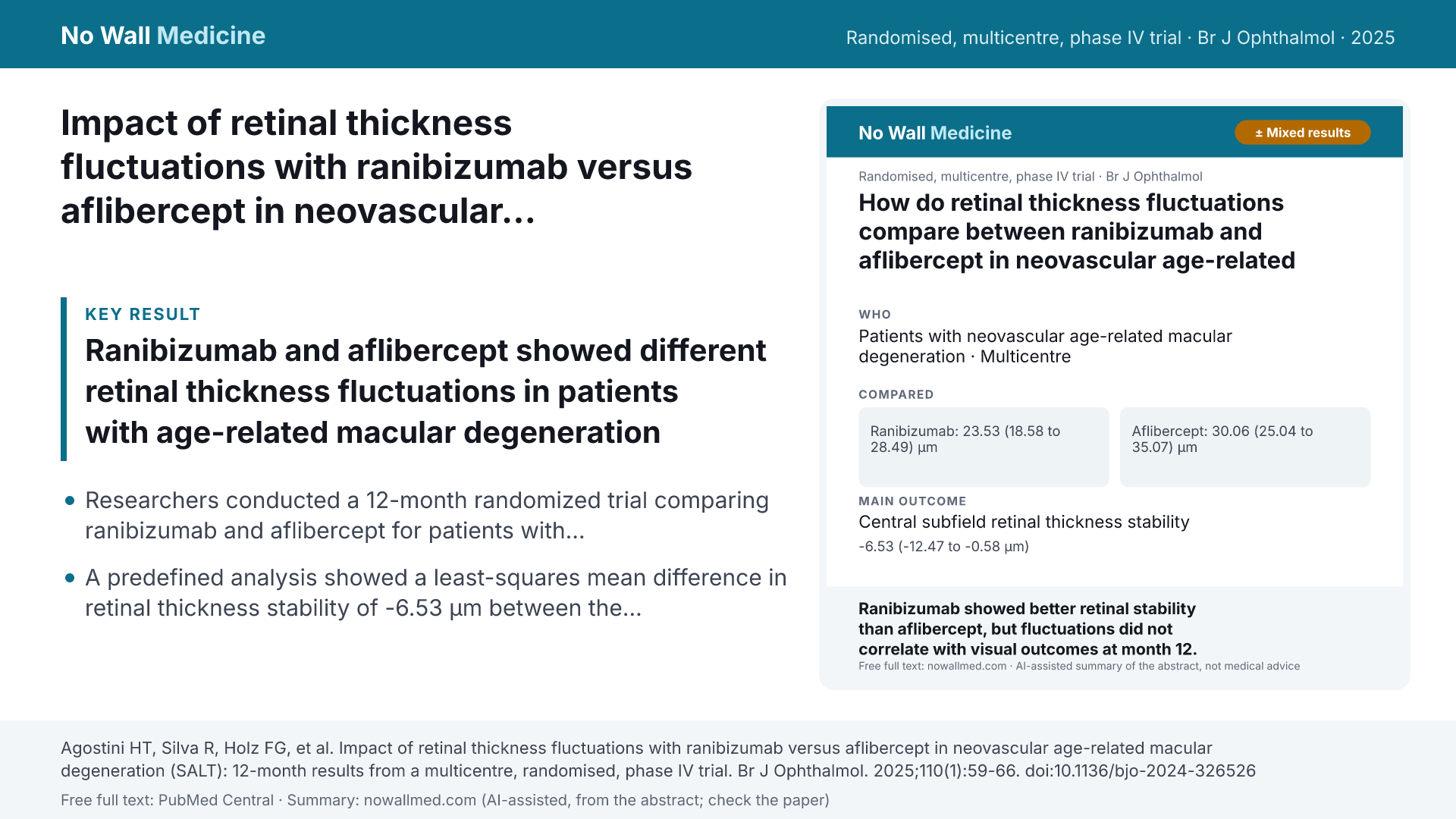
Ranibizumab and aflibercept showed different retinal thickness fluctuations in patients with age-related macular degeneration
Impact of retinal thickness fluctuations with ranibizumab versus aflibercept in neovascular age-related macular degeneration (SALT): 12-month results from a multicentre, randomised, phase IV trial
Randomised, multicentre, phase IV trialMixed results
How do retinal thickness fluctuations compare between ranibizumab and aflibercept in neovascular age-related macular degeneration?
Who
Patients with neovascular age-related macular degeneration · Multicentre
Compared
Ranibizumab: 23.53 (18.58 to 28.49) µm
Aflibercept: 30.06 (25.04 to 35.07) µm
Main outcome
Central subfield retinal thickness stability
Result: -6.53 (-12.47 to -0.58 µm)
Bottom line: Ranibizumab showed better retinal stability than aflibercept, but fluctuations did not correlate with visual outcomes at month 12.
Br J Ophthalmol · 2025-12-15Download image
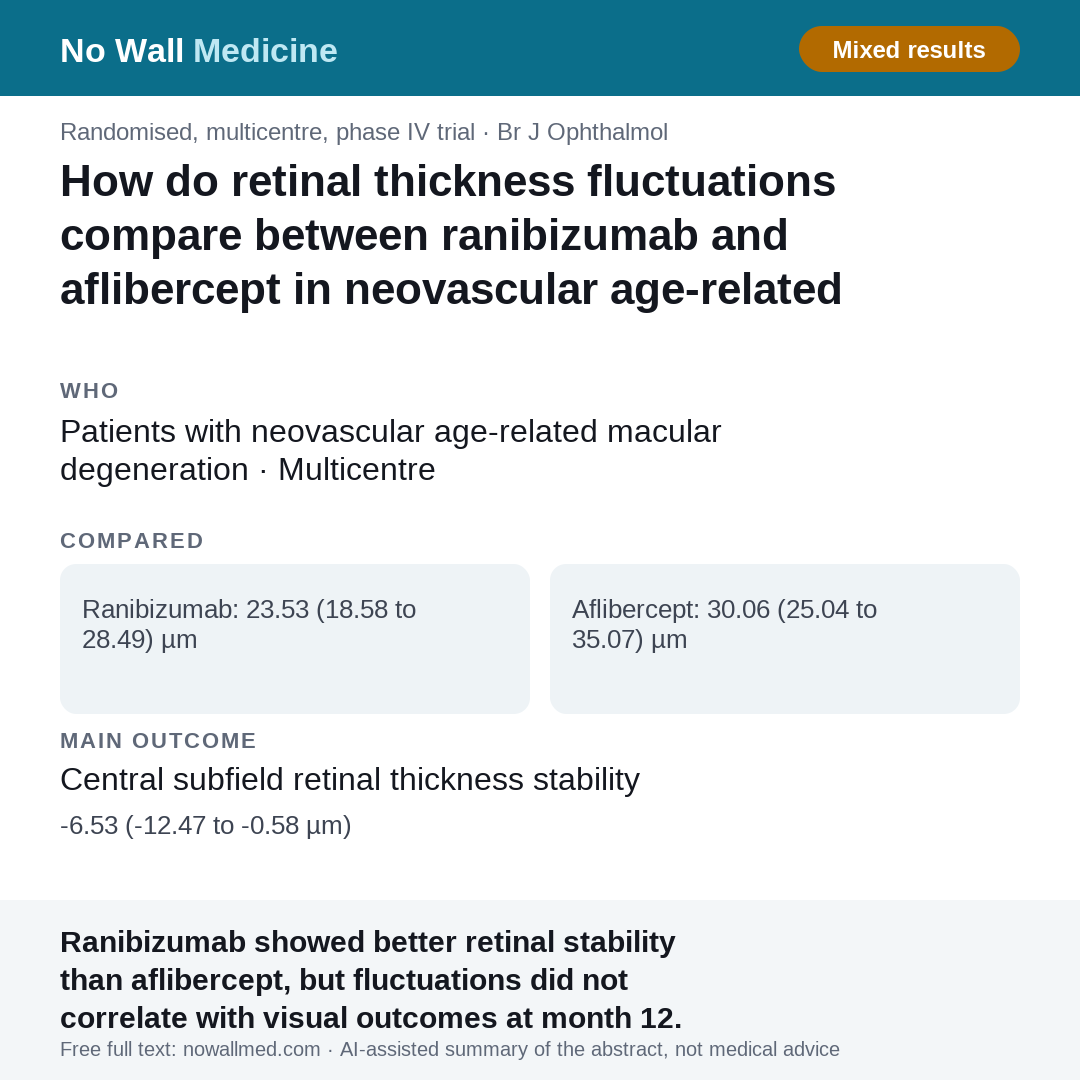
Clinical question: How do retinal thickness fluctuations compare between ranibizumab and aflibercept in neovascular age-related macular degeneration?
Key points
- Researchers conducted a 12-month randomized trial comparing ranibizumab and aflibercept for patients with neovascular age-related macular degeneration.
- A predefined analysis showed a least-squares mean difference in retinal thickness stability of -6.53 µm between the ranibizumab group (23.53 µm) and the aflibercept group (30.06 µm).
- The mean amplitude of retinal thickness fluctuations between months 3 and 6 was not correlated with best-corrected visual acuity at month 12 (r = -0.0888).
Headline and key points written with AI from the paper’s abstract, with every number checked against it. Read the paper before relying on them.
Was this summary helpful?
Abstract
Background/aims
To compare fluctuations of central subfield retinal thickness (CSRT) in patients with neovascular age-related macular degeneration undergoing ranibizumab pro re nata versus aflibercept bimonthly treatment in a prospective 12 month, phase IV, randomised, multicentre study. Methods
Ranibizumab was administered according to best-corrected visual acuity (BCVA) and/or disease activity detected on spectral domain optical coherence tomography. Aflibercept was administered at three initial monthly visits followed by bimonthly treatment. CSRT stability was evaluated between months 3 and 6. CSRT stability was compared between groups and correlated with functional outcomes at month 12. Results
Fluctuations of CSRT showed a least-squares (LS) mean (95% CI) difference of -4.12 (-10.22 to 1.98) µm between ranibizumab (25.16 (20.09 to 30.24) µm) and aflibercept groups (29.28 (24.14 to 34.43) µm) (p=0.1850). A predefined analysis of retinal stability, adjusted for baseline CSRT, showed a LS mean (95% CI) difference of -6.53 (-12.47 to -0.58 µm) in favour of ranibizumab (23.53 (18.58 to 28.49) µm) versus aflibercept (30.06 (25.04 to 35.07) µm) (p=0.0315). Pearson's correlation coefficient demonstrated no correlation between the mean amplitude of CSRT fluctuation between months 3 and 6, and BCVA at month 12 (r = -0.0888). Adverse event rates were low. Conclusions
Numerical differences in retinal thickness fluctuations between months 3 and 6 were detected between treatment regimens. While the presence of fluctuations has previously been shown to have a negative impact on functional outcomes, our data showed no correlation between the mean amplitude of fluctuations and functional outcomes at month 12.
Abstract reproduced under the article’s CC BY NC licence.
Subject terms
Headline, design, result, key points, caveat and citation as plain text.
Cite this article
Agostini HT, Silva R, Holz FG, et al. Impact of retinal thickness fluctuations with ranibizumab versus aflibercept in neovascular age-related macular degeneration (SALT): 12-month results from a multicentre, randomised, phase IV trial. Br J Ophthalmol. 2025. doi:10.1136/bjo-2024-326526
Spotted a mistake? Suggest a correction