Virtual reality biofeedback improved sleep quality in individuals with depressive or anxiety symptoms
Impact of Virtual Reality-Based Biofeedback on Sleep Quality Among Individuals With Depressive Symptoms, Anxiety Symptoms, or Both: 4-Week Randomized Controlled Study
3-arm randomized controlled trialNo clear difference
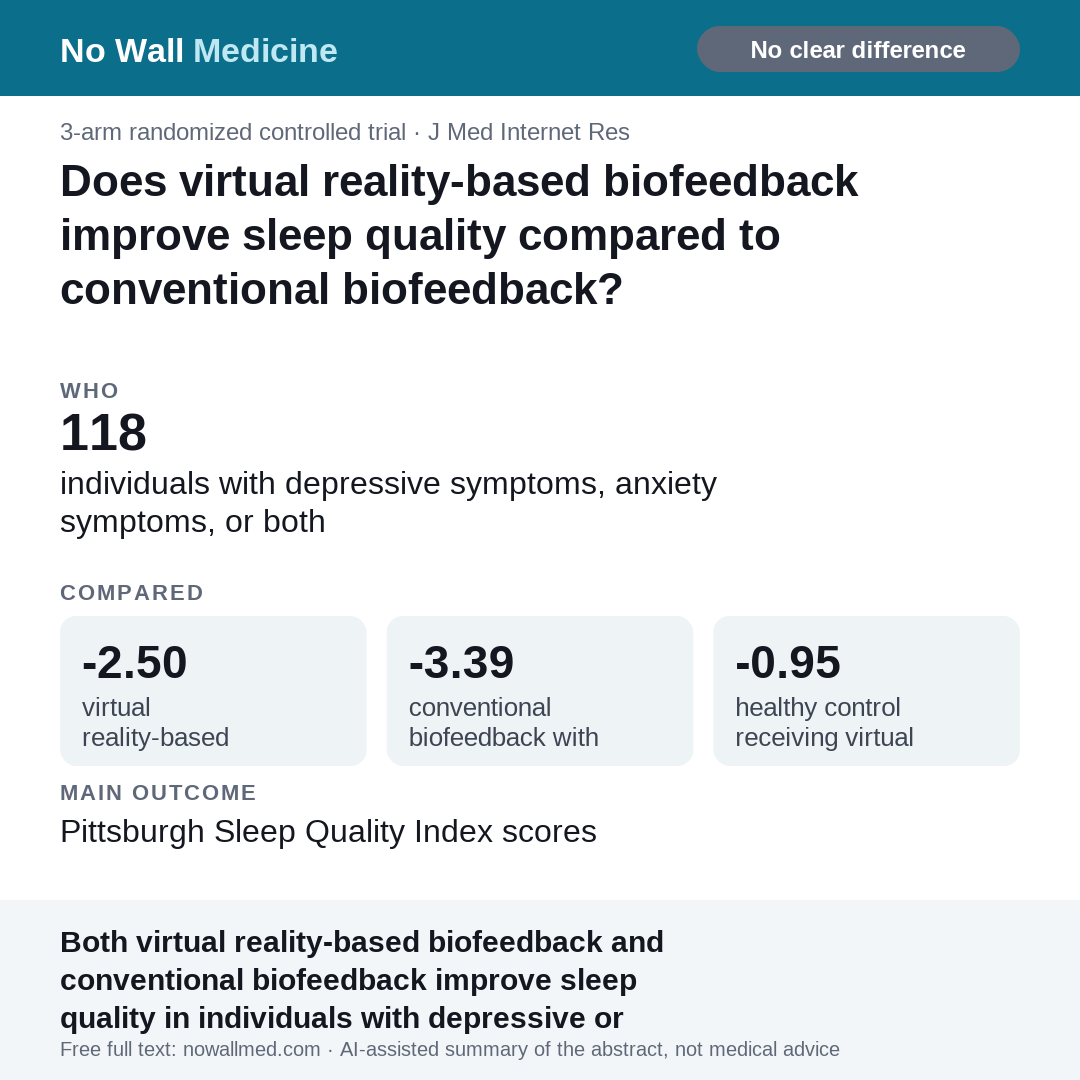
Does virtual reality-based biofeedback improve sleep quality compared to conventional biofeedback?
Who
118
individuals with depressive symptoms, anxiety symptoms, or both
Compared
-2.50virtual reality-based biofeedback with depressive or anxiety symptoms (SD 2.89)
-3.39conventional biofeedback with depressive or anxiety symptoms (SD 2.80)
-0.95healthy control receiving virtual reality-based biofeedback (SD 2.09)
Main outcome
Pittsburgh Sleep Quality Index scores
Bottom line: Both virtual reality-based biofeedback and conventional biofeedback improve sleep quality in individuals with depressive or anxiety symptoms.
J Med Internet Res · 2025-06-20Download image
Clinical question: Does virtual reality-based biofeedback improve sleep quality compared to conventional biofeedback?
Why it matters: Evidence on virtual reality-based biofeedback for sleep quality in individuals with depressive or anxiety symptoms was limited and inconclusive
Key points
- 118 participants with depressive or anxiety symptoms were randomized into virtual reality-based biofeedback or conventional biofeedback groups.
- Both groups had significant improvements in sleep quality, with mean reductions of -2.50 and -3.39 on the Pittsburgh Sleep Quality Index.
- Virtual reality-based biofeedback showed greater improvement in sleep disturbance compared to a healthy control group.
Limitation the authors note: None stated in the abstract
Headline and key points written with AI from the paper’s abstract, with every number checked against it. Read the paper before relying on them.
Was this summary helpful?
Subject terms
Cite this article
Seong S, Kim H, Cho Y, Kim MJ, Park KR, Choi J. Impact of Virtual Reality-Based Biofeedback on Sleep Quality Among Individuals With Depressive Symptoms, Anxiety Symptoms, or Both: 4-Week Randomized Controlled Study. J Med Internet Res. 2025. doi:10.2196/65772
Spotted a mistake? Suggest a correction
Top studies every Monday
The week’s key trials and guidelines in your specialties, plus any topics you follow. By email, free.
Get the weekly digest