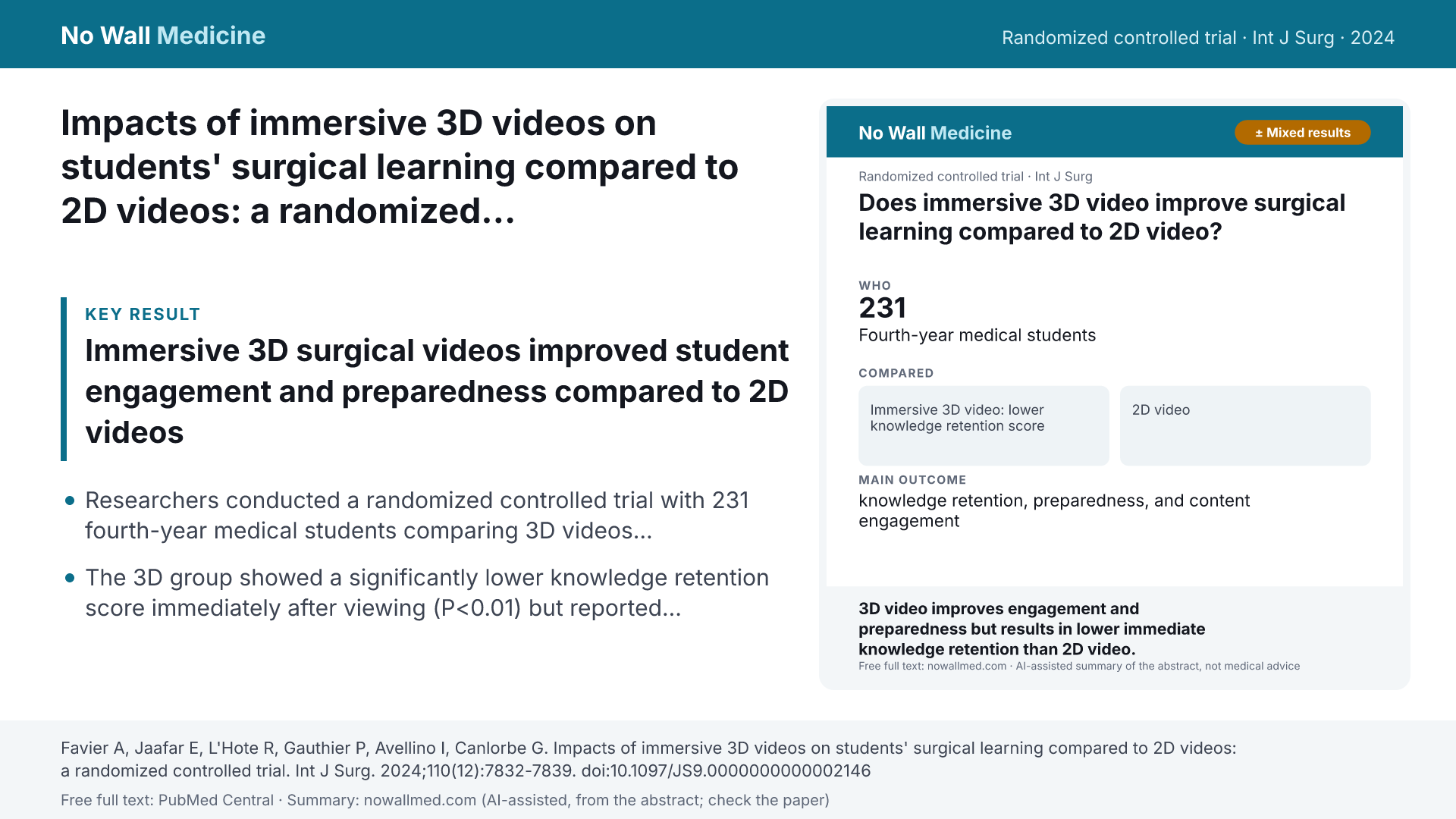
Immersive 3D surgical videos improved student engagement and preparedness compared to 2D videos
Impacts of immersive 3D videos on students' surgical learning compared to 2D videos: a randomized controlled trial
Randomized controlled trialMixed results
Does immersive 3D video improve surgical learning compared to 2D video?
Who
231
Fourth-year medical students
Compared
Immersive 3D video: lower knowledge retention score
2D video
Main outcome
knowledge retention, preparedness, and content engagement
Bottom line: 3D video improves engagement and preparedness but results in lower immediate knowledge retention than 2D video.
Limitation: The precise understanding of its pedagogical value required further investigation and refinement.
Int J Surg · 2024-12-01Download image
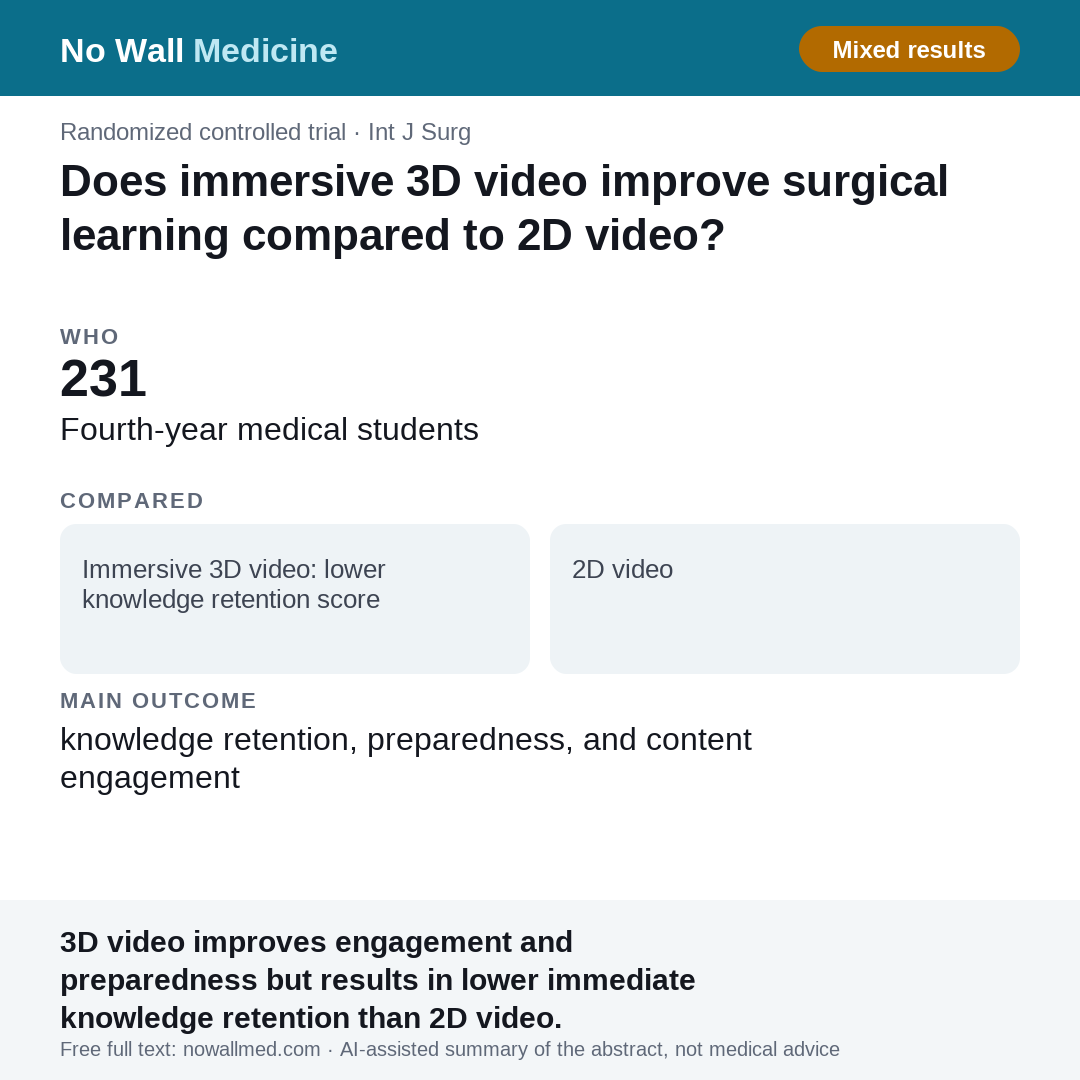
Clinical question: Does immersive 3D video improve surgical learning compared to 2D video?
Why it matters: Increasing medical student numbers and work-hour restrictions limit opportunities for learning through direct observation in the operating room.
Key points
- Researchers conducted a randomized controlled trial with 231 fourth-year medical students comparing 3D videos via head-mounted displays to 2D videos on conventional screens.
- The 3D group showed a significantly lower knowledge retention score immediately after viewing (P<0.01) but reported better expected preparedness (P=0.019) and higher involvement (P<0.001).
- One month later, students in the 3D group reported feeling more prepared (P=0.016), more self-confident (P=0.020), and less overwhelmed (P<0.01) than the 2D group.
Limitation the authors note: The precise understanding of the pedagogical value of immersive 3D video requires further investigation and refinement.
Headline and key points written with AI from the paper’s abstract, with every number checked against it. Read the paper before relying on them.
Was this summary helpful?
Subject terms
Cite this article
Favier A, Jaafar E, L'Hote R, Gauthier P, Avellino I, Canlorbe G. Impacts of immersive 3D videos on students' surgical learning compared to 2D videos: a randomized controlled trial. Int J Surg. 2024. doi:10.1097/JS9.0000000000002146
Spotted a mistake? Suggest a correction