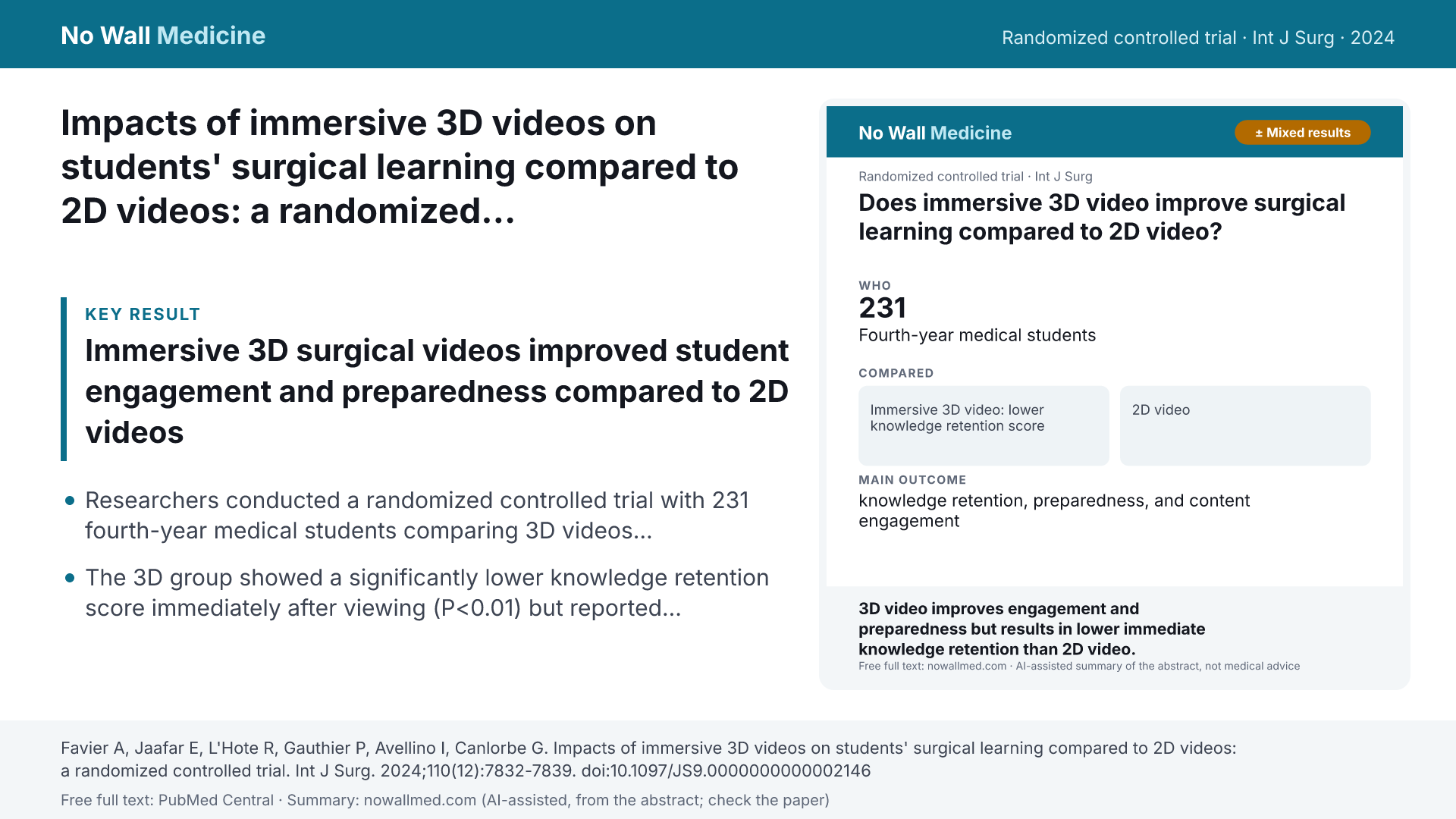
Impacts of immersive 3D videos on students' surgical learning compared to 2D videos: a randomized controlled trial
Key result: Immersive 3D surgical videos improved student engagement and preparedness compared to 2D videos
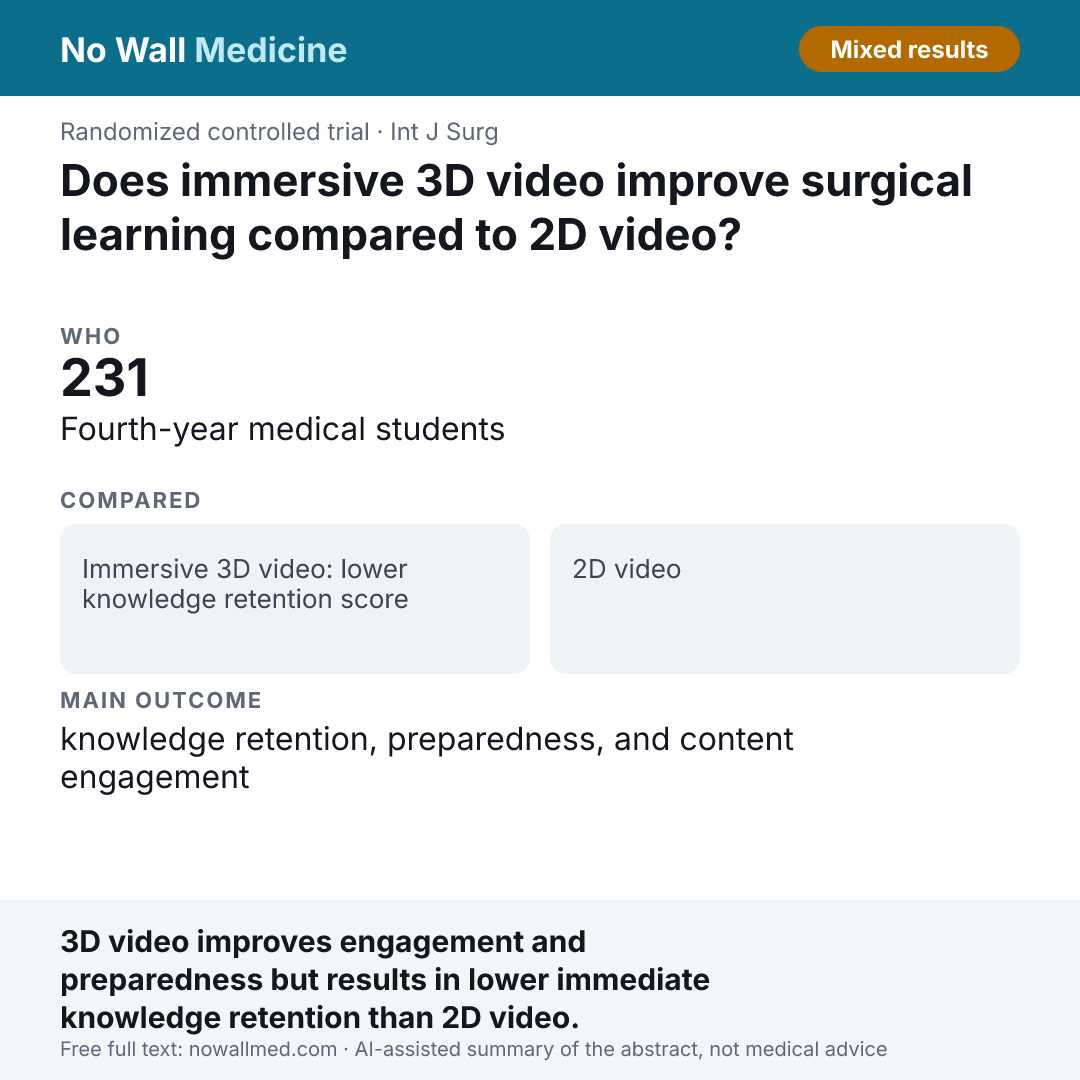
Key points
- Researchers conducted a randomized controlled trial with 231 fourth-year medical students comparing 3D videos via head-mounted displays to 2D videos on conventional screens.
- The 3D group showed a significantly lower knowledge retention score immediately after viewing (P<0.01) but reported better expected preparedness (P=0.019) and higher involvement (P<0.001).
- One month later, students in the 3D group reported feeling more prepared (P=0.016), more self-confident (P=0.020), and less overwhelmed (P<0.01) than the 2D group.
Why it matters: Increasing medical student numbers and work-hour restrictions limit opportunities for learning through direct observation in the operating room.
Limitation the authors note: The precise understanding of the pedagogical value of immersive 3D video requires further investigation and refinement.
Discussion prompts
- Would these patients look like yours? Who was left out?
- Is the main outcome one that matters to patients?
- Is the difference large enough to change what you do?
Cite: Favier A, Jaafar E, L'Hote R, Gauthier P, Avellino I, Canlorbe G. Impacts of immersive 3D videos on students' surgical learning compared to 2D videos: a randomized controlled trial. Int J Surg. 2024;110(12):7832-7839. doi:10.1097/JS9.0000000000002146
Free full text: PubMed Central · Summary and visual abstract: nowallmed.com/a/impacts-of-immersive-3d-videos-on-students-surgical-learning-compared-1hs4tv/ (AI-assisted from the abstract; check the paper before relying on it).