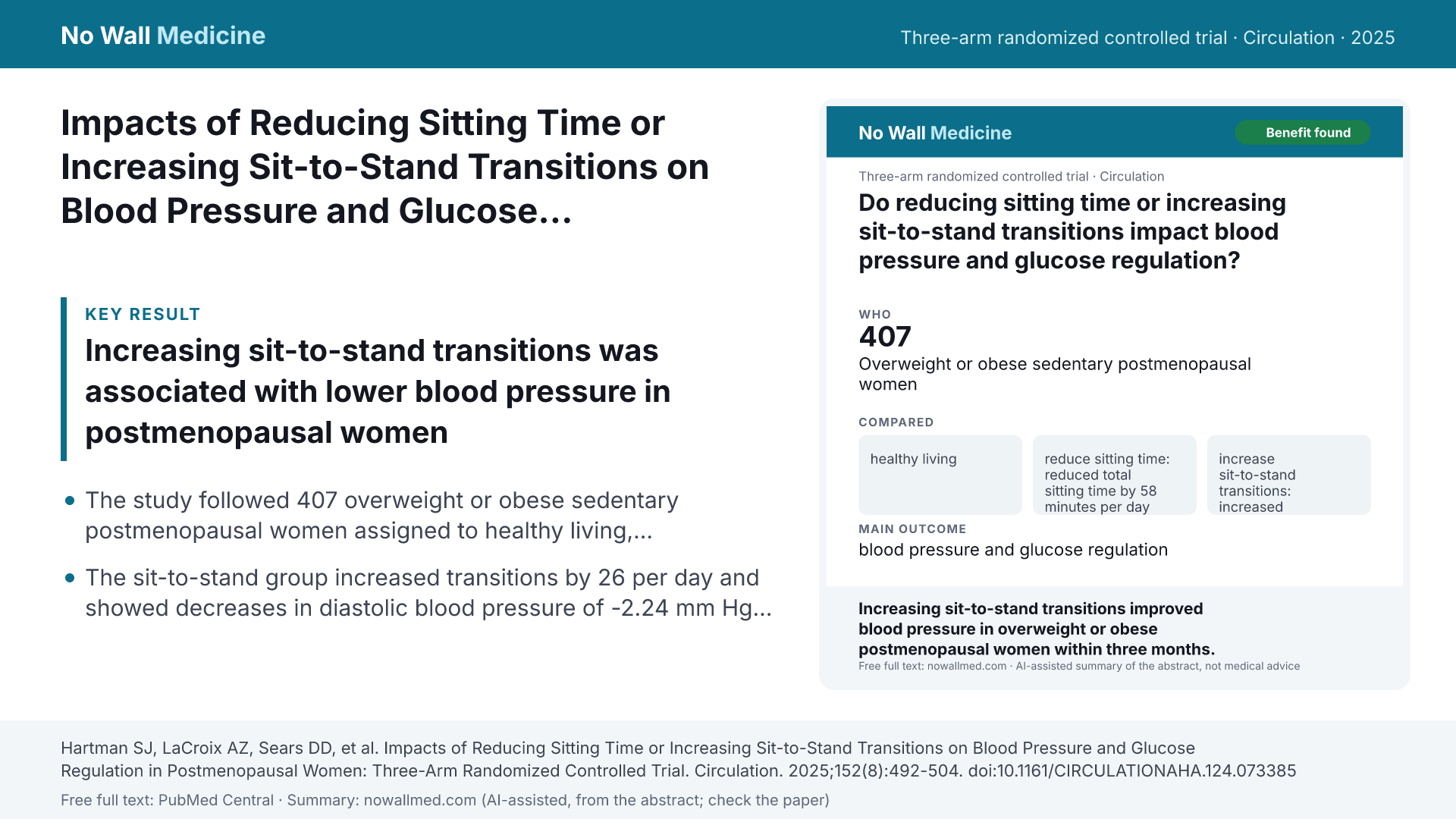
Increasing sit-to-stand transitions was associated with lower blood pressure in postmenopausal women
Impacts of Reducing Sitting Time or Increasing Sit-to-Stand Transitions on Blood Pressure and Glucose Regulation in Postmenopausal Women: Three-Arm Randomized Controlled Trial
Three-arm randomized controlled trialBenefit found
Do reducing sitting time or increasing sit-to-stand transitions impact blood pressure and glucose regulation?
Who
407
Overweight or obese sedentary postmenopausal women
Compared
healthy living
reduce sitting time: reduced total sitting time by 58 minutes per day
increase sit-to-stand transitions: increased sit-to-stand transitions by 26 per day
Main outcome
blood pressure and glucose regulation
Result: -2.24 mm Hg (95% CI -4.08 to -0.40) diastolic blood pressure
Bottom line: Increasing sit-to-stand transitions improved blood pressure in overweight or obese postmenopausal women within three months.
Circulation · 2025-07-25Download image
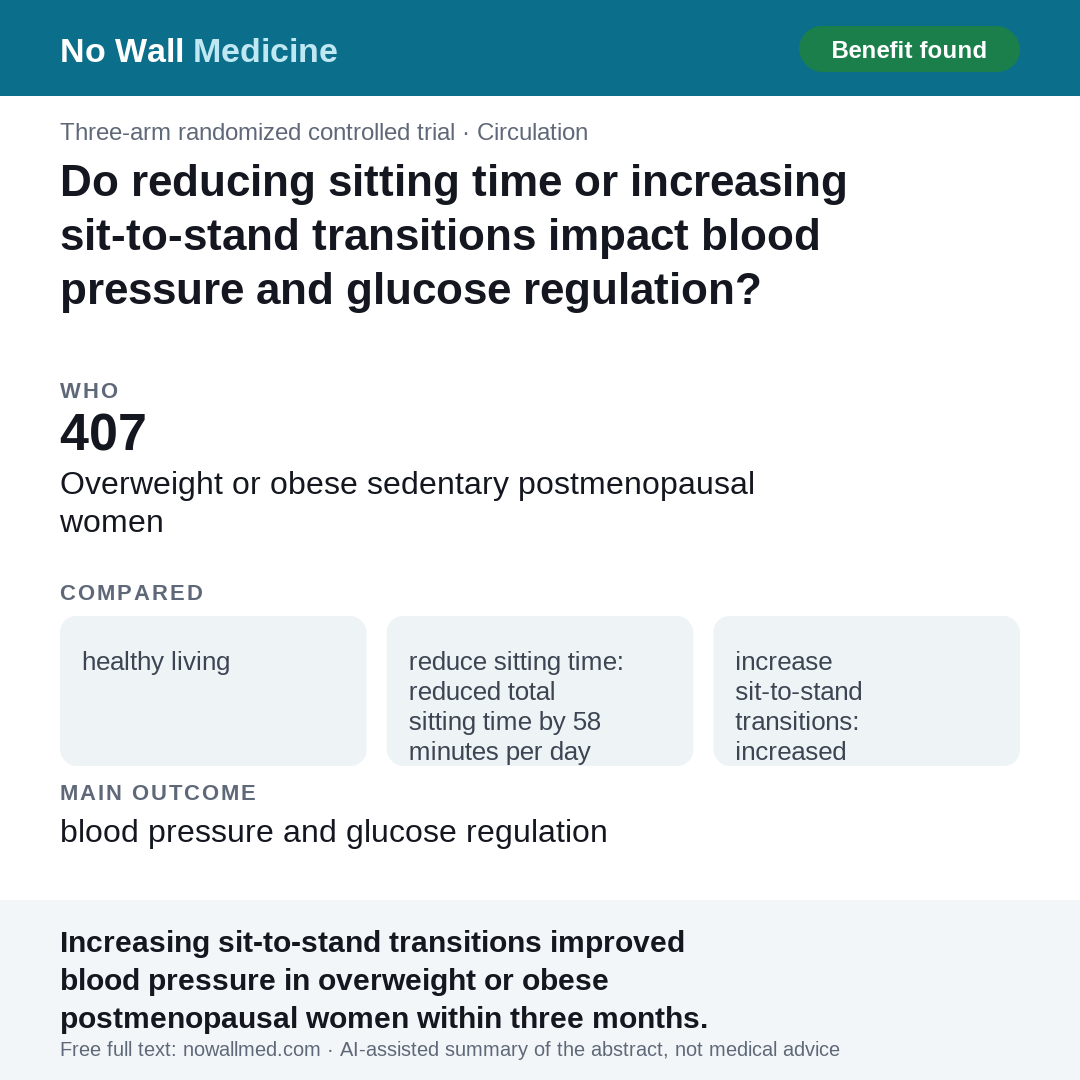
Clinical question: Do reducing sitting time or increasing sit-to-stand transitions impact blood pressure and glucose regulation?
Why it matters: It is unclear how different approaches to changing sedentary behaviors, such as reducing sitting time versus increasing transitions from sitting to standing, affect physiological health.
Key points
- The study followed 407 overweight or obese sedentary postmenopausal women assigned to healthy living, reduced sitting time, or increased sit-to-stand transitions for 3 months.
- The sit-to-stand group increased transitions by 26 per day and showed decreases in diastolic blood pressure of -2.24 mm Hg and systolic blood pressure of -3.33 mm Hg.
- The sit less group reduced sitting time by 58 minutes per day, but neither group showed significant effects on blood pressure or glucose regulation outcomes.
Headline and key points written with AI from the paper’s abstract, with every number checked against it. Read the paper before relying on them.
Was this summary helpful?
Subject terms
Cite this article
Hartman SJ, LaCroix AZ, Sears DD, et al. Impacts of Reducing Sitting Time or Increasing Sit-to-Stand Transitions on Blood Pressure and Glucose Regulation in Postmenopausal Women: Three-Arm Randomized Controlled Trial. Circulation. 2025. doi:10.1161/CIRCULATIONAHA.124.073385
Spotted a mistake? Suggest a correction