Impaired neuromusculoskeletal response to training stimuli associated with low energy availability: a systematic review
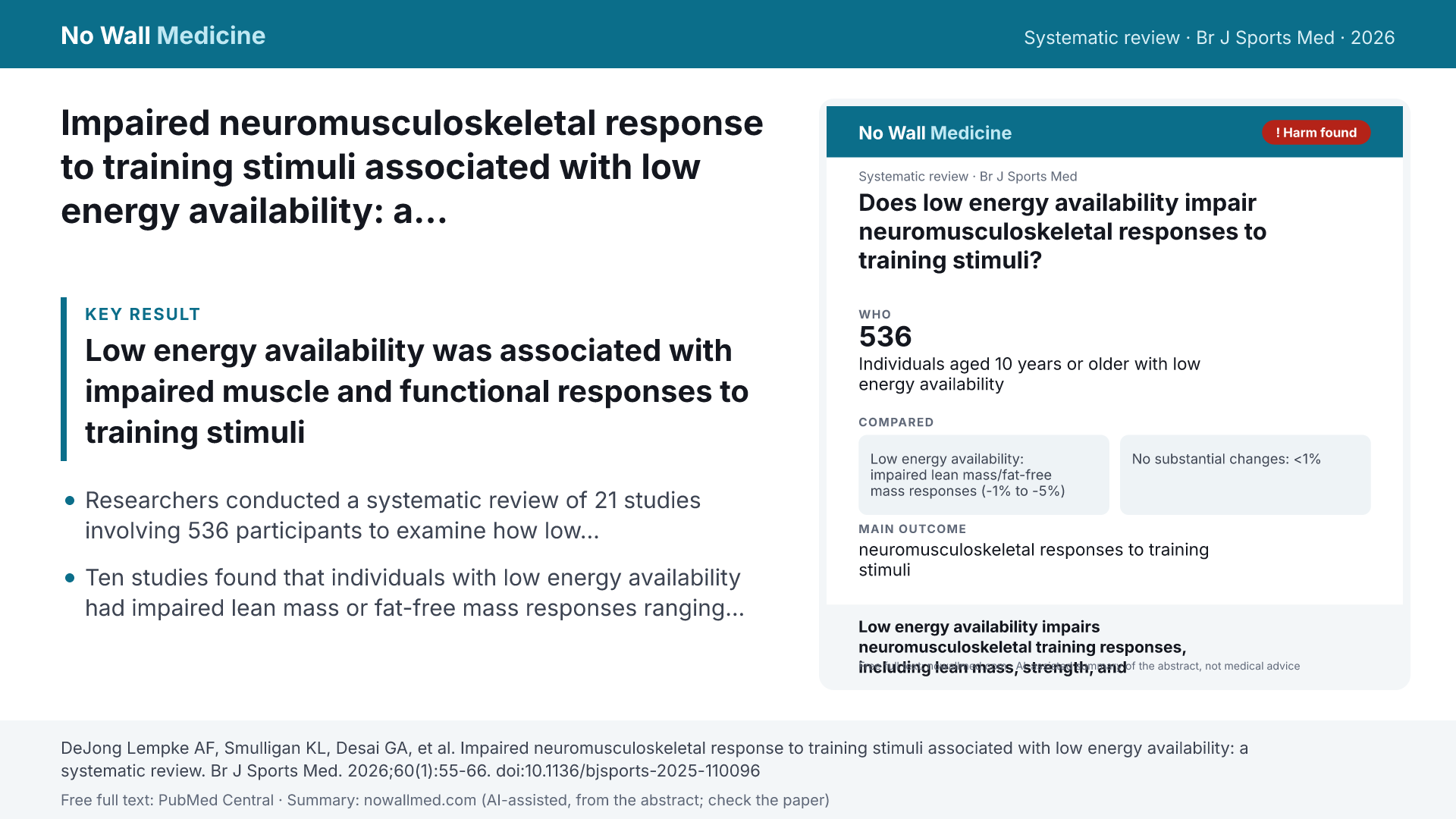
Key result: Low energy availability was associated with impaired muscle and functional responses to training stimuli
Systematic reviewHarm found
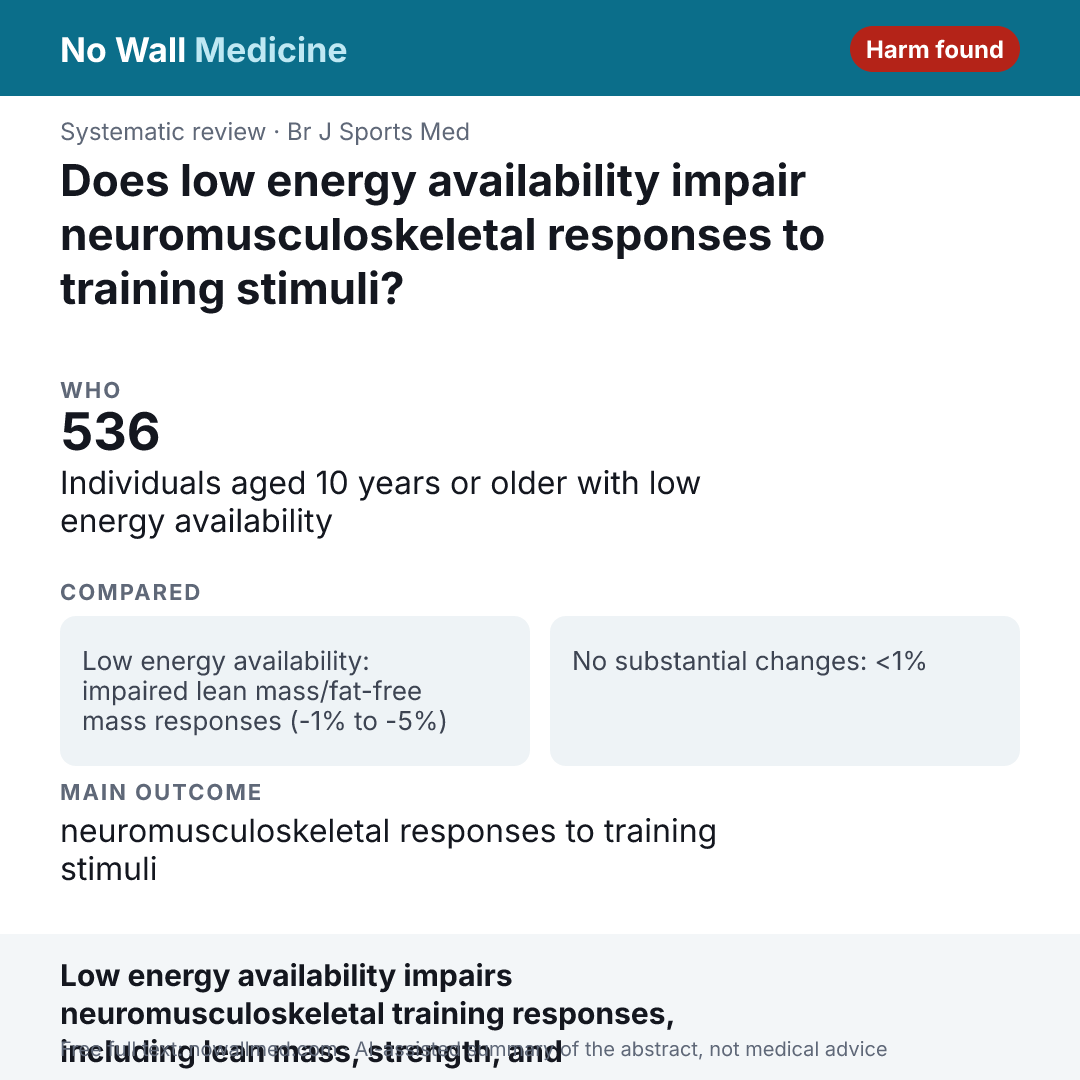
Does low energy availability impair neuromusculoskeletal responses to training stimuli?
Who
536
Individuals aged 10 years or older with low energy availability
Compared
Low energy availability: impaired lean mass/fat-free mass responses (-1% to -5%)
No substantial changes: <1%
Main outcome
neuromusculoskeletal responses to training stimuli
Bottom line: Low energy availability impairs neuromusculoskeletal training responses, including lean mass, strength, and functional performance.
Br J Sports Med · 2026-01-15 · Save PNG
Key points
- Researchers conducted a systematic review of 21 studies involving 536 participants to examine how low energy availability affects neuromusculoskeletal responses to training.
- Ten studies found that individuals with low energy availability had impaired lean mass or fat-free mass responses ranging from -1% to -5%.
- Six studies identified functional or sport-specific impairments between -4% and -10% among those with low energy availability.
Why it matters: Evidence is needed to understand how low energy availability affects the way the muscles and nervous system adapt to training stimuli.
Discussion prompts
- Would these patients look like yours? Who was left out?
- Is the main outcome one that matters to patients?
- Is the difference large enough to change what you do?
Cite: DeJong Lempke AF, Smulligan KL, Desai GA, et al. Impaired neuromusculoskeletal response to training stimuli associated with low energy availability: a systematic review. Br J Sports Med. 2026;60(1):55-66. doi:10.1136/bjsports-2025-110096
Free full text: PubMed Central · Summary and visual abstract: nowallmed.com/a/impaired-neuromusculoskeletal-response-to-training-stimuli-associated-1jsfbtj/ (AI-assisted from the abstract; check the paper before relying on it).