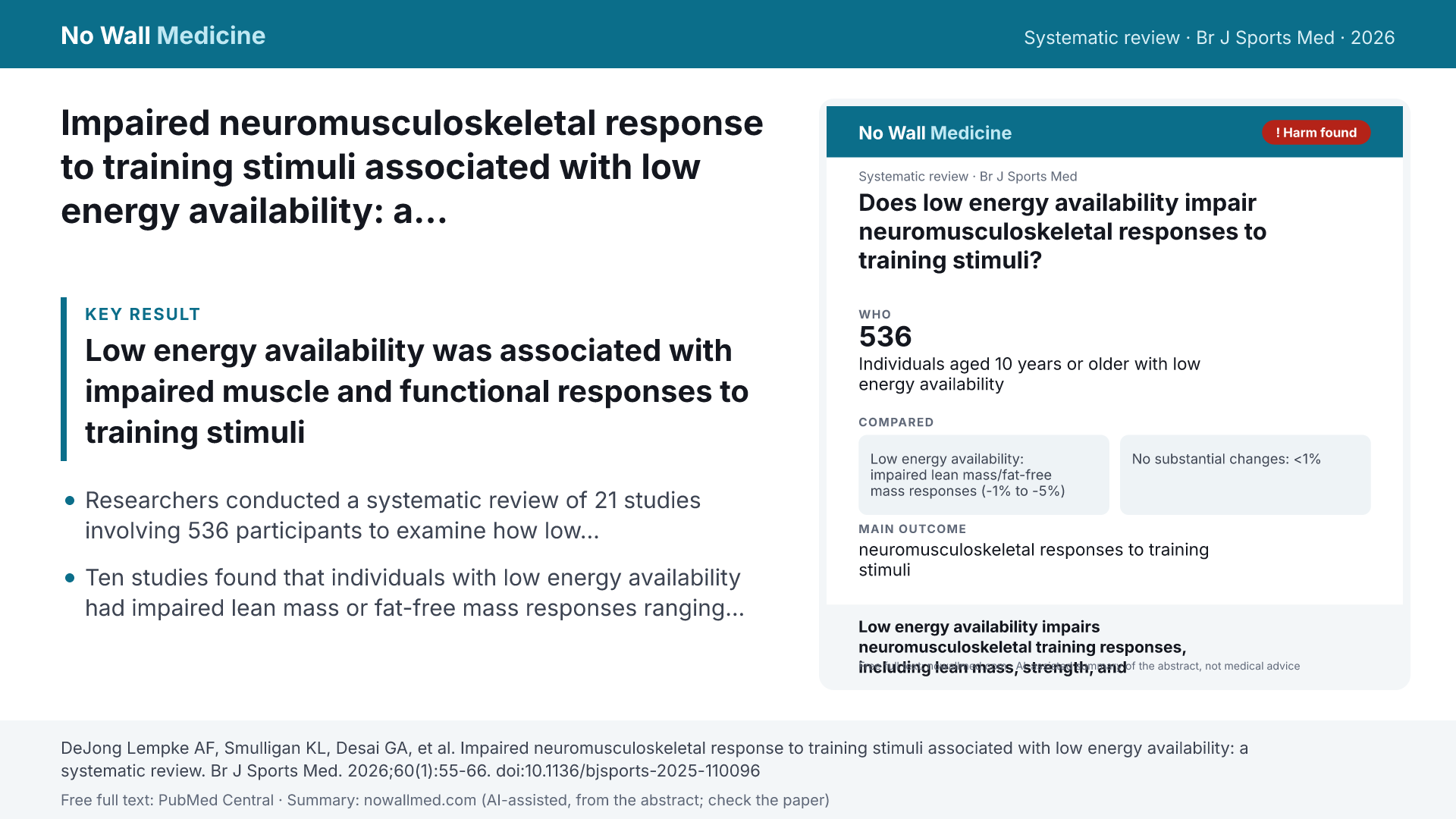
Low energy availability was associated with impaired muscle and functional responses to training stimuli
Impaired neuromusculoskeletal response to training stimuli associated with low energy availability: a systematic review
Systematic reviewHarm found
Does low energy availability impair neuromusculoskeletal responses to training stimuli?
Who
536
Individuals aged 10 years or older with low energy availability
Compared
Low energy availability: impaired lean mass/fat-free mass responses (-1% to -5%)
No substantial changes: <1%
Main outcome
neuromusculoskeletal responses to training stimuli
Bottom line: Low energy availability impairs neuromusculoskeletal training responses, including lean mass, strength, and functional performance.
Br J Sports Med · 2026-01-15Download image
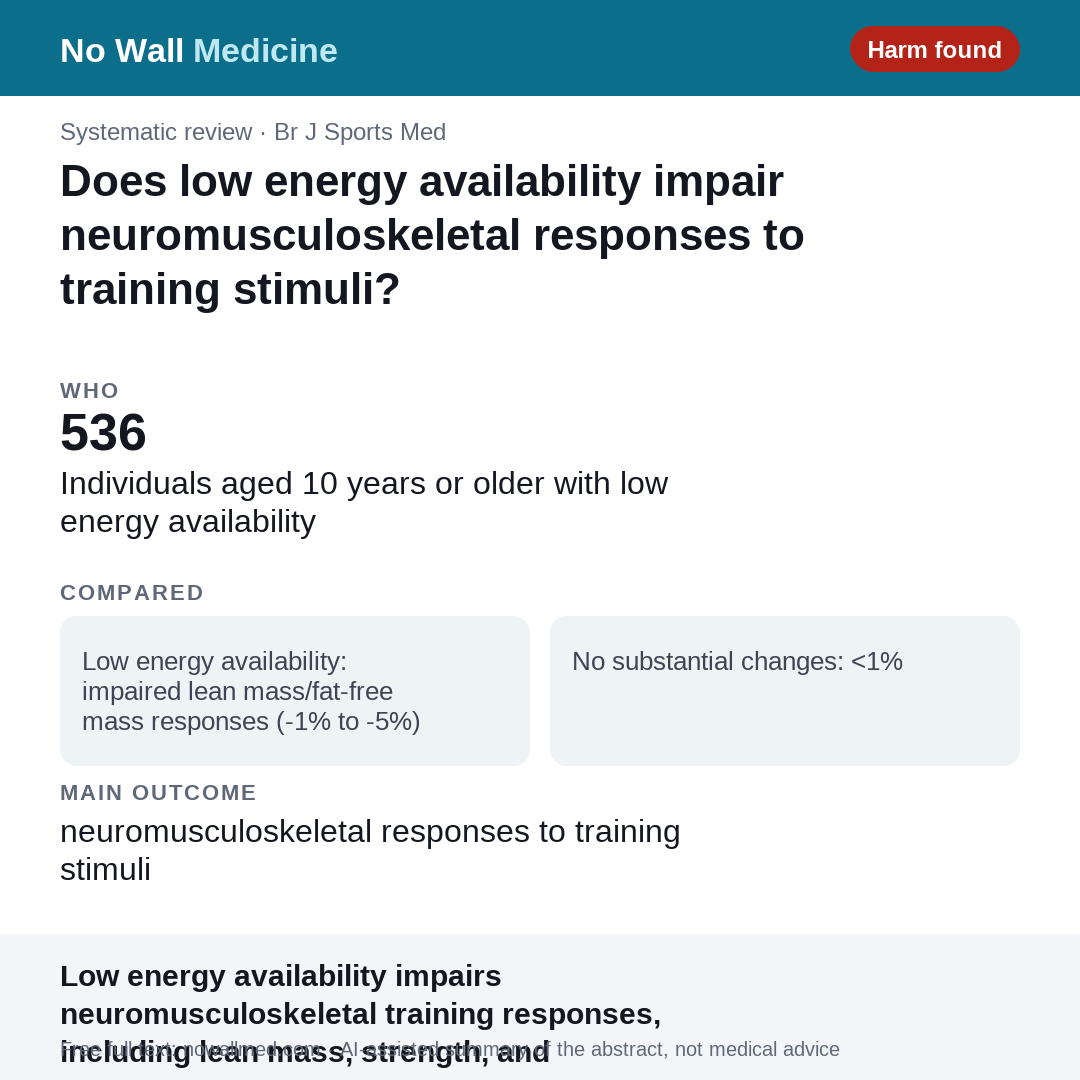
Clinical question: Does low energy availability impair neuromusculoskeletal responses to training stimuli?
Why it matters: Evidence is needed to understand how low energy availability affects the way the muscles and nervous system adapt to training stimuli.
Key points
- Researchers conducted a systematic review of 21 studies involving 536 participants to examine how low energy availability affects neuromusculoskeletal responses to training.
- Ten studies found that individuals with low energy availability had impaired lean mass or fat-free mass responses ranging from -1% to -5%.
- Six studies identified functional or sport-specific impairments between -4% and -10% among those with low energy availability.
Headline and key points written with AI from the paper’s abstract, with every number checked against it. Read the paper before relying on them.
Was this summary helpful?
Subject terms
Cite this article
DeJong Lempke AF, Smulligan KL, Desai GA, Hagan KE, Oldham JR, Islam LZ. Impaired neuromusculoskeletal response to training stimuli associated with low energy availability: a systematic review. Br J Sports Med. 2026. doi:10.1136/bjsports-2025-110096
Spotted a mistake? Suggest a correction