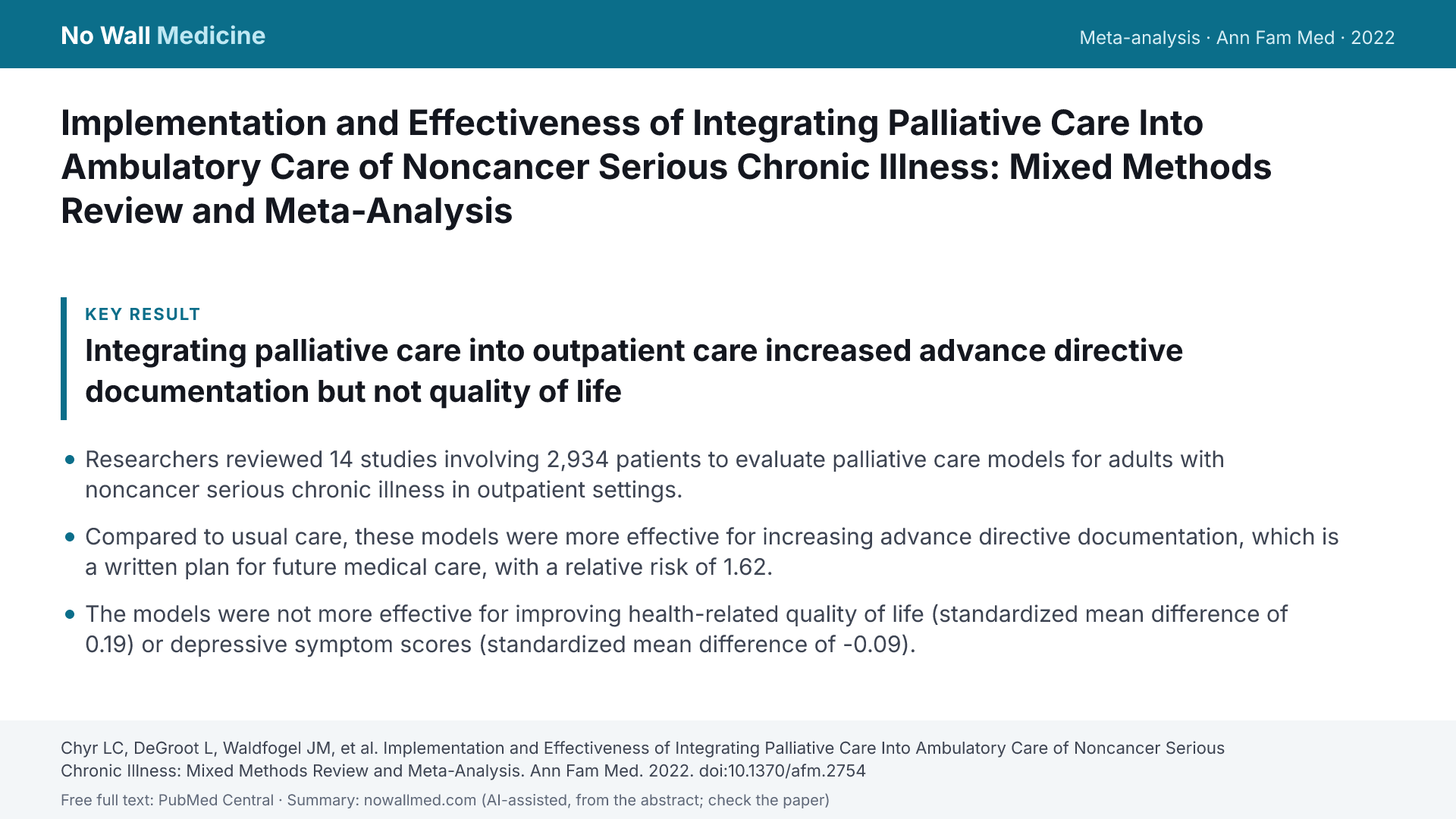
Implementation and Effectiveness of Integrating Palliative Care Into Ambulatory Care of Noncancer Serious Chronic Illness: Mixed Methods Review and Meta-Analysis
Key result: Integrating palliative care into outpatient care increased advance directive documentation but not quality of life
Key points
- Researchers reviewed 14 studies involving 2,934 patients to evaluate palliative care models for adults with noncancer serious chronic illness in outpatient settings.
- Compared to usual care, these models were more effective for increasing advance directive documentation, which is a written plan for future medical care, with a relative risk of 1.62.
- The models were not more effective for improving health-related quality of life (standardized mean difference of 0.19) or depressive symptom scores (standardized mean difference of -0.09).
Why it matters: It is unknown how effective integrating palliative care into outpatient settings is for improving quality of life or managing symptoms in adults with noncancer serious chronic illness.
Discussion prompts
- Would these patients look like yours? Who was left out?
- Is the main outcome one that matters to patients?
- Is the difference large enough to change what you do?
Cite: Chyr LC, DeGroot L, Waldfogel JM, et al. Implementation and Effectiveness of Integrating Palliative Care Into Ambulatory Care of Noncancer Serious Chronic Illness: Mixed Methods Review and Meta-Analysis. Ann Fam Med. 2022. doi:10.1370/afm.2754
Free full text: PubMed Central · Summary and visual abstract: nowallmed.com/a/implementation-and-effectiveness-of-integrating-palliative-care-into-1bl9ruo/ (AI-assisted from the abstract; check the paper before relying on it).